
Custom insurance software is software built around one insurer's, agency's or MGA's own products, processes and systems, instead of a packaged platform used by many companies. Most insurers do best with a hybrid: buy a proven core for policy, billing and claims, then build custom apps, portals, integrations and AI on top where they set you apart.
This guide is for insurance carriers, MGAs, agencies, brokers and insurtech founders. It covers how custom and off-the-shelf software compare, when each makes sense, which parts are worth building, a build-or-buy checklist, real examples, cost drivers and how to choose a partner.
What is custom insurance software?
Custom insurance software is any insurance system designed and built for one organization's needs, such as a policyholder app, an agent portal, a rating engine, a claims workflow or an integration layer. It's also called bespoke insurance software. The organization owns the code and decides how it works, rather than adapting its processes to a vendor's product.
The idea is the same as bespoke application development in any industry: software shaped around how your business actually works. Insurance just adds sensitive data, state regulation and older core systems that the new software has to work with.
Custom insurance software can cover:
- Customer-facing apps and portals for quotes, policies, payments and claims.
- Agent and broker tools for quoting, renewals and commissions.
- Underwriting and rating tools for specialty or niche products.
- Claims workflows for intake, triage, inspections and approvals.
- Integration layers that connect older systems to new apps.
- AI assistants that answer from policy wording or summarize claim files.
Custom vs off-the-shelf insurance software: what's the difference?
Off-the-shelf insurance software is a packaged platform sold to many insurers and configured for each one. Custom insurance software is built for one organization. Off-the-shelf is usually faster to launch and cheaper upfront; custom fits your products and processes exactly and you own it, but it takes longer and needs ongoing maintenance.
| Factor | Off-the-shelf platform | Custom insurance software |
|---|---|---|
| Time to launch | Faster for standard products | Longer, usually delivered in phases |
| Upfront cost | Lower; license or subscription | Higher; build cost |
| Ongoing cost | License fees, often per policy or user | Hosting and maintenance |
| Fit to your products | Your process adapts to the platform | The software adapts to your process |
| Integration with older systems | Depends on the vendor's connectors | Designed around your systems |
| Customer experience | Similar to other users of the same platform | Fully your own |
| Roadmap | The vendor decides | You decide |
| Ownership | The vendor owns it; you license it | You own the code |
Neither is better in general. The right choice depends on which part of your business the software supports.
When does custom insurance software make sense?
Custom insurance software makes sense when your products, distribution or customer experience are what set you apart, when packaged platforms keep hitting limits, when you need to connect several older systems into one experience, or when you want to own a capability instead of renting it.
Common signs that custom is the right call:
- Specialty products. Niche or specialty coverage with rating rules or workflows that packaged platforms don't handle.
- Constant workarounds. Staff rely on spreadsheets, re-keying and manual checks because the current system can't do what they need.
- Several systems, one customer. Customers or agents have to use different portals for different lines of business.
- A digital experience is your edge. Your growth depends on a better app, portal or quoting flow than competitors offer.
- Data you can't send elsewhere. Security or compliance needs mean data must stay in your own environment.
- Long-term cost. License fees that grow with every policy or user have overtaken what owning the software would cost.
When should you buy instead?
Buy off-the-shelf insurance software when your products and processes are standard, when speed to market matters most, when you don't have a team to own and maintain custom software, or when a proven platform already covers the regulated core, such as policy administration, billing and statutory reporting.
Buying is usually the better choice for:
- Standard personal lines with common rating and workflows.
- A new product line that needs to launch quickly on proven foundations.
- Core systems of record where a mature vendor already handles complex regulatory reporting.
- Back-office tools that every insurer needs in the same way, such as accounting or HR.
An honest test: if no one in your business can name what the custom version would do better, buy.
What is the hybrid approach, and why do most insurers use it?
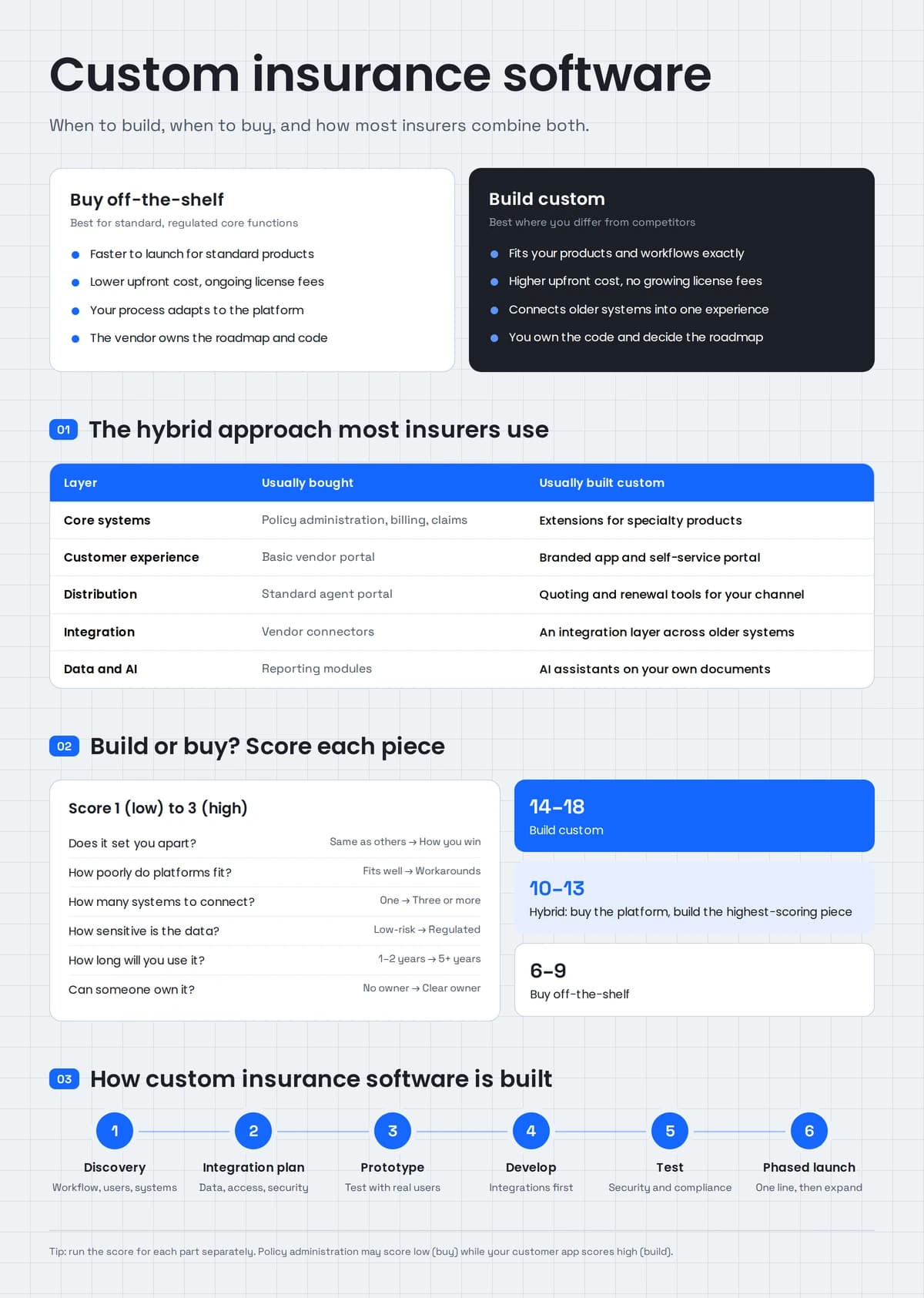
The hybrid approach means buying a proven core platform for policy, billing and claims, then building custom software around it where you differ: customer and agent experiences, specialty rating, integrations and AI. It combines the stability of a packaged core with the flexibility of custom software, and avoids a risky full replacement.
In practice, a hybrid setup usually looks like this:
| Layer | Usually bought | Usually built custom |
|---|---|---|
| Core systems | Policy administration, billing, claims | Extensions for specialty products |
| Customer experience | Basic vendor portal | Branded app and self-service portal |
| Distribution | Standard agent portal | Quoting and renewal tools fitted to your channel |
| Integration | Vendor connectors | An integration layer across older systems |
| Data and AI | Reporting modules | AI assistants and analytics on your own data |
The hybrid model also lets you modernize step by step. You keep the core running, put a new custom layer in front of it, and replace older pieces only when there's a clear reason. That's the approach behind our insurance software development work.
Which parts of insurance software are worth building custom?
The parts of insurance software most worth building custom are the ones customers and agents touch, the integrations that tie older systems together, specialty rating and workflows, and AI assistants grounded in your own documents. These are where a packaged platform looks the same for everyone, and where your own design creates an edge.
The customer-facing layer: apps and portals
This is where most custom value sits. A branded app or portal lets policyholders view policies and ID cards, pay premiums, file claims and track them, without calling. It connects to the core through a secure backend, so the core platform doesn't change.
For the features an insurance app needs, the right platforms and how to build one, see our insurance app development guide.
The agent and broker layer
Agents and brokers want tools that cut their admin: client views across lines, fast quoting with your rating rules, renewal reminders and commission tracking. Custom agency software can also include automated lead follow-up, so quote requests are answered quickly, including evenings and weekends.
The integration layer
Many insurers run several older systems that don't talk to each other. A custom integration layer reads and writes data across them and exposes it to new apps and portals through secure APIs. It's often the most valuable custom piece, because it makes everything else possible without replacing the core. Where an older system is the bottleneck, our enterprise software team can modernize the parts you depend on.
The AI layer
AI assistants can answer coverage questions from the policy wording, summarize claim files, extract data from submissions and draft letters for staff to review. They work best when built on your own documents, with sources shown and people making the decisions. Our AI integration services connect this kind of AI to policy, claims and document systems.
A build-or-buy checklist for insurers
To decide whether to build or buy a piece of insurance software, score it on how much it sets you apart, how well platforms fit, how many systems it touches, how sensitive the data is, how long you'll use it and whether you can own it. High scores point to custom; low scores point to buying.
Score each question from 1 (low) to 3 (high) for the specific piece of software you're considering:
| Question | 1 | 3 |
|---|---|---|
| Does it set you apart from competitors? | Every insurer does it the same way | It's how you win business |
| How well do packaged platforms fit? | One fits almost perfectly | Constant workarounds |
| How many systems does it need to connect? | One | Three or more, including older ones |
| How sensitive is the data? | Low-risk internal data | Regulated personal or health data |
| How long will you use it? | A year or two | Five years or more |
| Can someone in your business own it after launch? | No owner | A clear owner and budget |
Totals of 14 or more out of 18 usually favor custom. Totals of 9 or less usually favor buying. Anything between is often a hybrid: buy the platform and build the piece that scores highest.
Run this for each part separately. An insurer might score 8 for policy administration (buy) and 16 for its customer app (build), which is exactly the hybrid model.
Not sure how your system scores? Book a 30-minute call with our CTO and we'll walk through the checklist with you, including what to keep, what to build and what to leave alone.
Real custom insurance software examples
These two projects show the custom layer in practice: an AI assistant built on an insurer's own documents, and an automated lead follow-up system that suits insurance agencies. Both work alongside existing systems rather than replacing them.
Insurance Claims RAG Assistant
The problem: claims professionals searched scattered files to answer coverage questions.
What we built: the Insurance Claims RAG Assistant answers coverage questions in plain language over policy and claims documentation, built on PostgreSQL with pgvector.
Why it's custom: every answer links to the exact policy clause it came from, so the claims professional checks the source instead of trusting a summary. That kind of grounding in one insurer's own wording is hard to get from a generic tool.
Zonified Connect: lead follow-up for agencies
The problem: new leads waited for someone to call them back, and evenings and weekends went uncovered. Agencies face this with every quote request.
What we built: Zonified Connect is our own AI voice CRM. Voice and SMS agents connect to HubSpot, Google and Outlook calendars, Vapi and Twilio, contact each new lead on the business's own sequence and book an appointment only after the lead confirms a time.
Why it's custom: the follow-up rules are the business's own, and automation stops as soon as a person takes over the conversation.
How is custom insurance software built?
Custom insurance software is built in six stages: discovery with the people who do the work, an integration and security plan, design and prototype testing, development with integrations built first, testing including security and compliance checks, and a phased launch with ongoing support. Each stage ends with something you can review.
- Discovery. Map the workflow, users and systems, and agree what success looks like.
- Integration and security plan. Decide how the new software connects to the core, where data lives, who can see it and how it's logged.
- Design and prototype. Test clickable prototypes with customers, agents or staff before writing production code.
- Development. Build the integrations first, then the screens and logic on top of reliable data.
- Testing. Functional, security and accessibility testing, plus checks against your compliance obligations.
- Phased launch and support. Release to one line, state or agency first, then expand, with monitoring and regular updates.
If you're new to custom development, our overview of what bespoke software means and how it's built explains the process in plain terms.
How much does custom insurance software cost?
Custom insurance software cost depends on what you build, how many systems it connects to, the condition of your data, compliance requirements, the number of user types and platforms, and whether AI is involved. A focused customer app or integration layer costs far less than a full custom core. A short discovery phase gives the most reliable estimate.
The biggest cost drivers:
| Driver | Lower cost | Higher cost |
|---|---|---|
| Scope | One focused piece (an app, a portal, an integration) | A full custom core |
| Integrations | Systems with modern APIs | Several older systems with no APIs |
| Data | Clean and digital | Scattered, scanned or duplicated |
| Compliance | Standard data security | Health data, many states, detailed audit needs |
| Users | One user type | Policyholders, agents, adjusters and admins |
| AI | None | Grounded assistants and document extraction |
For apps specifically, published estimates from development firms range from about $15,000 for a basic app to $400,000 or more for a complex platform. Our guide to the features an insurance app needs explains what moves an app's cost.
Also budget for running costs: hosting, third-party services, security testing, AI usage and maintenance. With custom software, you pay to maintain it, but you don't pay rising license fees.
How do you choose a custom insurance software partner?
Choose a partner that understands policy, billing and claims workflows, asks about your core systems before proposing screens, builds security and compliance into the design, can show insurance or regulated-industry work, recommends buying where buying makes sense, and gives you full ownership of the code, designs and cloud accounts.
Ask these questions on your first call:
- Which parts of our setup would you not build custom, and why?
- How will the new software connect to our policy, billing and claims systems?
- How do you handle encryption, access control and audit logs?
- Can you show insurance or other regulated-industry projects?
- Do we own the code, designs and accounts from day one?
- Can you start with a discovery phase before a fixed quote?
- How will you support the software after launch?
A partner who wants to build everything, including parts a mature platform already does well, is likely to cost you more than you need to spend.
Talk to us about the part you want to build
You don't need to replace your whole platform to get software that fits. Start with the part that matters most to your customers or agents, and connect it to the systems you already run.
AllZone Technologies builds custom insurance software for carriers, MGAs, agencies and insurtech teams, from customer apps and agent portals to integration layers and AI assistants. Read our insurance app development guide, see our insurance software development work or contact us to get a scoped estimate.