01 / INSURANCE
Insurance runs on thesystems nobody sees.
Policy administration, claims handling and risk assessment are where an insurer's economics are actually decided. We build and modernise those systems, and apply intelligence where it reduces handling time without removing accountability.
THE PROBLEM
The constraint is rarely the interface
Most insurance technology problems trace back to a policy administration system that works correctly and cannot be changed. New products take months to configure, integrations are point-to-point, and every downstream system holds its own version of the truth.
Meanwhile claims handling stays manual because the input is unstructured. Documents, photographs and correspondence were never what rules engines were designed to read. The result is a cost base defined by handling time.
SYSTEMS WE BUILD
What we build for insurance.
01
Policy platforms
Product configuration, quoting and policy lifecycle modelled so a new product is a configuration change rather than a development cycle.
02
Claims systems
Intake, triage, assessment and settlement workflows with a full audit trail of who decided what and on what basis.
03
Customer portals
Self-service for the transactions that currently generate calls: documents, changes, renewals and claim status.
04
Risk systems
Pricing and exposure models integrated into the quoting path rather than run separately in spreadsheets.
05
Broker and partner interfaces
APIs and portals for the distribution channels that submit business, with validation at the point of entry.
06
Regulatory reporting
Reporting derived from the operational model, so submissions do not require a manual assembly exercise.
INTELLIGENCE
Where AI genuinely changes the outcome.
And, just as importantly, where it does not. We are direct about which problems in this sector are better solved with conventional software.
Document and claim intake
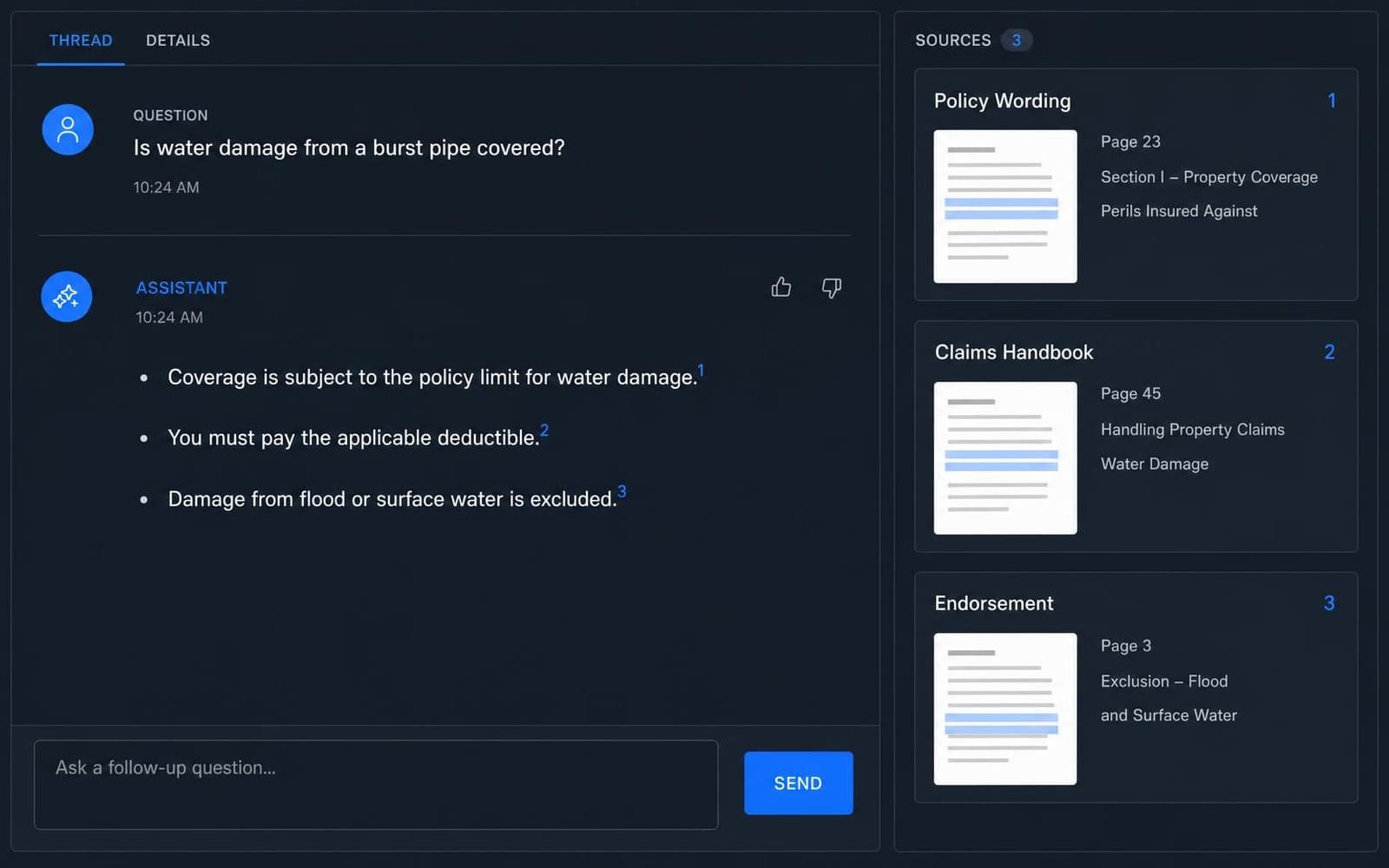
Extraction from unstructured submissions, whether forms, correspondence or images, into the structured fields a claims system needs.
Triage and routing
Classifying claims by complexity and routing them to the right handler, with the straightforward cases progressing without one.
Anomaly and fraud signals
Detection models surfacing cases for human review, with the reasoning exposed rather than hidden behind a score.
Assisted underwriting
Retrieval over policy wording and precedent so underwriters get the relevant clause instead of searching for it.
CAPABILITIES
Recurring product requirements.
- Policy administration
- Claims workflow
- Document processing
- Customer self-service
- Broker integration
- Audit and compliance
- Risk modelling
- Legacy modernisation
RELEVANT WORK
Delivered in this sector.

PROCESS
From ambiguity to production.
01
Discover
Understand the business, the users, the constraints and the actual opportunity, including where software is not the answer.
02
Architect
Define the product, the AI approach, the data model and the system architecture, with the trade-offs written down rather than assumed.
03
Build
Engineer the software and the intelligence layers together, in short cycles, against criteria agreed before work started.
04
Validate
Test functionality, quality, security and, where models are involved, behaviour, against inputs that reflect real use.
05
Deploy
Launch through infrastructure and pipelines built for repeatable release, with a rollback path that has been exercised.
06
Evolve
Observe how the system behaves in production, improve it against that evidence, and scale what is working.
TECHNOLOGY
Typical stack for this work.
Product
- React
- Next.js
- TypeScript
- JavaScript
- Node.js
- Express
- ASP.NET
- Laravel
- Ruby on Rails
- Vue.js
- Nuxt
- Tailwind CSS
Intelligence
- OpenAI
- LangChain
- Python
- PyTorch
- TensorFlow
- TensorRT
- OpenCV
- Deepgram
- ElevenLabs
- Perplexity
Data
- PostgreSQL
- MySQL
- MongoDB
- Redis
- Firebase
- Power BI
- Plotly
- Seaborn
- Dash
- Scala
Cloud & DevOps
- AWS
- Azure
- Google Cloud
- Docker
- Kubernetes
- Terraform
- Jenkins
- Git
- Bitbucket
FAQ
Common questions.
Yes, and that is the usual starting point. Most engagements involve building around a core system that is staying in place, using its interfaces where they exist and establishing controlled ones where they do not.
By designing for them rather than reporting on them afterwards. Decisions are recorded with their inputs, changes are versioned, and access is scoped, so an audit is a query rather than an investigation.
Wherever the bottleneck is reading unstructured input: intake, classification, extraction and retrieval. It makes least sense as a final decision-maker on a claim, and we build these systems so that a person remains accountable for the outcome.
NEXT STEP
Building something in insurance?
Tell us the constraints, whether regulatory, operational or technical. Those are usually what decides the architecture.