ALLZONE PRODUCT · SEO AND CONTENT PLATFORM
Zonified Rank
Publish Smarter. Rank Faster.
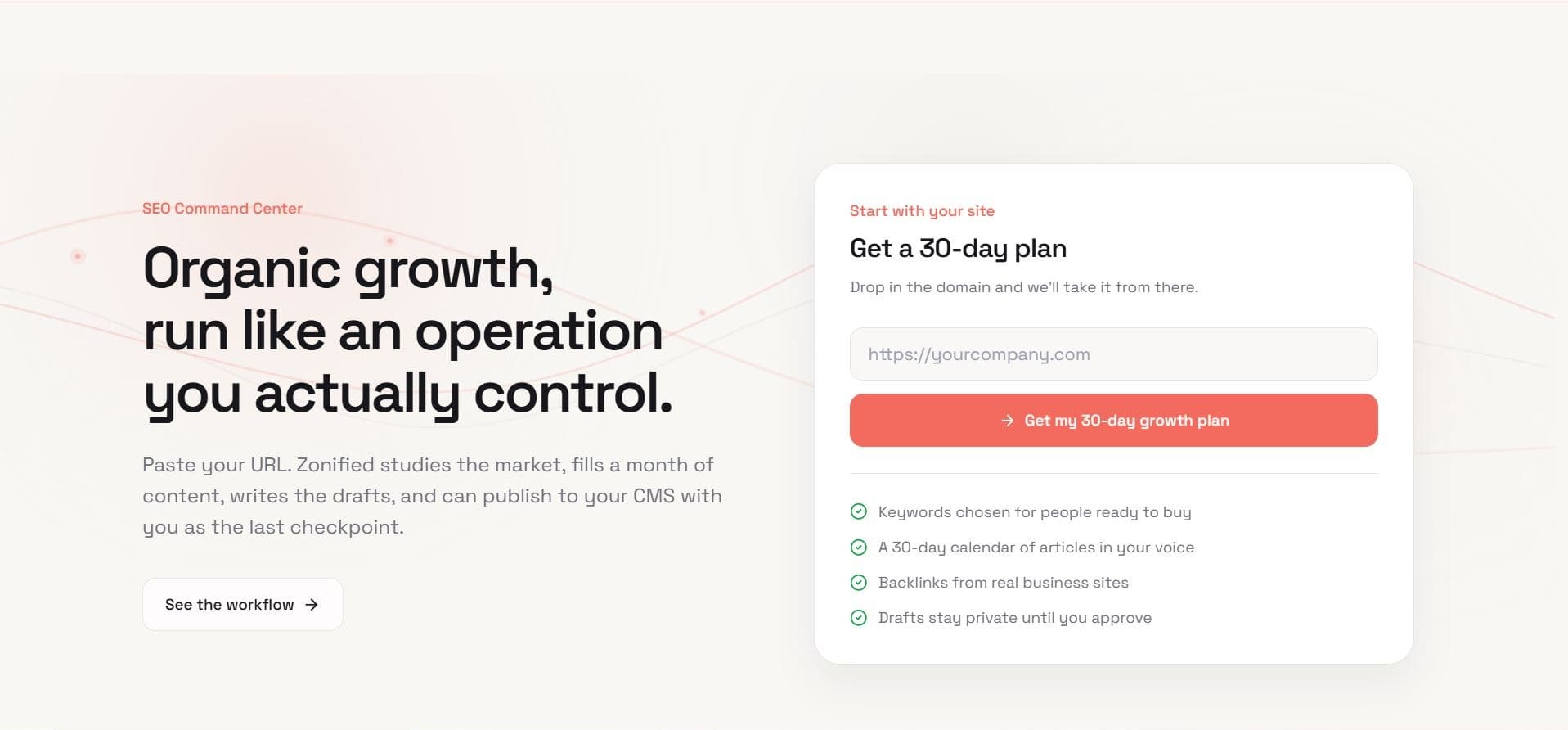
It reads the business behind a URL, finds the competitors and keywords worth chasing, builds a rolling calendar, writes and publishes the articles, and reports what each one earned in search.
- RUNNING ON
- allzonetech.com
- PUBLISHES TO
- WordPress · Shopify · Custom
- SOCIAL
- LinkedIn · Meta
- REPORTS FROM
- Search Console
THE PATTERN
Content programmes do not fail on ideas. They fail on month three.
The research gets done once. A few articles get written while everyone is still enthusiastic. Then a launch eats a fortnight, the writer moves onto something urgent, the calendar slips, and six months later the blog's most recent post is six months old. Search rewards the thing almost nobody manages, which is not brilliance but continuing.
Zonified Rank closes that loop rather than helping with one part of it. Research, planning, writing, publishing and reporting are one operation with a schedule attached, and the only decision left to a person is whether they want to approve each post before it goes out.
PROOF
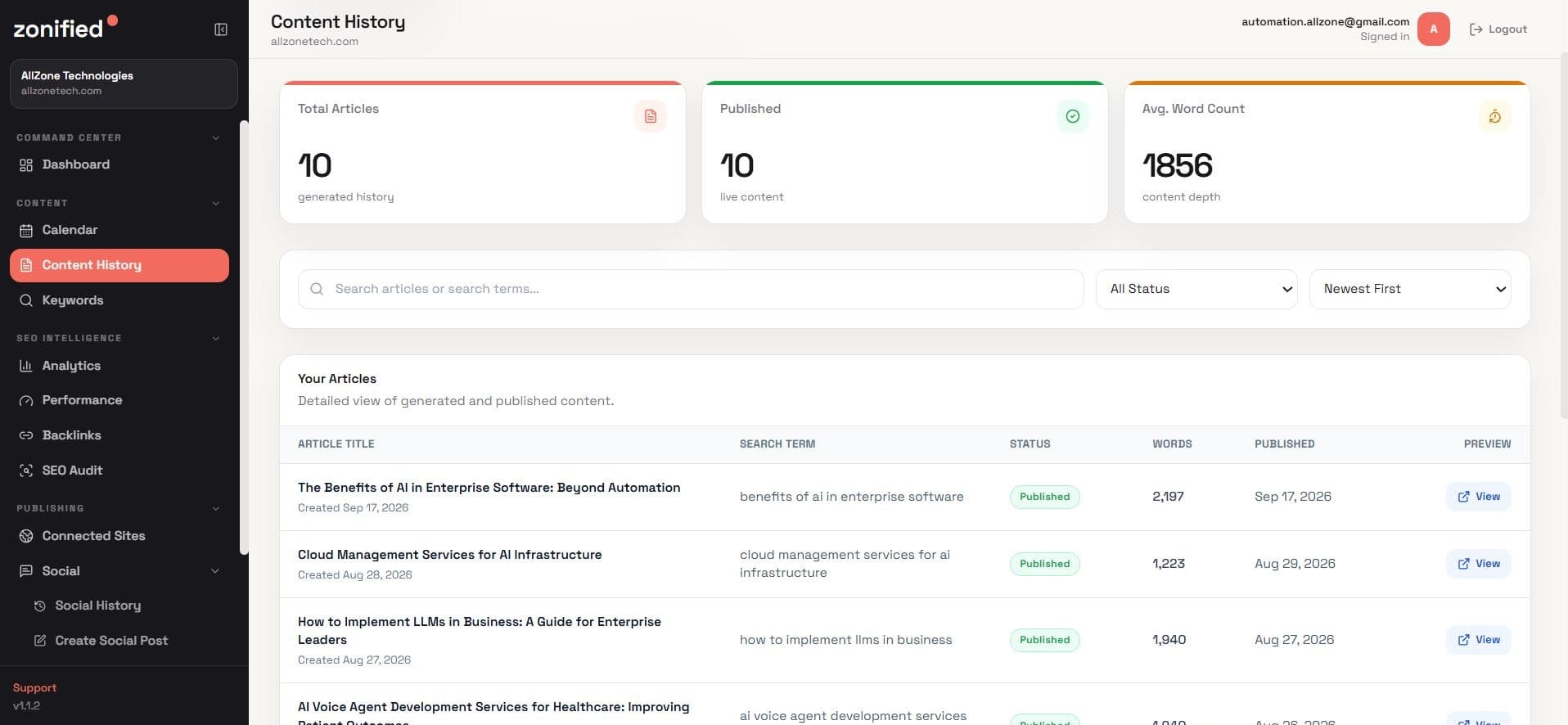
This site's blog is published by it.
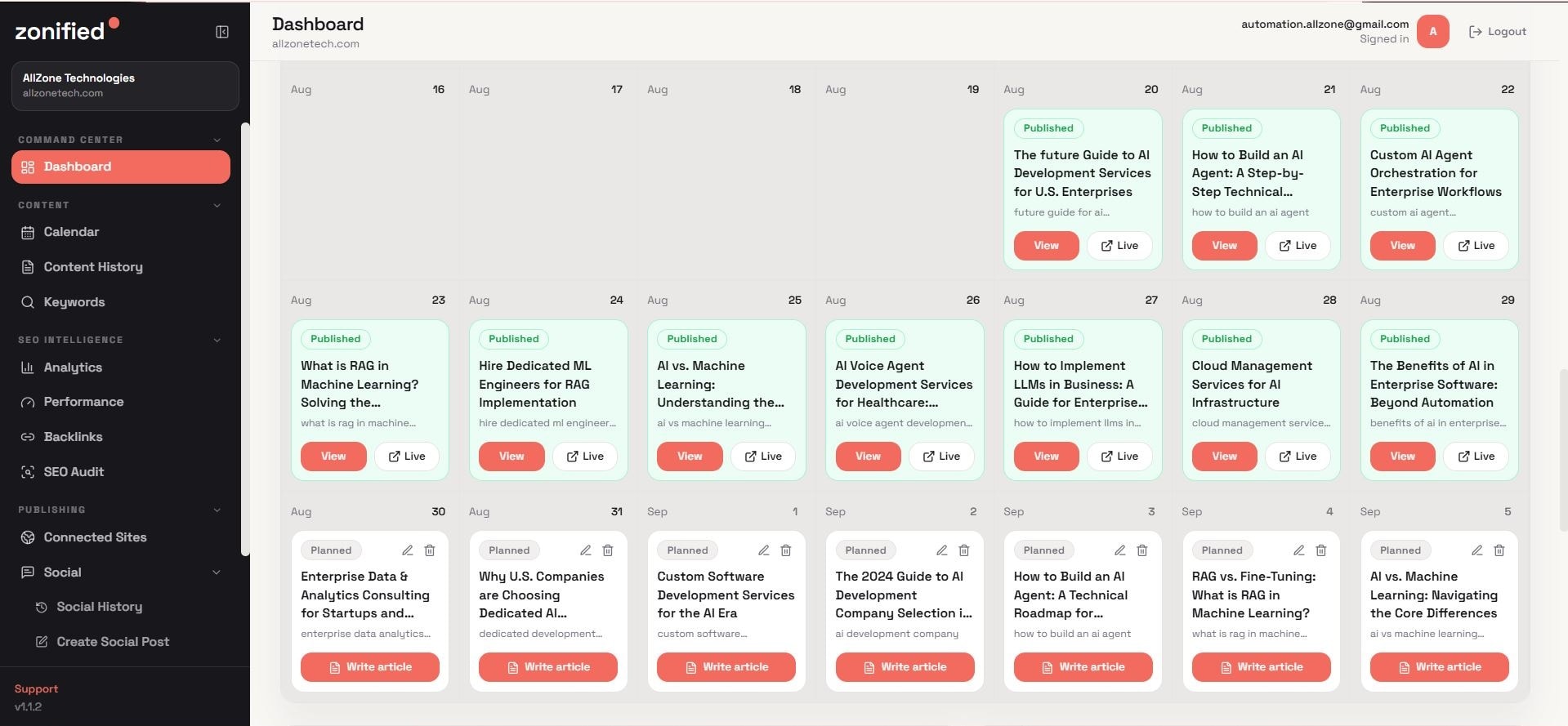
Not a pilot and not a demo tenant. allzonetech.com is a workspace in Zonified Rank, and eight articles went out on consecutive days in August under the same schedule any other domain would get. Every one of them is still live here, so the claim is one you can click rather than one you have to take on trust.
Read the blog- 20 AugustThe future Guide to AI Development Services for U.S. Enterprises
- 21 AugustHow to Build an AI Agent: A Step-by-Step Technical Roadmap
- 23 AugustCustom AI Agent Orchestration for Enterprise Workflows
- 23 AugustWhat is RAG in Machine Learning? Solving the Hallucination Problem
- 24 AugustHire Dedicated ML Engineers for RAG Implementation
- 25 AugustAI vs. Machine Learning: Understanding the Differences for Business
- 26 AugustAI Voice Agent Development Services for Healthcare
- 27 AugustHow to Implement LLMs in Business: A Guide for Enterprise Leaders
THE PIPELINE
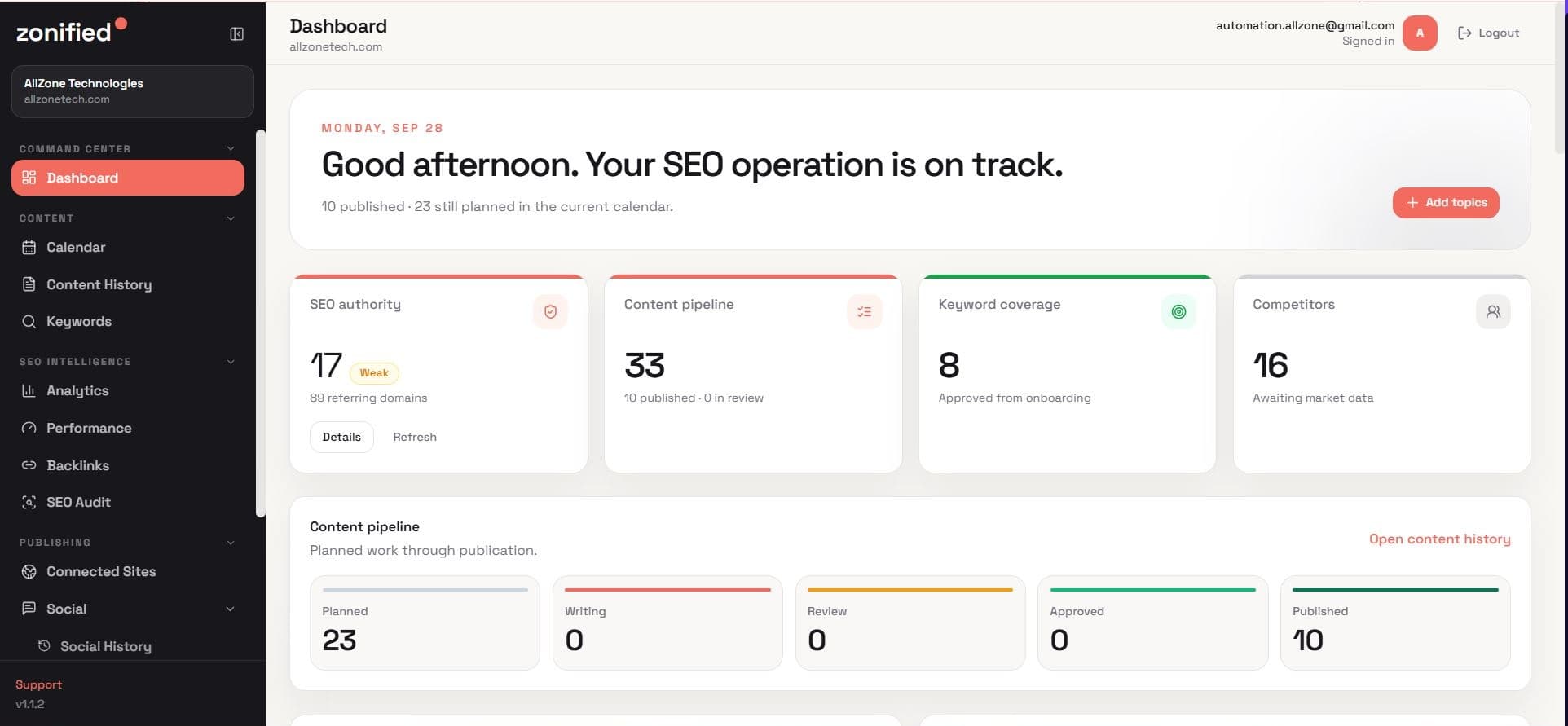
One operation, not five tools.
Research, planning, generation and publishing stay separate stages, so a failure in one does not quietly produce content from stale inputs in the next.
01Connect
A URL is the whole setup
It reads the offerings, the audience, the brand voice and the focus markets off the site itself. Nothing to fill in.
02Research
Competitors and keywords
Who is ranking against the domain, and which keywords are carrying the traffic they are getting.
03Plan
A rolling calendar
A balanced thirty day plan, rescheduled by dragging topics between days, and refreshed each month so the pipeline never empties.
04Write
Publish-ready articles
Headings, summaries, tables and takeaways, plus a table of contents, calls to action, video highlights and generated visuals.
05Approve
The switch, if you want it
This is the only stage where matic and manual differ, which is why the switch sits here and nowhere else.
06Publish
To the CMS and the feeds
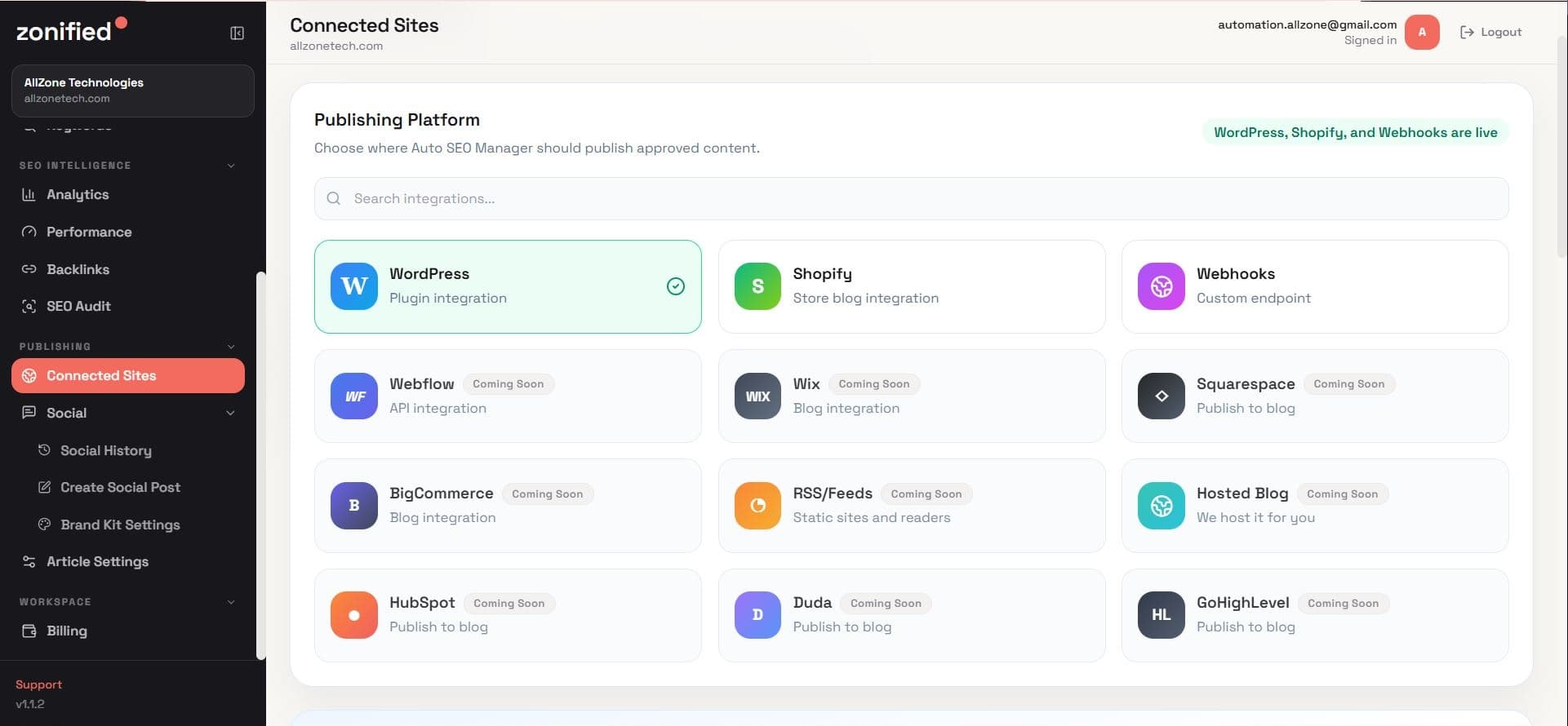
WordPress, Shopify and custom sites, with each finished article turned into posts for Facebook Pages, Instagram and LinkedIn.
07Track
Back to search
Impressions, clicks, click-through rate and keyword position per published article, alongside page speed and backlink movement.
INTELLIGENCE
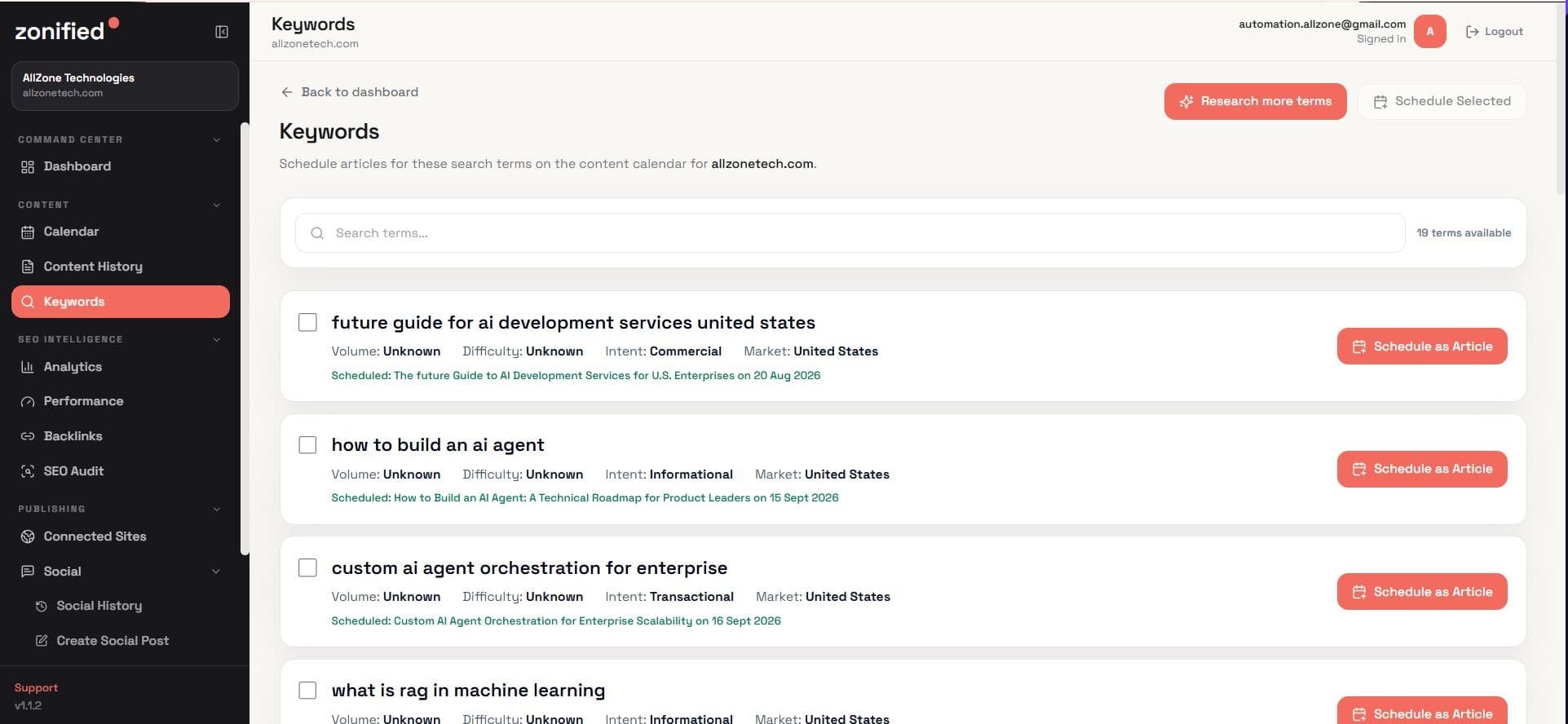
Keywords discovered and scheduled in one click.
Enter your domain and Zonified pinpoints the commercial and informational queries your competitors rank for. Select any search term and schedule it directly into your 30-day editorial calendar.
CONTROL
You decide whether a person sees it first.
The switch sits between generation and publishing, which is the only point where the two modes need to differ. Everything before it and everything after it is identical, so moving between them is a setting rather than a rebuild.
MATIC
An approved schedule publishes itself.
- Topics are planned, written and posted on the calendar without anyone opening the dashboard
- Suits a team that has agreed the strategy and wants the execution to stop being a standing meeting
- The calendar is still editable, so switching a topic is dragging it to another day
MANUAL
Every post is reviewed before it goes live.
- Each article is read, edited and approved by a person first
- Suits a regulated business, a sensitive brand, or the first month on any domain
- Nothing about the pipeline changes, so moving between the two is a setting rather than a rebuild
CAPABILITIES
What separates it from a writing tool.
Search markup, written in
Schema markup so articles qualify for rich snippets and FAQ results, applied as the article is generated rather than bolted on by a plugin afterwards.
Internal links that compound
matic links across existing pages, so each new piece contributes to the authority of the rest of the site instead of standing on its own.
Written against the business
The specific services, locations and customers of the domain, rather than around a keyword. It is the difference between something that company would publish and filler.
Social, from the same article
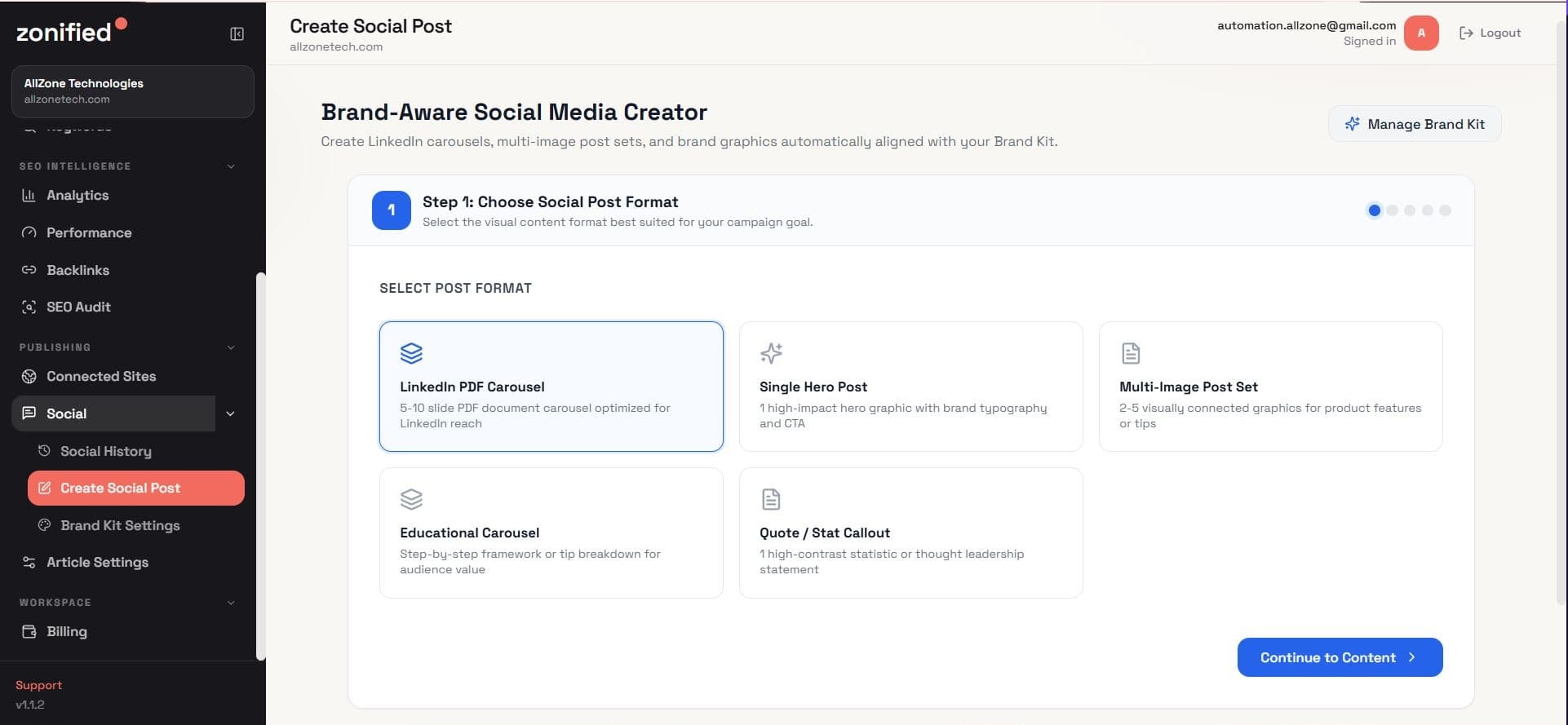
Each finished piece turned into posts for Facebook Pages, Instagram and LinkedIn, so distribution is not a second job.
Site health alongside content
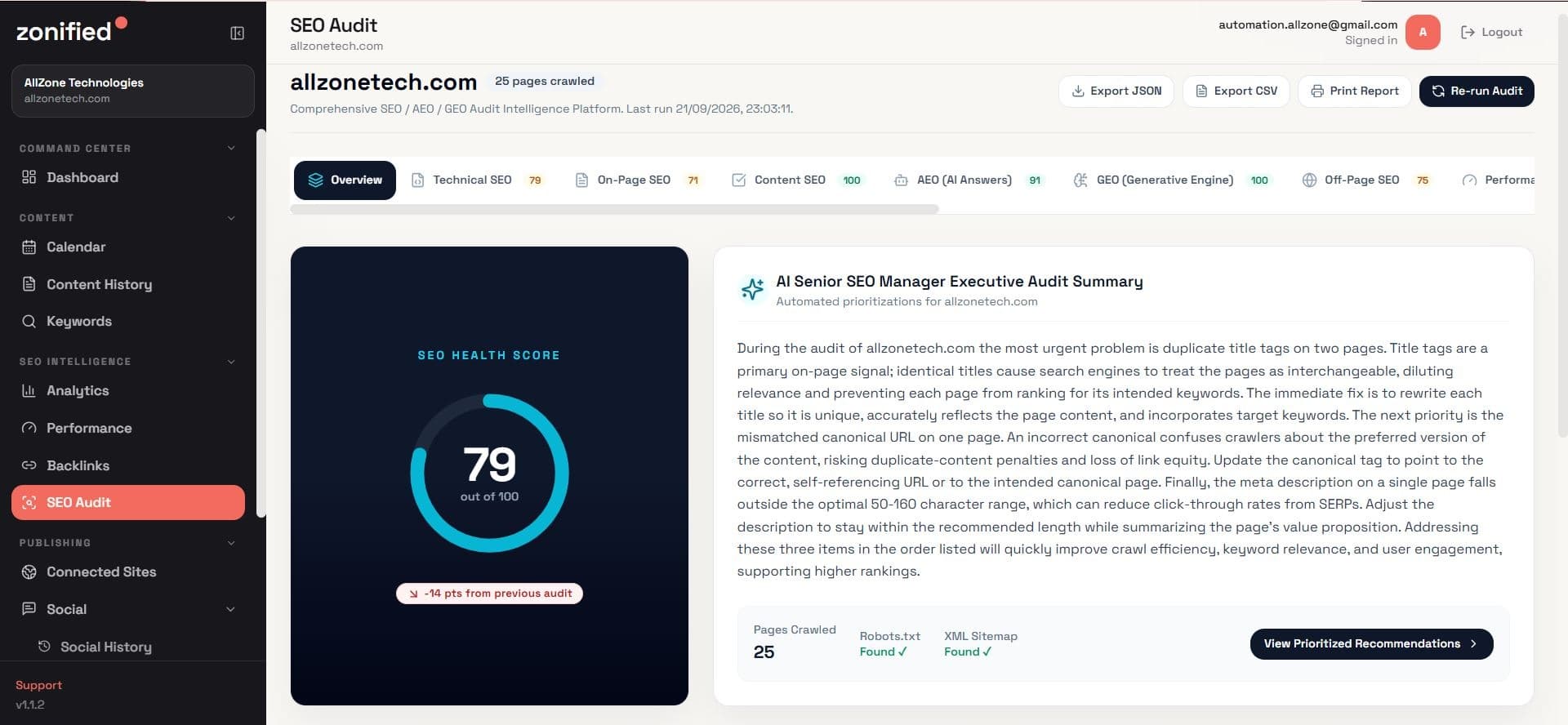
Page speed scores and mobile and desktop health from performance audits, in the same place as the publishing schedule.
A full publishing log
What went out, when, to where, and under whose approval. Useful on the day someone asks why a post exists.
Multi-CMS Connected Publishing
Publish automatically to WordPress, Shopify, Webhooks, or custom headless backends without manual copy-paste.
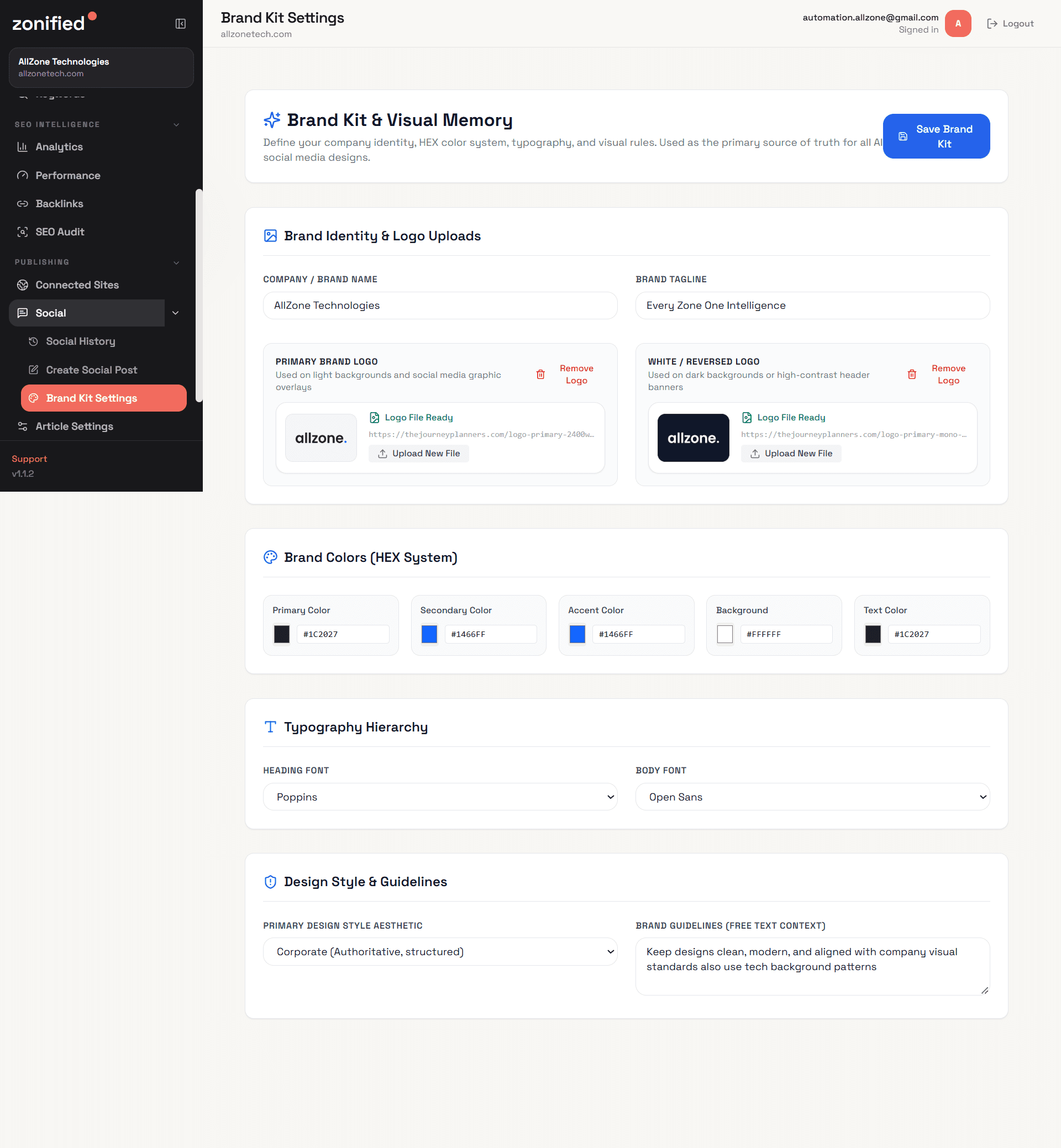
Brand-Aware Social Distribution
Turn finished articles into LinkedIn PDF carousels, stat callouts, and multi-image graphic sets in your brand palette.
FOR AGENCIES
Built for more than one domain.
If you are running content for clients rather than for yourself, this is the half of the product that decides whether it is usable. Workspaces, scoped permissions, and independent approval switches per tenant.
Several domains, one dashboard
Client sites live side by side as workspaces rather than as separate logins, which is the difference between running five domains and running one five times.
Per-site permissions
Invited team members scoped to the sites they work on, so a contractor on one account cannot see another client's pipeline.
Approval per client
One domain can publish matically while another has every post reviewed, because the switch belongs to the site rather than to the account.
REPORTING
It closes the loop back to search.
Anything can generate an article. The question a content programme actually has to answer is whether the article earned anything, which is why performance is attributed per published piece rather than to the site as a whole.
Google Search Console
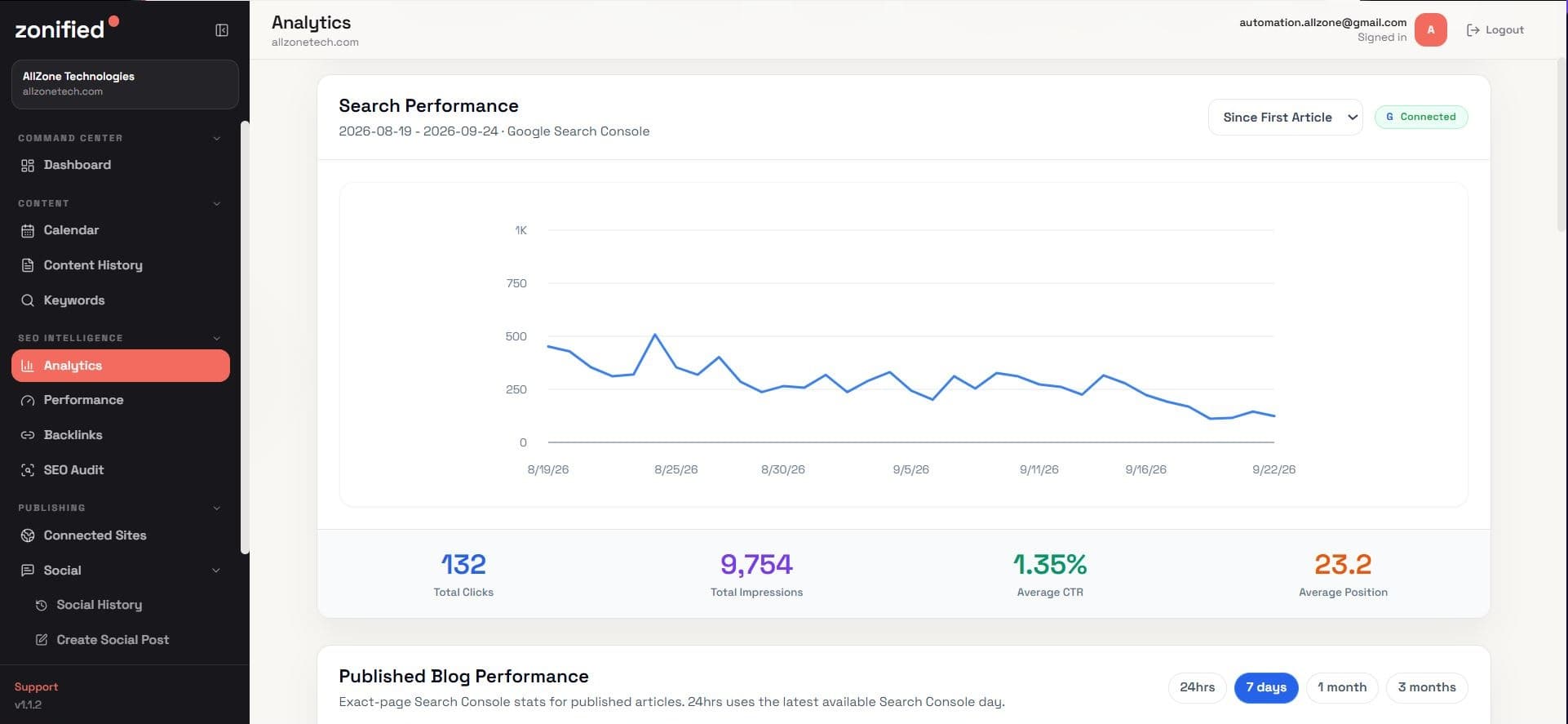
Impressions, clicks, click-through rate and keyword position, attributed to individual published articles rather than to the site as a whole. This is the part that answers whether the work earned anything.
PageSpeed Insights
Page speed scores plus mobile and desktop health, pulled on a schedule so a regression shows up rather than waiting for someone to run an audit.
Backlinks and authority
Backlink profile, referring domains and domain authority followed over time rather than checked once and screenshotted into a deck.
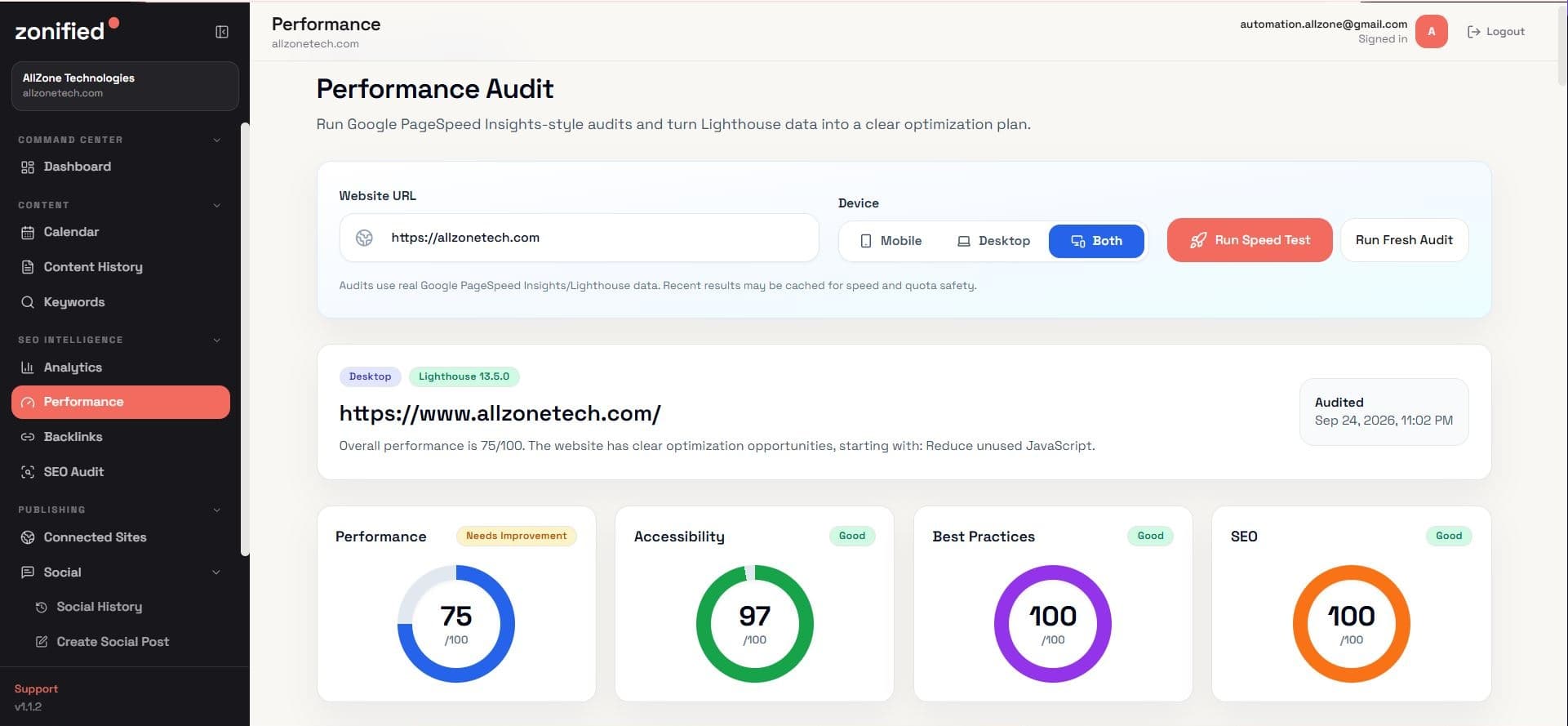
Core Web Vitals & PageSpeed
Lighthouse 13.5 automated audit tracking mobile and desktop performance, accessibility, and Core Web Vitals.
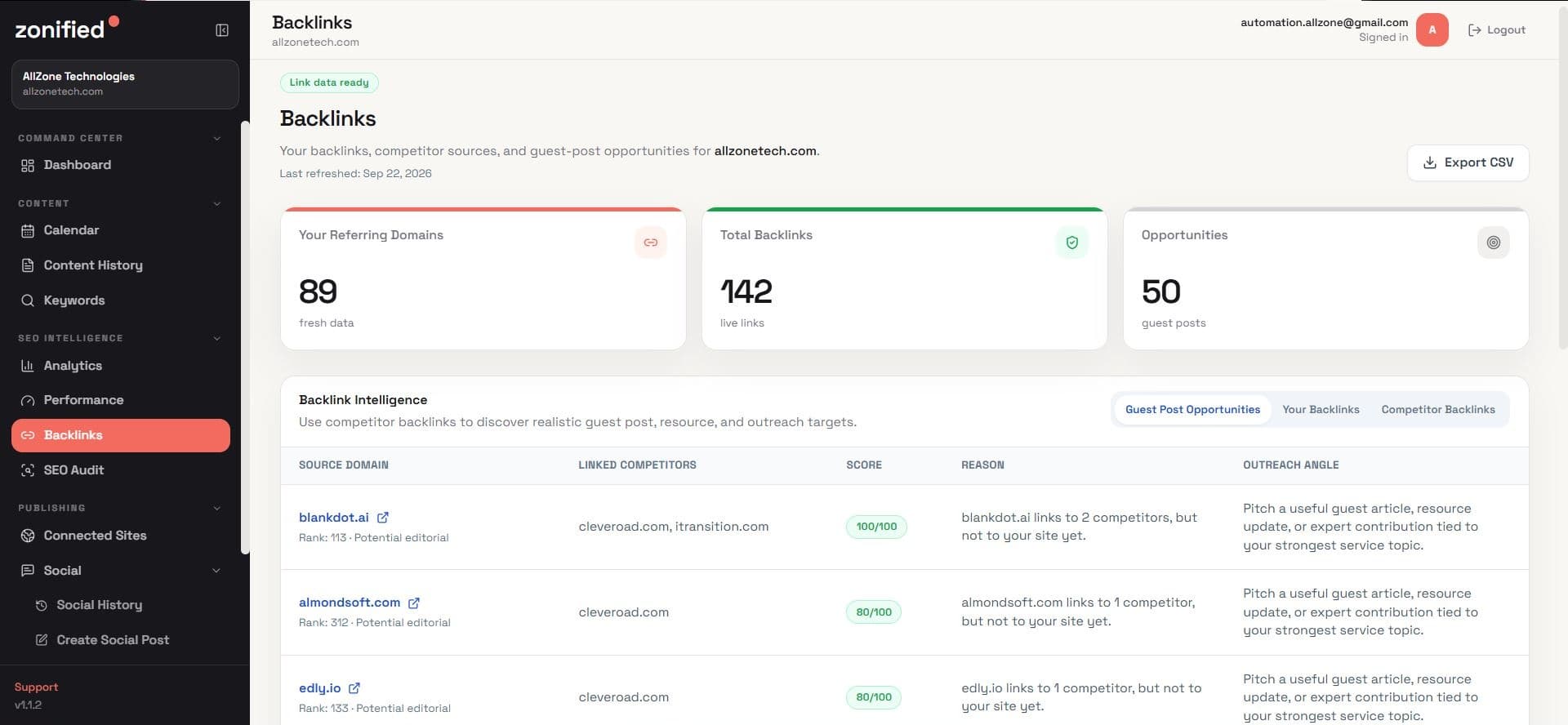
Backlinks & Outreach Intelligence
Referring domains, competitor backlink profiles, and vetted guest-post opportunities with outreach angles.
FAQ
Before you ask.
A domain. It reads the offerings, audience, brand voice and focus markets off the site itself, then finds the competitors ranking against it and the keywords carrying their traffic. There is no onboarding questionnaire to fill in before it can do anything useful.
Only if you tell it to. There are two modes. In automatic, an approved schedule publishes itself. In manual, every post is reviewed and edited before it goes live. The switch sits between generation and publishing, which is the only point in the pipeline where the two modes differ, and it can be set per site.
WordPress, Shopify and custom sites directly, and each finished article is also turned into posts for Facebook Pages, Instagram and LinkedIn. Destinations are pluggable connections, so another platform is a new connector rather than a change to how articles are written.
Google Search Console impressions, clicks, click-through rates and keyword positions are tracked per published article, not just for the site as a whole. Page speed scores, mobile and desktop health, backlink profile, referring domains and domain authority are followed on a schedule alongside them.
That is the part it is built around. Articles are written against the specific services, locations and customers of the domain rather than around the keyword alone, because a piece that reads as filler earns nothing in search and costs the brand something.
Yes. Sites live side by side as workspaces, with invited team members, per-site permissions and a full publishing log. Approval mode is set per site, so one client can publish automatically while another has every post reviewed.
Both are applied as the article is generated. Schema markup so pieces qualify for rich snippets and FAQ results, and automatic internal links across existing pages so each new article contributes to the authority of the rest of the site.
On this site. allzonetech.com is a workspace in Zonified Rank, and eight of the articles in the blog here were planned, written and published by it on consecutive days in August. They are still live and you can read them.
NEXT STEP
Point it at your domain.
The useful first conversation is not a slide deck. Give us the URL and we will show you what it finds: the competitors, the keywords, and the first month of calendar it would build for you.