ENTERPRISE SOFTWARE ENGINEERING
Agentic Engineering Platform
An AI development environment where specialised agents carry a requirement through planning, implementation, testing and review to a reviewable pull request.
- PROJECT
- Agentic Engineering Platform
- INDUSTRY
- Enterprise Software Engineering
- STACK
- LangGraph · LangChain · Claude Code · MCP · Python · Docker · CI/CD
OVERVIEW
The project
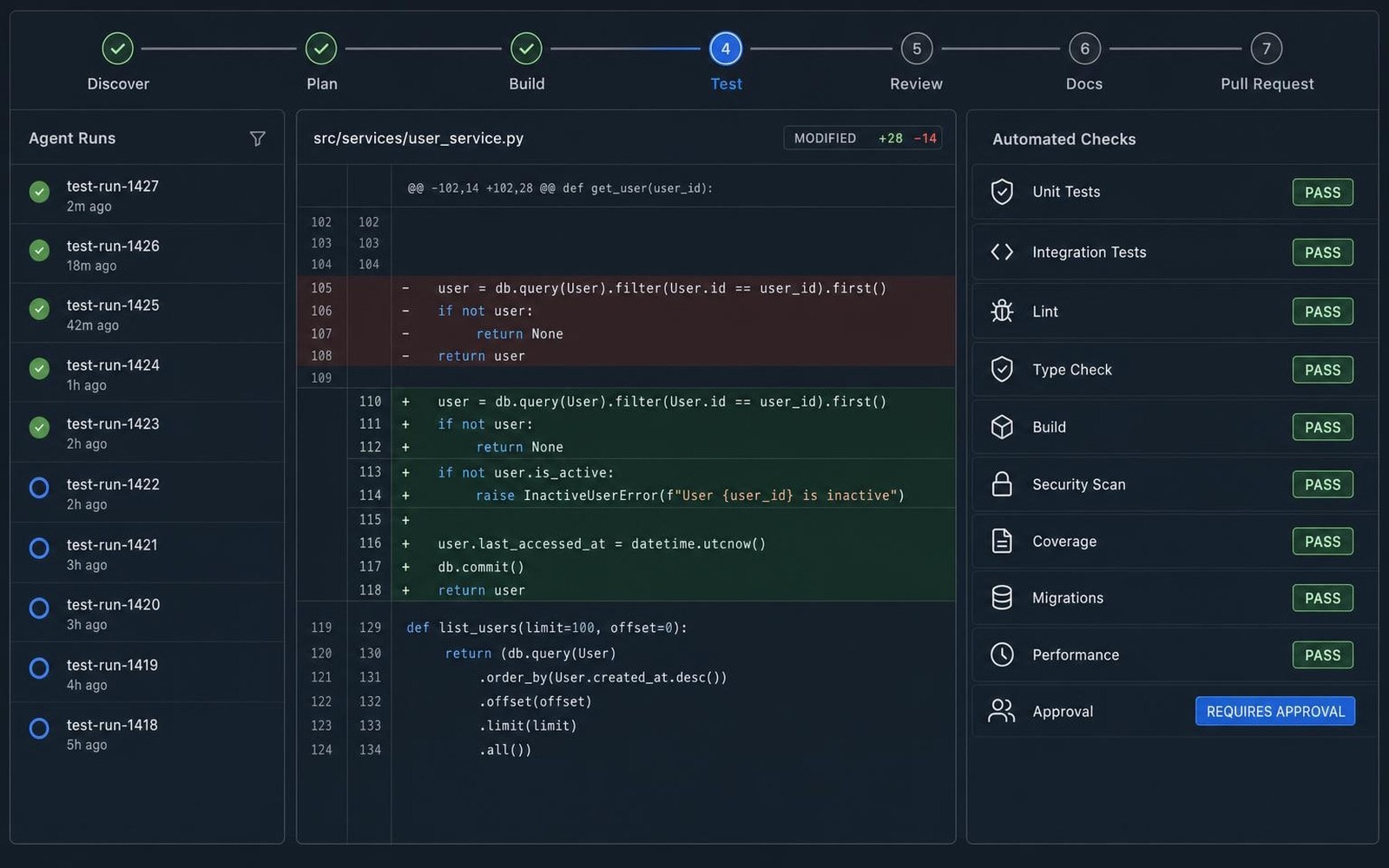
A software development environment built around specialised agents rather than one general assistant. A requirement enters as plain language and leaves as a pull request carrying the implementation, its tests, the review findings and the documentation generated from them. Every agent works inside an isolated branch and workspace, reaching engineering systems through permission controlled tooling and never through production credentials.
CHALLENGE
What made it difficult
Generating code is the easy part. The hard part is everything that has to be true before a change can be trusted: that the requirement was understood, that the existing repository, schema and API contracts were accounted for, that the work was actually tested, and that a person approved anything consequential.
A linear chain of prompts cannot carry that weight. A failure at review is a different problem from a failure at planning, and restarting the whole workflow every time something breaks makes the system slower than the manual process it was meant to replace.
WHAT WE DID
The work delivered.
- 01
Requirement structuring
Business requirements converted into acceptance criteria, affected components, risks and implementation phases before any code is written.
- 02
Planning against the real codebase
A planning layer that reads repository structure, database schema, business rules, API contracts, infrastructure context and relevant Git history, so a plan reflects the system as it actually is.
- 03
Implementation and QA agents
An implementation agent working from an approved plan inside an isolated branch, with a QA layer running unit, integration, regression, lint, type, security and CI checks over the result.
- 04
Review and failure routing
A review layer that assesses the change against requirements, architecture and acceptance criteria, with failures classified and returned to the stage that owns them instead of restarting the workflow.
- 05
Controlled tool access
MCP as the single governed path to repository, CI/CD and documentation operations, backed by sandboxed workspaces and non production credentials.
- 06
Human approval gates
Explicit approval points on requirements, high risk changes, pull requests, database and infrastructure operations, and deployment.
ARCHITECTURE
How it fits together
- An orchestrated stateful workflow rather than a linear chain of agent calls
- An engineering knowledge layer covering repository structure, schemas, business rules, API contracts, standards and Git history
- MCP as a permission controlled tool access layer over repository, CI/CD and documentation systems
- Isolated workspaces, feature branches and sandbox environments separating agent execution from production
- LangGraph and LangChain orchestration over Python services, containerised and shipped through CI/CD
TECHNOLOGY
The stack
- LangGraph
- LangChain
- Claude Code
- MCP
- Python
- Docker
- CI/CD
OUTCOME
What exists now.
A requirement arrives as a reviewable pull request with its plan, tests, review findings and documentation attached, so the change is judged on evidence rather than on trust
A failed check returns to the stage that caused it, so a code defect does not force the requirement to be replanned from scratch
Autonomy is granted per stage once reliability has been demonstrated, rather than handed to the agents by default
NEXT STEP
Tell us what you're building.
Bring us the problem with its real constraints attached. We will tell you what we would build, and what we would not.