RECRUITMENT AUTOMATION
AI Resume Screening
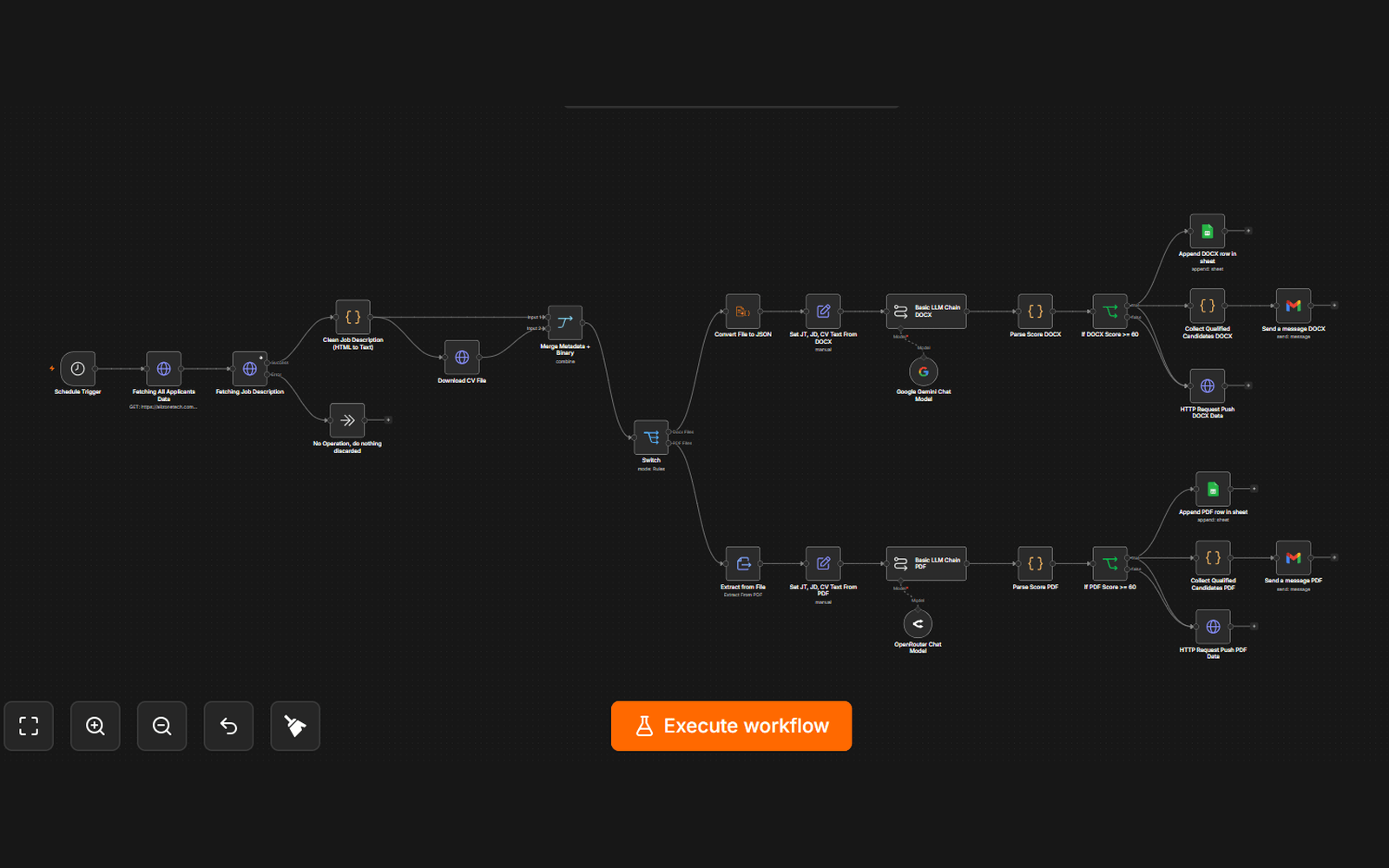
An screening pipeline that pulls each application from the ATS, reads the CV whatever format it arrives in, and scores it against that role's own criteria.
- PROJECT
- AI Resume Screening
- INDUSTRY
- Recruitment Automation
- STACK
- n8n · WordPress REST API · Google Gemini · OpenRouter · PDF Processing · DOCX Processing
OVERVIEW
The project
A hiring pipeline with more applications than anyone could read was being screened by whoever had time. AllZone built a workflow that retrieves each application and its matching job description through the WordPress REST API, extracts the CV content whether it arrives as a PDF or a DOCX, evaluates the candidate against the role's requirements and returns a structured score.
CHALLENGE
What made it difficult
CVs arrive in whatever format the candidate had to hand. A single extraction path handles one of them well and mangles the other, and a mangled CV scores badly for reasons that have nothing to do with the candidate.
A score also has to be defensible. A ranked list with nothing behind it cannot be reviewed, so the evaluation had to produce fields a recruiter can read rather than one number.
WHAT WE DID
The work delivered.
- 01
ATS integration
Applicant records and the matching job description retrieved through the WordPress REST API, so screening runs against the role the candidate actually applied to.
- 02
Format aware extraction
Separate processing paths for PDF and DOCX files, so the text reaching the evaluation step is clean either way.
- 03
Structured evaluation
AI screening against the job requirements, producing a structured score rather than an unexplained verdict.
- 04
Threshold and handoff
A configurable qualification threshold that collects the candidates who clear it and notifies the recruiter.
ARCHITECTURE
How it fits together
- The ATS as the source of both applicants and job descriptions, rather than a separate job list to keep in sync
- Branching on file type ahead of extraction, instead of one path attempting both formats
- Evaluation returning structured fields, which is what makes a score reviewable
- A threshold step between collection and notification, so the cut can move without touching the pipeline
TECHNOLOGY
The stack
- n8n
- WordPress REST API
- Google Gemini
- OpenRouter
- PDF Processing
- DOCX Processing
OUTCOME
What exists now.
Every application is screened against its own job description, not only the ones that happened to be read first
A recruiter reviews structured scoring rather than a bare ranking, so a decision can be questioned
Volume stops setting the limit on how many applications get a fair first pass
NEXT STEP
Tell us what you're building.
Bring us the problem with its real constraints attached. We will tell you what we would build, and what we would not.