LOGISTICS · FREIGHT SECURITY
Freight Fraud Prevention Software: Verifying the Driver at the Dock
CargoID Secure is a freight security platform that confirms the person at the dock is the verified driver assigned to that specific load, using an ID and selfie check, single-use pickup codes and a signed custody record.
- Client
- CargoID Secure
- Industry
- Logistics & Freight Security
- Core Stack
- NextJsReactTailwindRadix UIShadCN UIPriority Hints
- Delivery Timeline
- Pilot programme with shippers and warehouses on live pickups
Executive Summary
Carrier vetting happens when a load is tendered, but theft happens when it is picked up, and organised fraud rings exploit the gap by impersonating drivers and hijacking dispatch. We built CargoID Secure, a platform that verifies the driver’s identity once, issues a single-use pickup code only on site, and records every scan in one signed custody record shared by the shipper, broker, carrier and warehouse.
Who This Is For
THE CHALLENGES
Core Technical Challenges
vetted is not the same as verified
Carrier vetting confirms that a company is legitimate, and it happens when a load is tendered. Theft happens later, at pickup. Fraud rings now target loads tendered to legitimate carriers, by impersonating drivers, hijacking dispatch or turning up for loads assigned to someone else. Many facilities still release freight on a bill of lading and a call to dispatch, and neither proves who is standing at the dock.
The cost is large and rising. Verisk CargoNet estimated U.S. and Canadian cargo theft losses at nearly $725 million in 2025, up 60% from 2024, with the average theft worth $273,990. A fix also has to work in practice. The check at the dock must be fast, it has to suit four different parties (shipper, warehouse, broker and carrier), and the record it leaves has to be one that all of them can trust, since each company otherwise keeps its own paperwork and its own version of events.
CHALLENGES & SOLUTIONS
Technical Challenges & Engineered Solutions
A direct breakdown of each architectural obstacle faced during development and the production solution implemented to overcome it.
Carrier vetting confirms the company, not the person at the dock.
The driver completes a one-time identity check, a government ID plus a live selfie through a trusted verification provider, on a phone bound to their account and linked to a persistent driver profile.
A name and a phone call to dispatch prove nothing about who is at the gate.
When the driver arrives, the app generates a digitally signed pickup code. The dock team scans it, and the platform confirms the driver, the load and the authorisation.
A pickup credential that can be reused or sent ahead defeats the check.
Codes are location-gated and single-use. They are issued only on site, tied to one driver and one shipment, expire, and are rejected if reused.
Each company in the chain kept its own version of events.
Every verification attempt, approved or rejected, is timestamped and digitally signed in one custody record shared by shipper, broker, carrier and warehouse.
HOW IT WORKS
End-to-End Execution Pipeline
- 01 Step
Load assigned.
The shipper or broker creates the shipment, and the carrier assigns a specific driver.
- 02 Step
Driver verified.
The driver completes an ID and live selfie check through the verification provider, on a phone bound to their account.
- 03 Step
Pickup code issued on site.
On arrival at the facility, the app generates a digitally signed code that works only for that load, at that location, once.
- 04 Step
Scan and release.
The dock team scans the code, and the platform confirms the driver, the load and the authorisation before freight is released.
- 05 Step
Record the custody.
Every scan, approved or rejected, is timestamped and signed into the shared custody record.
KEY FEATURES
Capabilities Built Into the System
TECH STACK
Technologies We Use
Production-grade frameworks, infrastructure, and tools integrated into this platform.
OUTCOME
Measured Business Outcomes
- Result 01
A dock team confirms in one scan that the person at the gate is the verified driver assigned to that load, instead of relying on a bill of lading and a phone call
- Result 02
A pickup code works for one load, at one location, once, so it can’t be reused or sent ahead
- Result 03
Shipper, broker, carrier and warehouse share one record of who released the freight, to whom, and on whose authorisation
- Result 04
The platform is in a pilot programme with shippers and warehouses on live pickups, with a pilot report covering verification times, rejected attempts and custody records
CLIENT FEEDBACK
What the Client Said
Direct feedback from leadership on engineering execution, technical transparency, and delivered results.
“AllZone took our dock verification concept and turned it into an intuitive, ironclad platform in record time. Their engineering team did not just write code. They deeply understood freight security and edge cases at the gate and built an experience that both drivers and warehouse teams genuinely love using.”

MOCKUP SHOWCASE
Delivered System Mockups
Interface mockups, architecture diagrams, and workflow visuals illustrating the solution in production.
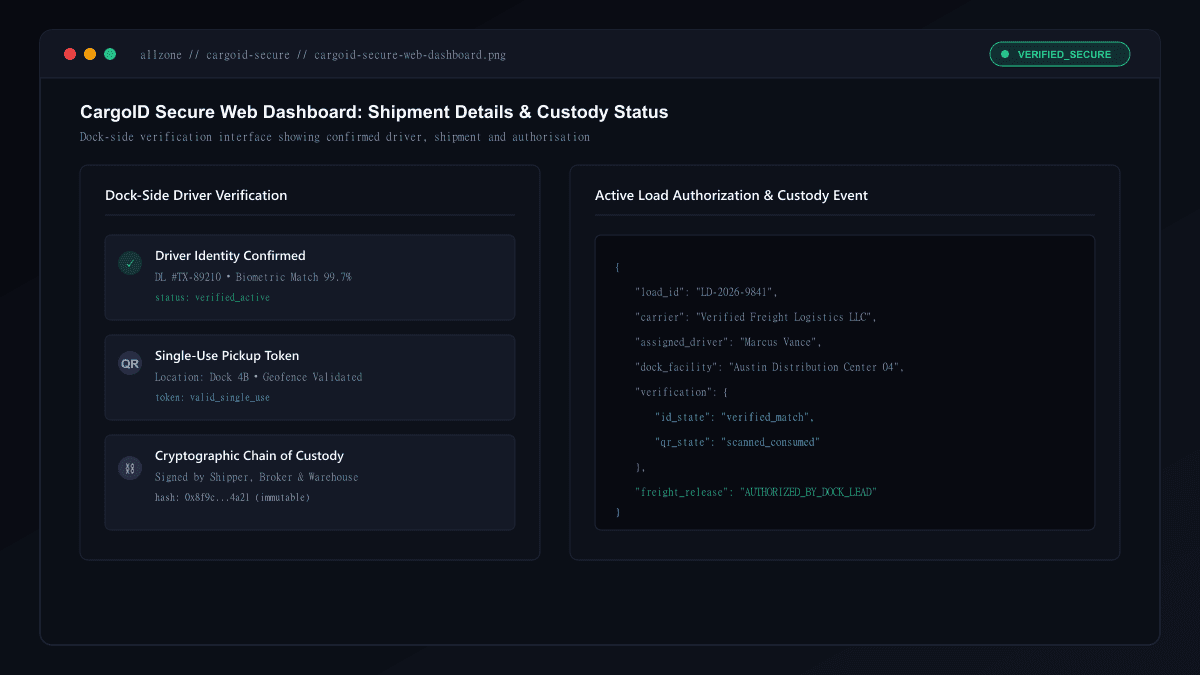
Existing: web dashboard shipment details screen
Freight fraud prevention software: CargoID Secure web dashboard showing the details of a shipment
CAPABILITIES
Related Engineering Services
Explore the engineering services, autonomous agent frameworks, and custom software practices leveraged throughout this engagement.
PORTFOLIO
Related Case Studies

FAQ
Common Questions
Frequently asked technical and operational questions regarding this implementation.
It is a check that the person collecting a load is the specific driver assigned to it. CargoID Secure verifies the driver’s identity once, then issues a single-use pickup code only on site, which the dock team scans before freight is released.
Carrier vetting confirms that a company is legitimate when a load is tendered. It doesn’t prove who turns up at pickup. This platform adds the missing step: confirming that the person at your dock is the verified driver assigned to this shipment.
So they can’t be reused or sent ahead. Each code is issued only on site, is valid for one driver and one shipment, expires, and is rejected if used again.
Every verification attempt, approved or rejected, is timestamped and digitally signed. That gives shipper, broker, carrier and warehouse one shared record of who released the freight and on whose authorisation.
Yes. We’d start from your parties, your docks and your fraud risks, then design the identity check, the authorisation flow and the record around them.
That is an integration we’d scope with you. We’d look at how loads are assigned and released in your current systems, then plan the connection.
NEXT STEP
Build something similar
Tell us where freight changes hands in your network and what goes wrong there today. We’ll show you how driver verification, single-use pickup codes and a shared custody record would work for your docks.