PRODUCT ENGINEERING · REACT NATIVE
React Native App Development: A Consumer App Built to a Native Standard
PowerStation engaged us for React Native product work: mobile architecture and implementation, with our input on performance and design quality as the app took shape.
- Client
- PowerStation
- Industry
- Product Engineering
- Core Stack
- React NativeTypeScriptNode.js
- Delivery Timeline
- Product engineering engagement
Executive Summary
Cross-platform apps give up some platform-level control in exchange for a shared codebase, so the work only pays off if performance and interaction quality still feel native. PowerStation brought us in for React Native product work on a consumer app. We handled the mobile architecture and implementation and contributed to performance and design quality during delivery, and where we saw ways to improve the approach, we said so while the work was in progress.
Who This Is For
THE CHALLENGES
Core Technical Challenges
a shared codebase has to feel native
Cross-platform mobile work trades some platform-level control for a shared codebase. Keeping performance and interaction quality at a native standard is where that trade is either justified or exposed.
The engagement also called for input, not just execution: spotting where the approach could be improved as the work went on, while there was still time to change it.
CHALLENGES & SOLUTIONS
Technical Challenges & Engineered Solutions
A direct breakdown of each architectural obstacle faced during development and the production solution implemented to overcome it.
One codebase for two platforms risked a lowest-common-denominator app.
We handled the React Native architecture and implementation with TypeScript and Node.js so shared code didn’t come at the cost of quality.
Performance problems usually show up at launch, when they’re expensive to fix.
We contributed to application performance during delivery, not after it.
Design intent is often lost between mockup and build.
We gave input on design implementation quality alongside the engineering work.
A fixed plan can hide a mismatch until too late.
We raised improvements as we went, so the client could adjust the approach mid-engagement instead of discovering a problem at launch.
HOW IT WORKS
End-to-End Execution Pipeline
- 01 Step
Agree the architecture.
We set up the mobile application structure for a shared React Native codebase.
- 02 Step
Build the app.
We implement features in React Native and TypeScript against the Node.js backend.
- 03 Step
Watch performance as we build.
Performance is checked during delivery, not saved for the end.
- 04 Step
Review design quality.
Design implementation is reviewed alongside the engineering.
- 05 Step
Feed back early.
Where the approach could improve, we say so while changes are still cheap.
KEY FEATURES
Capabilities Built Into the System
TECH STACK
Technologies We Use
Production-grade frameworks, infrastructure, and tools integrated into this platform.
OUTCOME
Measured Business Outcomes
- Result 01
The app holds a native standard of performance and interaction quality despite running on a shared cross-platform codebase
- Result 02
The client adjusted the approach mid-engagement based on delivery-time input, instead of discovering a mismatch at launch
CLIENT FEEDBACK
What the Client Said
Direct feedback from leadership on engineering execution, technical transparency, and delivered results.
“Working with AllZone on our React Native project was an excellent experience. The team demonstrated great skill, creativity, and clear communication at every stage. They offered valuable input that improved both performance and design quality. Everything was completed smoothly and on schedule, I highly recommend them!”

MOCKUP SHOWCASE
Delivered System Mockups
Interface mockups, architecture diagrams, and workflow visuals illustrating the solution in production.
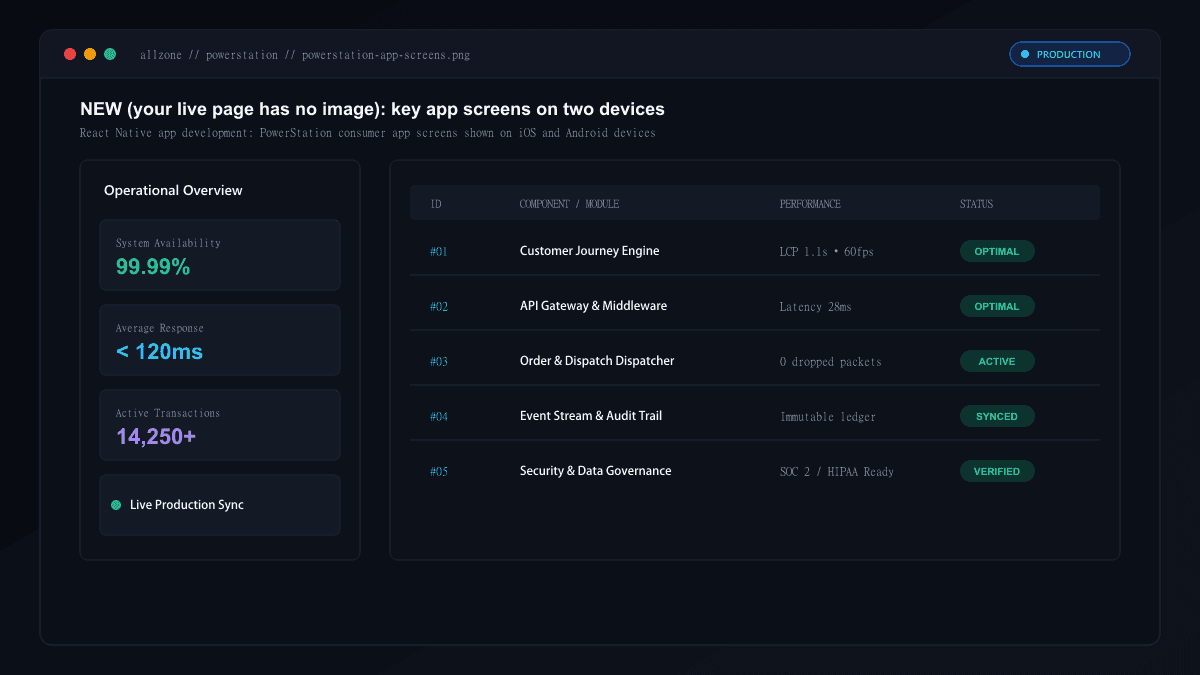
NEW (your live page has no image): key app screens on two devices
React Native app development: PowerStation consumer app screens shown on iOS and Android devices
CAPABILITIES
Related Engineering Services
Explore the engineering services, autonomous agent frameworks, and custom software practices leveraged throughout this engagement.
PORTFOLIO
Related Case Studies
FAQ
Common Questions
Frequently asked technical and operational questions regarding this implementation.
We worked on their React Native product: mobile architecture and implementation, with input on performance and design quality during delivery.
It can, but it takes deliberate work. A shared codebase gives up some platform-level control, so performance and interaction quality have to be checked as the app is built, which is what we did here.
Because changing an approach mid-project is cheap, and discovering a mismatch at launch is not. In this engagement the client adjusted the approach based on our input while the work was underway.
React Native and TypeScript for the app, with Node.js on the backend.
React Native is a cross-platform approach, so one codebase serves both platforms. We’d confirm the details against your product and your performance needs.
Yes. We’d start by reviewing the current architecture, performance and design quality, then agree where we’d contribute.
NEXT STEP
Build something similar
Tell us what your app needs to do and which platforms matter most. We’ll show you how a React Native build would work for your product, and where we’d keep a close eye on performance.