
AI in insurance is the use of machine learning, generative AI and AI agents to speed up claims, underwriting, fraud detection, customer service and distribution. It works best when it supports people rather than replacing their judgment: AI prepares the work, shows its sources and a qualified person makes the decisions that affect customers.
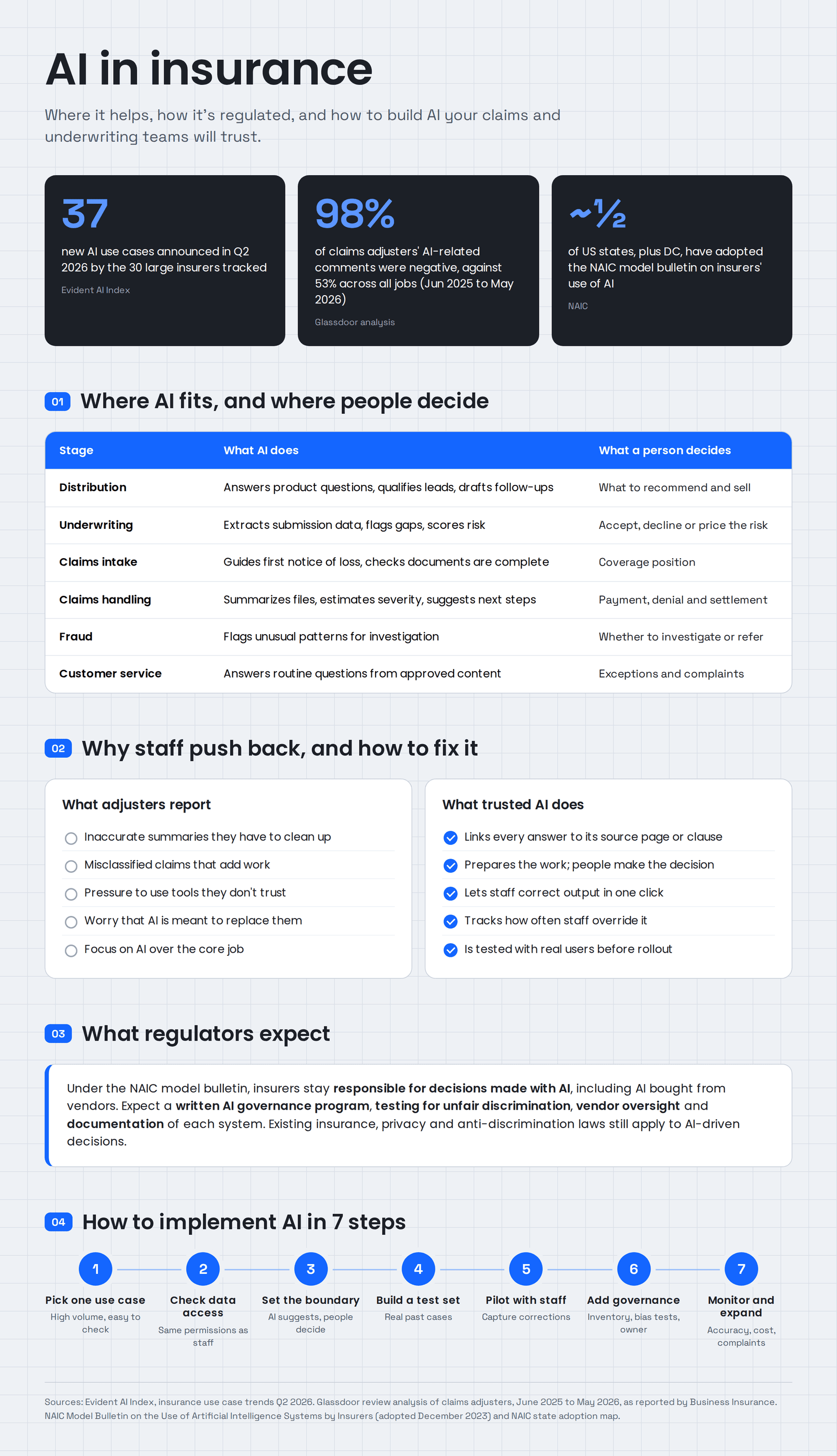
Insurers are moving fast. The 30 insurers tracked by the Evident AI Index announced 37 new AI use cases in the second quarter of 2026 alone, up from 27 the quarter before. But the people closest to these tools are often the most doubtful. This guide covers where AI fits, what it can and can't do, how it's regulated, and how to build AI that your claims and underwriting teams will actually use.
What is AI in insurance?
AI in insurance is software that learns from data or language to help insurers assess risk, handle claims, detect fraud and serve customers. It includes predictive models that score risk, generative AI that reads and writes documents, and AI agents that carry out multi-step tasks across systems, usually with a person approving the outcome.
Insurance has used statistical models for pricing for decades. What's new is that AI can now work with unstructured information, such as claim notes, emails, photos, medical records and policy wording, which makes up much of an insurer's daily work.
AI, machine learning, generative AI and automation: what's the difference?
These terms get mixed up, and the difference matters when you plan a project and when you explain it to a regulator.
| Term | What it is | Insurance example |
|---|---|---|
| Automation | Software that follows fixed rules | Send a renewal reminder 30 days before expiry |
| Machine learning | Models that learn patterns from historical data | Score a claim's likelihood of fraud |
| Generative AI | Models that read and write text, images or code | Summarize a 200-page claim file for an adjuster |
| AI agents | AI that plans and takes steps across systems | Gather documents, check coverage and prepare a claim for review |
A good insurance AI system usually combines all four. Rules handle the predictable steps, models score risk, generative AI handles documents and conversation, and an agent ties the steps together, with a person approving anything that affects a customer.
How is AI used in insurance today?
AI is used in insurance for claims intake and triage, document review, underwriting and pricing support, fraud detection, customer service, and sales support for agents and brokers. According to Evident's tracking of 30 large insurers, most new use cases in 2026 sit in underwriting and pricing, claims management, and sales and distribution.
Here's where AI fits across the insurance value chain, and where people stay in charge.
| Stage | What AI does | What a person decides |
|---|---|---|
| Distribution | Answers product questions, qualifies leads, drafts follow-ups | What to recommend and sell |
| Underwriting | Extracts submission data, flags missing information, scores risk | Whether to accept, decline or price the risk |
| Policy service | Handles routine changes and questions from approved content | Exceptions and complaints |
| Claims intake | Guides first notice of loss (FNOL), checks documents are complete | Coverage position |
| Claims handling | Summarizes files, estimates severity, suggests next steps | Payment, denial and settlement |
| Fraud | Flags unusual patterns for investigation | Whether to investigate or refer |
| Compliance | Checks documents against rules and requirements | Sign-off |
AI in claims processing
AI in claims processing reads first notice of loss reports, photos, invoices and medical records, then sorts, summarizes and routes the claim. Simple, low-value claims can move faster, while complex claims reach an experienced adjuster with the key facts already organized.
Useful claims applications include:
- Guided FNOL in an app, on the web or by phone, so the first report is complete.
- Document classification and extraction from invoices, estimates and reports.
- Claim summaries that turn long files into a short brief with links to the source pages.
- Triage that routes claims by complexity, severity and specialty.
- Next-step suggestions for the adjuster, such as missing documents or inspections.
Automated insurance claims processing can include straight-through processing for very simple claims, where a claim is paid without manual handling. Keep that to narrow, low-risk categories with clear rules, and monitor it closely.
AI in underwriting and pricing
AI in underwriting reads submissions, loss runs and supporting documents, pulls out the data an underwriter needs, checks it against appetite and guidelines, and highlights risks. Underwriters spend less time re-keying data and more time on judgment, especially in commercial and specialty lines where submissions arrive as long, messy documents.
Pricing models are more sensitive. Using external data and algorithms to set rates can raise unfair discrimination concerns, which is why several states now regulate it closely.
Insurance fraud detection
AI helps insurance claim fraud detection by spotting patterns people miss: unusual timing, repeated details across claims, links between parties, or documents that look altered. The model flags a claim for review; it doesn't decide that fraud happened. Special investigation units should always make that call.
The main risk is false positives. A model that flags too many honest claims slows payments and damages trust, so measure precision, not just how many cases it flags.
Customer service and AI agents
AI insurance agents, in the sense of AI assistants rather than licensed human agents, can answer policy questions, take payments, start claims and update details by chat or phone. They work well when they answer only from approved content and the customer's own policy, and hand over to a person with full context when needed.
For phone-heavy service, AI voice agents can handle first-line calls such as FNOL and payment questions, with every call logged.
AI for insurance agents and brokers
AI for insurance brokers and agencies focuses on the admin that eats selling time: summarizing calls, drafting follow-ups, preparing renewal reviews, comparing quotes and filling forms. AI agents for insurance agencies can also contact new leads quickly, which matters because quote requests go cold fast.
Our AI agent development work builds these assistants inside the CRM and tools an agency already uses.
What does generative AI add to insurance?
Generative AI in insurance adds the ability to read, summarize and write the documents that make up most insurance work: policies, submissions, claim files, medical records, emails and letters. It turns long, unstructured files into short, structured briefs and drafts, so staff spend less time reading and typing and more time deciding.
Generative AI use cases in insurance include:
- Answering coverage questions from the actual policy wording.
- Summarizing claim files and medical records for adjusters.
- Extracting data from broker submissions for underwriters.
- Drafting customer letters and emails for a person to review.
- Comparing policy versions and endorsements.
- Checking documents against regulatory or internal requirements.
The big risk is confident but wrong answers, often called hallucinations. The fix is retrieval-augmented generation (RAG), a method where the AI first retrieves the relevant passages from your own documents and then answers using only those passages, with a link to each source. Our RAG development work is built around this.
Why do claims adjusters distrust AI and what does that teach us?
Claims adjusters distrust AI mainly because tools have created extra work: inaccurate summaries, misclassified claims and pressure to use systems they don't trust. In a Glassdoor analysis, 98% of adjusters' AI-related comments between June 2025 and May 2026 were negative, compared with 53% across all jobs.
The same analysis found that among negative reviews with specific complaints, the most common were AI replacing workers, being forced to use AI tools, and companies focusing on AI at the expense of their core business. Adjusters interviewed in follow-up reporting described cleaning up faulty AI summaries and carrying the blame for errors.
Job data adds pressure. Postings for claims adjusters have fallen about 55% from their post-pandemic peak, against about 36% for the wider labor market, though researchers note the data doesn't prove AI is the cause.
The lesson for insurers is practical. AI that staff can't check will be resisted, and AI that's resisted won't deliver results. Build these into every tool:
- Show the source. Every summary or answer links to the page or clause it came from.
- Keep decisions human. AI prepares; adjusters and underwriters decide.
- Make corrections easy. Let staff fix AI output in one click, and use those fixes to improve it.
- Measure errors honestly. Track how often staff override or correct the AI.
- Involve users early. Test with the adjusters and underwriters who will use it before rollout.
- Be clear about the purpose. Say what the tool is for and what it isn't.
Is AI in insurance regulated?
Yes. In the US, insurance AI is regulated mainly by states. About half of US states and the District of Columbia have adopted the NAIC's model bulletin on insurers' use of AI, which expects a written AI governance program, testing for unfair discrimination, vendor oversight and documentation. Some states, such as Colorado, have specific laws on algorithms and external data.
The main rules to know:
- NAIC model bulletin. Adopted by the National Association of Insurance Commissioners on December 4, 2023, the bulletin says insurers remain responsible for decisions made with AI, including AI from vendors. You can check which states have adopted it on the NAIC's adoption map.
- Existing insurance laws still apply. Unfair trade practices, unfair claims settlement and anti-discrimination laws cover decisions whether a person or a model made them.
- State-specific rules. Colorado's law on insurers' use of external consumer data and algorithms requires testing for unfair discrimination, and other states have their own guidance.
- Privacy and data security. State insurance data security laws, federal financial privacy rules and HIPAA for health plans still govern the data AI uses.
- EU AI Act. For insurers operating in Europe, AI used for risk assessment and pricing in life and health insurance is classed as high-risk, with requirements for transparency, human oversight and monitoring.
In practice, that means keeping an inventory of AI systems, documenting what each one does, testing for bias, monitoring results, reviewing vendors and keeping a person accountable for every consequential decision. Confirm your specific obligations with your compliance team or legal counsel.
How to implement AI in an insurance company: 7 steps
To implement AI in an insurance company, choose one high-volume task with a clear measure, check the data and systems it needs, decide what AI may do and what people decide, build with real past cases as a test set, pilot with the staff who do the work, set up governance and monitoring, then expand to the next use case.
- Pick one use case with a clear measure. Good first choices are claim file summaries, submission data extraction, FNOL intake or policy Q&A for service staff. Write down the measure: handling time, backlog, accuracy or customer wait time.
- Check data and system access. Confirm the AI can reach the documents and records it needs through your claims, policy and document systems, with access rules that match each user's permissions.
- Set the boundary. Decide which steps AI handles, which it only suggests, and which always need a person. Anything that affects coverage, payment or price stays with qualified staff.
- Build a test set from real cases. Collect a few hundred past examples with the correct outcome, removing personal data where needed. Every version of the tool is scored against this set before anyone uses it.
- Pilot with the people who do the work. Run the tool alongside adjusters or underwriters, with their corrections captured. If they don't trust it in the pilot, fix it before rollout.
- Put governance in place. Record the system in your AI inventory, document its purpose and data, test for bias where it affects customers, review vendors and assign an accountable owner.
- Monitor, then expand. Track accuracy, override rates, cost and complaints in production. Once the first use case is stable, reuse the same data connections and controls for the next.
The biggest mistake is starting with the most ambitious idea, such as fully automated claims decisions. Start where AI saves time on reading and typing, and where a person can easily check the result.
Our AI integration services follow this approach to connect AI with policy, claims and document systems, with permissions, logging and human approval built in.
Real example: a claims assistant that cites the policy
Our Insurance Claims RAG Assistant shows what trustworthy insurance AI looks like in practice. It answers claims professionals' coverage questions in plain language, and every answer links to the exact policy clause it came from, so the person checks the source instead of trusting a summary.
The problem: claims professionals searched scattered files to answer coverage questions.
What we built: the Insurance Claims RAG Assistant works over policy and claims documentation, built on PostgreSQL with pgvector. A question such as whether water damage from a burst pipe is covered gets a plain-language answer with each point footnoted to the policy wording, claims handbook or endorsement it came from.
Why it matters: this design answers the adjusters' main complaint directly. The AI doesn't make the coverage decision; it gathers the evidence and shows its work. Retrieval quality is monitored in production, so problems are caught early.
The same pattern works elsewhere. LabelRX, a compliance tool we built for product labels, lets a specialist check every AI finding against the specific requirement behind it. For agencies, Zonified Connect uses voice and SMS agents to contact new leads and book appointments, and stops automating as soon as a person takes over.
What data and systems does insurance AI need?
Insurance AI needs access to the right documents and records, such as policy wordings, claim files, submissions and customer history, through secure connections to policy administration, claims, CRM and document systems. The data must be reasonably complete, labeled by line of business and protected by the same access rules staff follow.
Before building, check these:
- Document quality. Are policy forms, endorsements and claim files stored digitally and searchable, or locked in scanned images?
- Versioning. Can the system tell which policy form and endorsement applied on the date of loss?
- Access rules. Can AI respect who may see what, such as medical records or special investigation files?
- System connections. Do your core systems have APIs, or will an integration layer be needed?
- History for testing. Do you have past cases with known outcomes to build a test set?
If data is scattered across older systems, a short data project usually comes first. Our data and analytics team prepares the pipelines and data quality that AI depends on.
Will AI replace insurance jobs?
AI is changing insurance jobs more than replacing them outright, but the effect is real, especially at entry level. Routine reading, data entry and first drafts are being automated, while decisions on coverage, complex claims, underwriting judgment and customer relationships still need experienced people.
Two things are true at once. Insurers see productivity gains when AI handles repetitive work. And workers are worried: hiring for junior claims roles has fallen sharply since early 2024, although researchers say many factors, not only AI, are behind it.
The insurers that handle this well tend to:
- Use AI to remove repetitive work, not to remove judgment.
- Keep training paths open for junior staff, since automation can remove the simple work people used to learn on.
- Involve adjusters and underwriters in design and testing.
- Be honest about goals and measure outcomes for customers, not just cost.
How do you choose an AI partner for insurance?
Choose an AI partner for insurance that understands claims and underwriting workflows, builds source-grounded AI rather than open-ended chatbots, integrates with your core systems, supports governance and documentation for regulators, and gives you ownership of the code, prompts and test data.
Ask these questions:
- Have you built AI over insurance or other regulated documents?
- Does every AI answer link to its source?
- How do you keep coverage, payment and pricing decisions with people?
- How do you test accuracy before launch and monitor it after?
- Can the AI respect our user permissions in code, not just in prompts?
- Will you help document the system for our AI governance program and regulators?
- Can you integrate with our policy, claims and document systems?
- Do we own the code, prompts, test sets and cloud accounts?
- How do you protect against prompt injection from documents and emails?
You can see more of our insurance work on our insurance software page.
Start with one trusted use case
The insurers getting value from AI aren't doing everything at once. They pick one task, build AI their staff can check, and expand from there.
AllZone Technologies builds AI for insurers, agencies and insurtech teams, from claims assistants that cite the policy to voice agents and integrations with core systems. See our AI integration services or contact us to talk through your first use case.