AI Agent Development Services: What You Get, What It Costs and How to Choose a Partner
AI agent development services design, build and run AI systems that complete multi-step work inside your business tools, not just answer questions. A good provider scopes one workflow, connects the agent to your systems with tight permissions, tests it against real cases, and keeps it reliable after launch. Cost depends mostly on integrations, data condition and how much the agent is allowed to do on its own.
If you already know the workflow you want automated, talk to our agentic AI team. If you are still comparing options, this guide covers what you should get, what moves the price and how to tell a real agent builder from a reseller.
What are AI agent development services?
AI agent development services are the engineering work needed to put an AI agent into production. An AI agent is software that uses a language model to plan steps, call tools and complete a task toward a goal.
In practice, the service covers:
- Choosing a workflow worth automating.
- Designing how the agent reasons, which tools it may use and where a person must approve.
- Connecting it to systems like your CRM, ERP, help desk, data warehouse or email.
- Testing it against real cases before anyone relies on it.
- Deploying, monitoring and improving it after launch.
- The model is the easy part. Most of the work, and nearly all of the risk, sits in the integrations, permissions and testing around it.
AI agents vs chatbots vs automation
Buyers often get quoted for an “AI agent” that is really a chatbot or a rules-based workflow with a model added. Knowing the difference protects your budget.
| Chatbot / assistant | Rule-based automation | AI agent | |
|---|---|---|---|
| What it does | Answers questions | Runs fixed steps | Plans steps and takes actions toward a goal |
| Handles unstructured input | Yes | Poorly | Yes |
| Takes action in your systems | Rarely | Yes, on fixed rules | Yes, chosen case by case |
| Adapts when a case differs | Within the conversation | No | Yes, within its permissions |
| Best for | Questions and lookups | Predictable, repeated processes | Varied, multi-step work across systems |
If every case follows the same rules, plain automation is cheaper and more reliable. Agents earn their cost when input is messy and each case needs judgment.
What AI agent development services include
A complete service covers eight pieces of work. If a proposal skips several of them, you are buying a demo.
- Discovery and use-case selection. Mapping the workflow with the people who do it, measuring where time goes, and agreeing what a correct result looks like.
- Agent architecture. Deciding between one agent and several, which steps need a model and which need plain code, and how the agent recovers when a step fails.
- Tool and system integration. Connecting the agent to your software through APIs or Model Context Protocol (MCP) servers, with each tool limited to what the job needs.
- Knowledge and data access. Giving the agent the documents and records it needs, usually through retrieval (RAG development), while respecting who may see what.
- Guardrails and human-in-the-loop. Defining what the agent may do alone, what needs approval and what it may never do, with every action logged.
- Evaluation. Building a test set from real cases, scoring the agent, and re-running it whenever the prompt, model or data changes.
- Deployment and AgentOps. Hosting, tracing, cost monitoring, alerts and rollback.
- Handover. Documentation and training so your team can run and extend the agent.
Types of AI agents businesses build
| Agent type | What it does | Example from our work |
|---|---|---|
| Department or operations agents | Rebuild recurring reports, forecasts and analyses from company data | Manufacturing Agent Platform |
| Customer support agents | Triage, answer and resolve tickets, handing off to a person when needed | Customer Support Agent Platform |
| Sales and lead agents | Contact new leads, qualify them and book appointments | Zonified Connect |
| Software engineering agents | Turn a requirement into tested, reviewable code | Agentic Engineering Platform |
| Content and marketing agents | Plan, draft, publish and track content | Zonified Rank |
| Recruitment agents | Read applications and score them against a role’s criteria | AI Resume Screening |
| Knowledge agents | Answer questions from documents with the source attached | Insurance Claims RAG Assistant |
Business problems AI agents solve (with real examples)
Buyers rarely search for “agents.” They search for the problem. Here are four we have built agents for.
“Every department rebuilds the same reports by hand”
Problem: staff spend hours each week pulling data, rebuilding analyses and answering the same internal questions. Process knowledge lives in a few people’s heads.
Solution: scoped agents per department, each connected to the company’s data and limited to its own recurring work.
Real example: we built a Manufacturing Agent Platform for a precision manufacturer with no in-house AI team. It runs nine department agents made up of ninety narrowly scoped sub-agents, on top of the company’s data warehouse and Microsoft 365. Each sub-agent was validated by the staff who use it, and the client’s team maintains the platform after handover.
“New leads go cold before anyone calls them”
Problem: leads arrive evenings and weekends, wait in an inbox, and book with whoever responds first.
Solution: voice and SMS agents that contact every lead on the business’s own sequence.
Real example:Zonified Connect, our own AI voice CRM, works each new lead from first text to a confirmed appointment. It books only after the lead confirms a time, and automation stops once a person takes over the conversation. For phone-first businesses, see AI voice agent development.
“Support volume grows faster than the team”
Problem: tickets pile up, simple questions crowd out complex ones, and response times slip.
Solution: a multi-agent setup that triages, resolves what it safely can and routes the rest with full context.
Real example: our Customer Support Agent Platform carries a conversation from triage to resolution while keeping a clear path to a person at every step.
“Our engineering team can’t ship fast enough”
Problem: small changes queue behind bigger work, and reviews are slow because the evidence isn’t attached.
Solution: specialized agents that plan, implement, test and review a change before a human sees it.
Real example: our Agentic Engineering Platform turns a requirement into a pull request with its plan, tests, review findings and documentation attached, so reviewers judge the change on evidence.
Is your workflow ready for an AI agent?
Run your candidate workflow through these questions. Four or more “yes” answers usually means it is worth scoping.
- It happens often: daily or weekly, not once a quarter.
- It takes real staff time, and people would rather not do it.
- The input is messy: emails, PDFs, calls, free-text tickets.
- It touches two or more systems.
- A good result can be described and checked.
- The data the agent needs exists, even if it is scattered.
- A mistake early on can be caught before it causes harm.
- Someone will own the agent after launch.
If the work follows the same fixed rules every time, start with ordinary automation instead. If people mainly need answers from documents, a retrieval assistant may be all you need.
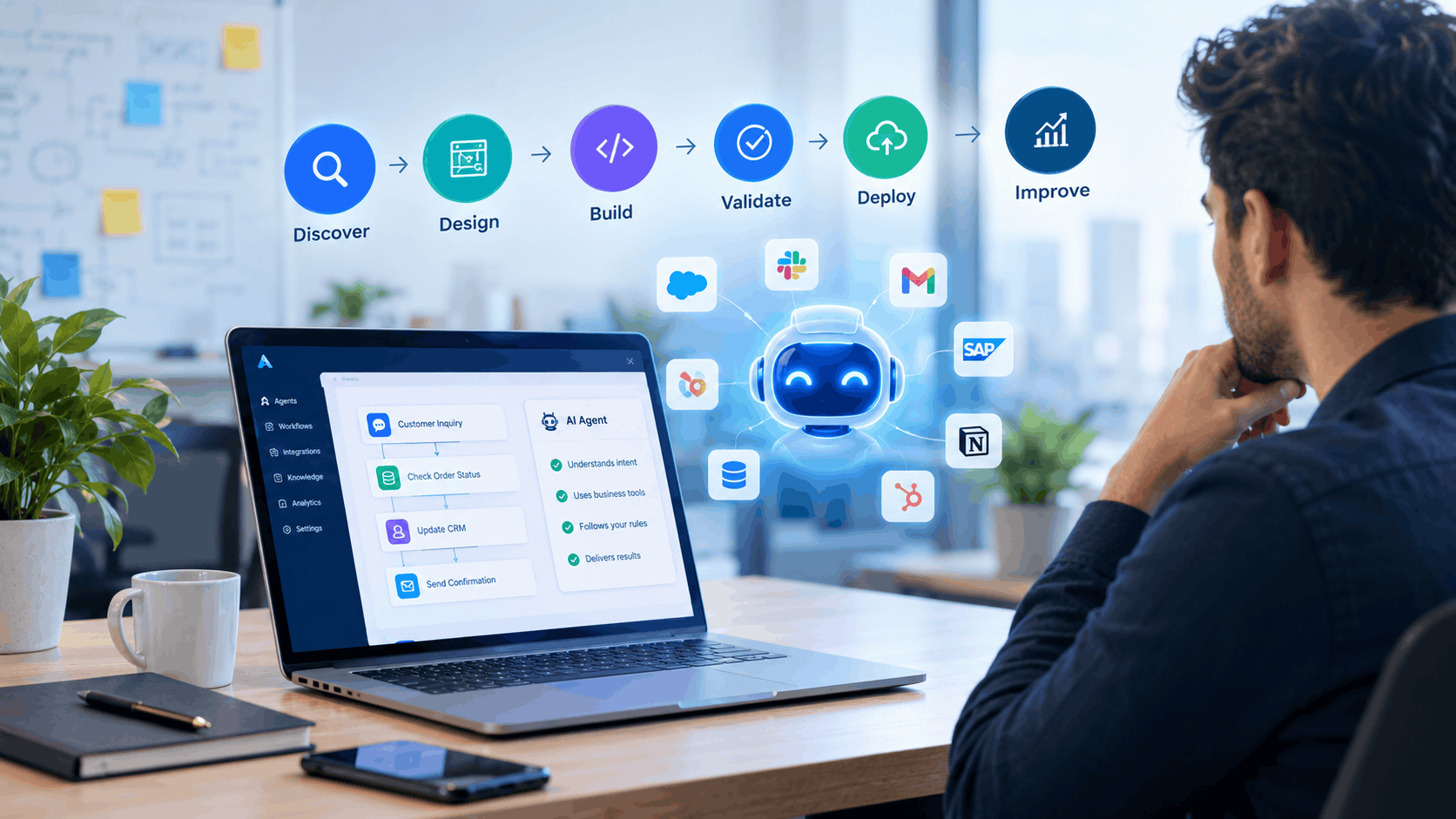
How an AI agent development project runs
Most successful projects follow six stages. The key habit is starting narrow: one agent, one workflow, real data.
- Discover. Sit with the people who do the work, map the workflow and its data, and agree what a correct result looks like.
- Architect. Choose the agent pattern, models, tools, permissions and approval points, and write down why.
- Build. Build the data pipeline, tools and agent, with a test set started on day one.
- Validate. Staff test the agent against real scenarios. Failures feed back into prompts, tools or data until it is usable in daily work.
- Deploy. Release with monitoring, role-based access, cost limits and documentation.
- Evolve. Track quality in production, add use cases, and re-test before switching to a new model.
The stage most teams skip is Validate. An agent that passes a demo but was never tested on real cases is the one that gets switched off three months later.
What drives AI agent development cost
Any fixed price quoted before scoping is a guess. What you can control is scope, and scope is what moves the cost. If you want a fuller budgeting view, see our AI development cost guide.
Build cost drivers
| Driver | Lower cost | Higher cost |
|---|---|---|
| Scope | One defined workflow | “Add AI across operations” |
| Integrations | One or two systems with clean APIs | Many systems, legacy software, no APIs |
| Data condition | Digital, organized, current | Scanned files, duplicates, scattered sources |
| Autonomy | Read-only, drafts for review | Acts on its own in live systems |
| Number of agents | One agent | Several coordinating agents |
| Compliance | Internal, low-risk data | Health, financial or regulated data |
| Quality bar | Internal tool, occasional misses tolerated | Customer-facing, errors are costly |
Running cost drivers
- Model usage. Hosted models charge per token, and agents use more tokens than chatbots because they plan and call tools in loops.
- Infrastructure. Hosting, vector databases, logging and tracing.
- Third-party services. Telephony and speech for voice agents, plus any paid APIs the agent calls.
- Maintenance. Updating data and prompts, re-running tests and checking new model versions.
Tip: ask every provider to estimate your monthly running cost at expected volume. A proposal that can’t do this hasn’t thought about production.
Three ways to budget
- Assessment or proof of concept. A small build on your real data to prove accuracy and value before committing more.
- Production build. A fixed scope delivered end to end, with integrations, evaluation, guardrails and deployment.
- Dedicated team. Monthly capacity for an ongoing agent roadmap.
Build, buy or use a platform agent?
You have three routes, and many companies use more than one.
| Route | Good fit when | Watch out for |
|---|---|---|
| Buy an off-the-shelf AI tool | The need is common (meeting notes, generic writing) and the vendor’s data terms are acceptable | Little control over behavior, data location or integrations |
| Use agents built into your platform (CRM, help desk, Microsoft 365) | Most of the work lives inside that one platform | Agents stop at the platform’s edge, and pricing scales with seats or usage |
| Build custom agents | The value depends on your own data, several systems or your own process | Needs a clear owner, a test set and ongoing maintenance |
A common pattern: buy for generic tasks, use platform agents where one system holds all the work, and build custom where your process is the product.
How to choose an AI agent development company
The market is crowded with rebranded chatbots. Gartner has warned about “agent washing,” estimating that only about 130 of the thousands of agentic AI vendors are real, and predicting that over 40% of agentic AI projects will be canceled by the end of 2027. Choosing the right partner is how you stay out of that 40%.
Checklist
- Published case studies showing the problem, what was built and what runs today.
- Agents in production that take actions, not only chatbots.
- A written evaluation plan built from your real cases.
- Clear answers on permissions, logging and human approval.
- Software, data and cloud engineers on the same team, not AI alone.
- A realistic estimate of monthly running costs.
- You own the code, prompts, test sets, infrastructure and accounts.
- Documentation and training so your team can maintain the agent.
Questions to ask an AI agent developer
- Which agent have you shipped that people use every day? What broke after launch?
- What will this agent be allowed to do without approval?
- How will you measure whether it is right, before and after launch?
- What happens when a tool call fails or the data isn’t there?
- How do you stop users or documents from manipulating the agent (prompt injection)?
- What will it cost us to run each month?
- What will we own when the project ends?
Red flags
- Promises of “100% accuracy” or “zero errors.”
- No evaluation plan, or “we’ll test it with your users after launch.”
- Broad write access to email, CRM or payments from day one.
- Accounts and API keys created under the provider’s name instead of yours.
- A multi-agent “swarm” proposed before one agent has been proven.
- Vague answers about who will actually write the code.
In-house, partner or dedicated team?
| Option | Strengths | Watch out for |
|---|---|---|
| In-house team | Deep product knowledge, long-term ownership | Slow hiring; one person rarely covers data, backend, security and evaluation |
| Freelancer | Fast start on a small, clear task | Key-person risk and thin documentation |
| AI agent development partner | Mixed skills and a delivery process from day one | Make sure you own everything that gets built |
| Dedicated team | Adds agent skills inside your own process | You still need an internal owner |
Many companies combine options: a partner builds version one and trains the internal team that runs it afterward.