How to Build White Label Software: Architecture, Costs and Partner Guide
To build white label software, you design one product that many companies can run under their own brand: separate data for each customer, configurable logos, colors, domains and emails, and a reseller layer for billing and accounts. These must be planned into the architecture from the start, because adding them later usually means a rebuild.
This guide is for agency owners, SaaS founders and CTOs. It explains the different white label models, what the architecture really includes, the build steps, costs, code ownership and how to choose a development partner.
What is white label software development?
White label software development is the process of building software that another company sells or delivers under its own brand. The developer stays invisible to the end customer. It covers two things: building a rebrandable product that many resellers license, and acting as a hidden development team that builds client projects under an agency's name.
The two meanings get mixed up all the time, and they lead to very different projects:
- A rebrandable product. You build one platform, such as a CRM, booking system or reporting dashboard, and many companies run it under their own brand. This is a product architecture problem.
- A hidden development partner. An agency sells a custom app to its client, and a partner builds it behind the scenes under the agency's name. This is a delivery and trust problem.
This guide focuses mainly on the first, because that's where projects most often go wrong technically. The partner model gets its own section further down.
White label vs private label vs custom software
White label software is one product rebranded by many sellers. Private label software is built or adapted for a single seller who gets exclusive rights to it. Custom software is built for one company's own use, not for resale. The difference is who can sell it and how many brands share the same core.
| White label | Private label | Custom software | |
|---|---|---|---|
| Who sells it | Many resellers, each under their own brand | One seller, exclusively | Nobody; the company uses it |
| Shared core | Yes, one codebase for all brands | Often adapted from a base product | No |
| Customization | Branding plus configured features | Deeper changes for one buyer | Fully built to spec |
| Cost to each brand | Lowest | Medium | Highest |
| Differentiation | Low unless you add services on top | Medium | High |
| Typical buyer | Agencies, consultants, resellers | A company launching its "own" product | A company solving its own problem |
In practice the lines blur. Many "white label" deals include exclusive features for a large reseller, which edges toward private label.
How does white label software work?
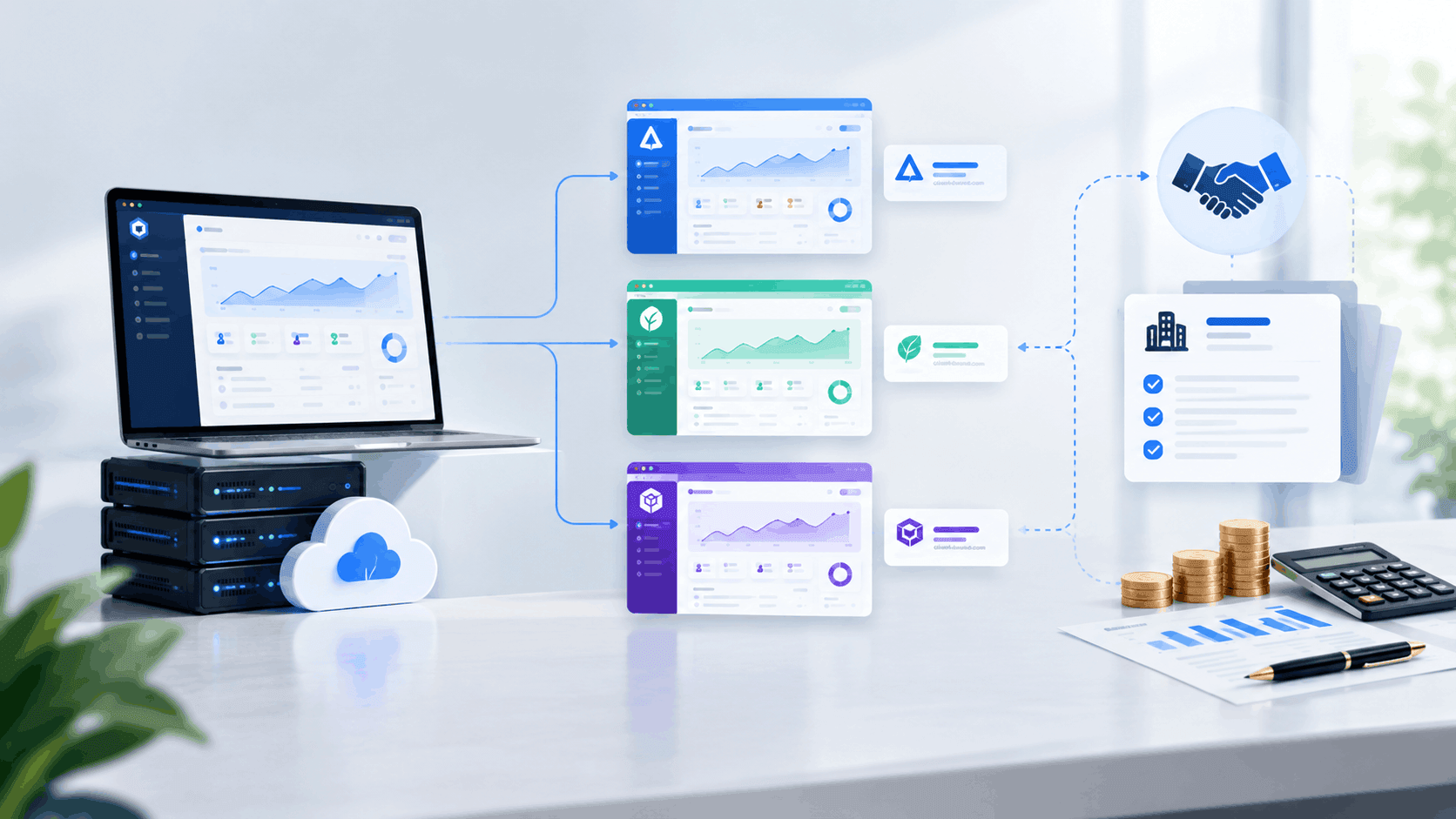
White label software works through a provider, a reseller and an end client. The provider builds and hosts the platform. The reseller licenses it, applies its own brand and pricing, and sells it. The end client logs in and sees only the reseller's brand. The provider keeps maintaining the core for every reseller at once.
A typical flow looks like this:
- The provider builds the platform with branding and configuration built in.
- A reseller signs up, often on a monthly fee or revenue share.
- The reseller uploads its logo, colors and domain, and sets its own prices.
- The reseller creates accounts for its clients, or clients sign up through the reseller's site.
- Clients use the product as if the reseller built it.
- The provider ships updates, which reach every reseller at the same time.
That last point is the real value of the model. One fix or new feature serves every brand. It's also the real risk: one bad release breaks every brand at once.
Which white label model do you actually need?
You need a ready-made white label tool if you want to resell a common product fast. You need a custom white label platform if you want to own the product and its recurring revenue. You need a white label development partner if you sell custom projects and need hidden delivery capacity.
| Your situation | Model that fits | What you're really buying |
|---|---|---|
| You want to add a reporting or social tool to your agency services this month | Resell a ready-made platform | Speed; you accept their roadmap |
| You have a niche workflow and want your own SaaS product others can resell | Build a custom white label platform | Ownership and long-term margin |
| You already sell a product and want partners to resell it under their brands | Add white label features to your product | A new sales channel |
| You sell custom websites or apps but lack developers | Hire a white label development partner | Capacity under your name |
Many agencies start with the first model, outgrow it when the vendor's limits block their clients, then move to the second. If that's your path, build the second with that move in mind.
Who builds white label software, and why?
Three groups build white label software: SaaS companies that want resellers to sell for them, agencies that want a product with recurring revenue instead of one-off projects, and industry specialists who package their know-how as software. Each wants growth without building a large sales or development team.
- SaaS companies add a white label tier so agencies and consultants become a sales channel. Each reseller brings its own clients.
- Agencies turn a service they deliver again and again, such as reporting, onboarding or lead follow-up, into a product they sell monthly under their brand.
- Industry specialists such as insurance, healthcare or education consultants package their workflow as a platform their peers can rebrand.
A useful test before building: are there at least [placeholder: number] companies who would pay to run this under their own name? If you can't name them, start with a pilot for one reseller.
What does real white label architecture include?
Real white label architecture includes multi-tenancy so each customer's data is isolated, a branding and configuration layer, custom domains and email, a reseller hierarchy with its own billing, per-tenant feature control and, often, branded mobile apps. A logo upload screen alone is not white label software.
Multi-tenancy: one platform, many brands
Multi-tenancy means one running platform serves many customers (tenants), with each tenant's data kept separate. It's the base of any serious white label product. The three common patterns are:
| Pattern | How data is separated | Good for | Trade-off |
|---|---|---|---|
| Shared database, tenant ID on every row | Code filters every query by tenant | Many small tenants, low cost | One missed filter can leak data |
| Schema per tenant | Each tenant gets its own schema in one database | Moderate tenant count, cleaner isolation | Migrations run per schema |
| Database per tenant | Each tenant gets its own database | Regulated data, large resellers | Highest hosting and ops cost |
Many platforms mix them: shared database for small clients, a dedicated database for a large reseller who demands it. Whatever you choose, tenant isolation should be enforced centrally in the data layer, not left to each developer to remember.
Branding, domains and email
Branding is more than a logo. A tenant's brand should control:
- Logo, favicon, colors and fonts, applied through themes rather than hard-coded styles.
- Product name in page titles, emails, invoices, PDFs and error pages.
- A custom domain such as app.resellerbrand.com, with automatic SSL certificates.
- Email sent from the reseller's own domain, with the right SPF, DKIM and DMARC records so it doesn't land in spam.
- Support links, terms and privacy policy URLs.
The principle is configuration, not code. A new reseller should be live by filling in settings, without a developer touching the codebase.
Reseller hierarchy and billing
Most white label platforms need three levels: the platform owner, the reseller and the reseller's clients. Each level needs its own admin view and permissions. The platform owner manages resellers, each reseller manages its clients, and clients manage their own users.
Billing usually follows the same tree. The platform owner bills resellers (per seat, per client or flat fee), and resellers bill their clients at their own prices, often through their own payment account. This is called rebilling, and it's one of the features resellers ask about first.
White label mobile apps
A web app can serve many brands from one deployment. A mobile app usually can't. Each reseller who wants "their own app" in the App Store and Google Play typically needs a separately built and published app with its own name, icon, bundle ID and store listing [verify current Apple and Google rules on templated and white-labeled apps].
The practical answer is a build pipeline that produces each branded app from one codebase and one config file per brand. Our mobile application work covers both native and cross-platform builds like these.
Where vendor branding usually leaks
Resellers lose trust fast when the provider's name shows up. Check every one of these before launch:
- ☐ Transactional emails and their sender address
- ☐ PDF exports, invoices and reports
- ☐ Error pages, maintenance pages and 404s
- ☐ Browser tab titles and favicons
- ☐ OAuth consent screens ("Allow [provider] to access your Google account")
- ☐ SMS sender IDs and voice caller IDs
- ☐ Help docs, chat widgets and status pages
- ☐ App store listings and push notification names
- ☐ Code comments or headers visible in the browser
How to build white label software in 8 steps
To build white label software, validate demand with real resellers, define what each brand can change, choose a tenancy model, build a configuration-driven branding layer, add the reseller hierarchy and billing, automate onboarding, test isolation and branding for every tenant, then launch with one pilot reseller before opening to more.
- Validate with real resellers. Talk to five to ten companies who would sell it. Ask what they'd charge, what their clients need and what would stop them switching. Their answers define your feature list.
- Define the configuration boundary. Write down what a reseller can change (brand, domain, pricing, enabled features) and what stays fixed (core workflow, data model). A clear boundary stops one big reseller from turning your product into a custom project.
- Choose the tenancy model. Pick shared database, schema per tenant or database per tenant based on tenant count, data sensitivity and budget. This is the hardest decision to reverse later.
- Build branding as configuration. Themes, names, domains, email senders and legal links come from tenant settings, never from code. Test with two very different brands from week one.
- Add the reseller hierarchy and billing. Build the platform, reseller and client levels with separate permissions, then plan billing: how you charge resellers and whether they rebill their clients through you.
- Automate onboarding. A new reseller should go from signup to a branded, working instance without a developer. Domain verification, SSL and email records should be guided or automatic.
- Test isolation and branding for every tenant. Automated tests should confirm that tenant A can never see tenant B's data, and that no provider branding appears in any email, PDF or page. Run them on every release, because one update reaches every brand.
- Launch with a pilot reseller. One committed reseller using it with real clients will surface the gaps no internal test finds. Fix those, then open signups.
Steps 3 and 7 matter most. A tenancy model chosen in a hurry, or a release that skips isolation tests, causes the problems resellers never forgive: one client seeing another's data.
Should you build, buy or partner?
Buy a ready-made white label tool when speed matters and the product is common. Build a custom platform when the workflow is your advantage and you want to own the revenue. Use a white label development partner when you sell custom projects and need capacity you can't hire fast enough.
| Factor | Buy (resell a platform) | Build (custom white label product) | Partner (hidden dev team) |
|---|---|---|---|
| Time to first sale | Days to weeks | Months [verify typical range] | Depends on each project |
| Upfront cost | Low, monthly fee | High | Per project or per month |
| Control of roadmap | None | Full | Full, per client project |
| Differentiation | Low; competitors resell the same tool | High | High |
| Who owns the code | The vendor | You (if the contract says so) | You (if the contract says so) |
| Main risk | Vendor raises prices or shuts down | Building something resellers don't buy | Partner quality or confidentiality slips |
A common middle path: resell a ready-made tool to learn what clients want, then build your own platform once you know.
Real and illustrative examples
The best way to see how white label design works is through concrete projects. One example below is a real platform we built; the others are illustrative scenarios based on common requests, labeled as such.
Real project: a configuration-driven platform (SparkUp AI)
SparkUp AI is an AI workflow automation marketplace of ready-made tools, with a drag-and-drop builder for assembling new ones without code. It was built with React, TypeScript, .NET and Azure.
The design choice that matters for white label work: a new automation tool reaches the catalogue without a bespoke frontend build, because the configuration adapts to the tool rather than the other way round. That same principle, settings instead of code changes, is what lets a white label product onboard a new brand without a developer.
Illustrative: an agency turns a repeated service into a product
Illustrative example. A marketing agency builds the same lead follow-up setup for every client. It commissions a white label platform with a shared database and tenant IDs, its own branding by default, and a reseller tier so partner agencies can sell it too. Each client logs into a portal on the agency's domain. The agency moves part of its revenue from one-off setup fees to monthly subscriptions.
Illustrative: a SaaS company opens a reseller channel
Illustrative example. A scheduling SaaS gets requests from consultants who want to offer it under their own names. Instead of a full rebuild, the team adds a branding layer, custom domains, branded email and a reseller admin. The hardest part turns out to be email deliverability from hundreds of reseller domains, not the theming.
Illustrative: an industry specialist with regulated data
Illustrative example. A healthcare consultancy wants a patient intake platform clinics can brand. Because the data is regulated, each clinic gets its own database, and the reseller layer only shows billing and usage, never patient records. Hosting costs more, but the compliance review becomes far simpler. Our cloud and DevOps team usually handles per-tenant infrastructure like this.
Who owns the code and the client data?
In white label development, the contract decides who owns the code. When you commission a custom white label platform, insist on full ownership of the source code, infrastructure accounts and documentation. When you resell a vendor's platform, the vendor owns the code and you license it. Client data should belong to the client in every case.
Check these points before signing:
- IP assignment: the contract states that all code, designs and documentation transfer to you on payment.
- Repository and cloud accounts: they sit in your organization, not the partner's.
- Confidentiality: an NDA that covers your clients' names and data, and bars the partner from contacting them.
- Data processing terms: who can access end-client data, where it's stored and how it's deleted when a tenant leaves.
- Exit plan: you can hand every file to another developer without the original partner's help.
White label software itself is legal and common. The legal risks sit in the contracts: licensing terms, IP ownership, data protection and any claims you make about who built the product. Have a lawyer review them; this guide isn't legal advice.
How much does white label software development cost?
White label software development cost depends on the number of features, the tenancy model, how much branding resellers can control, billing and reseller tiers, mobile apps per brand, integrations and compliance needs. Reselling a ready-made tool costs a monthly fee. Building your own rebrandable platform is a larger upfront investment plus hosting and maintenance.
| Cost driver | Lower cost | Higher cost |
|---|---|---|
| Scope | One focused workflow | Full suite (CRM, billing, reporting, messaging) |
| Tenancy | Shared database | Database per tenant |
| Branding depth | Logo, colors, domain | Full theming, branded email, PDFs, SMS, voice |
| Reseller layer | Single level | Platform, reseller and client levels with rebilling |
| Mobile | Web only, responsive | Separate branded app per reseller |
| Integrations | A few standard APIs | Many third-party and legacy systems |
| Compliance | Non-sensitive data | Regulated data (health, finance, insurance) |
Typical ranges: focused white label MVP [placeholder: $ range], full multi-tenant platform [placeholder: $ range], monthly hosting and maintenance [placeholder: $ range]. Use figures from our own recent proposals only.
How long does it take?
A focused white label MVP with one workflow, basic branding and a single reseller level typically takes [placeholder: weeks]. A full platform with a reseller hierarchy, rebilling and branded mobile apps takes longer and is best released in phases. Branding leaks and email deliverability are the issues that most often delay launch.
How to choose a white label development partner
Choose a white label development partner who has built multi-tenant products before, signs an NDA and full IP assignment, works in your repositories, keeps the same developers on your project, never contacts your clients, and can explain how they test tenant isolation. Treat vague answers on ownership as a deal-breaker.
Ask these on your first call:
- ☐ Have you built a multi-tenant platform? Which tenancy model did you choose, and why?
- ☐ Will the developers we meet be the ones doing the work?
- ☐ Do we own all code, designs and accounts from day one?
- ☐ Will you sign an NDA covering our clients, and agree never to contact them?
- ☐ Do you work in our repository and our cloud account?
- ☐ How do you test that one tenant can never see another's data?
- ☐ How do you check for provider branding leaks before release?
- ☐ Can you work as a fixed-scope project or as a dedicated team?
- ☐ What happens if we move maintenance to another team later?
If you need capacity rather than a fixed project, a dedicated team that works inside your process is often the better fit for white label delivery.
Common mistakes to avoid
The most common white label mistakes are treating branding as a logo upload, picking a tenancy model without thinking about data sensitivity, letting one large reseller turn the product into a custom build, skipping isolation tests and ignoring email deliverability. Most are cheap to avoid early and expensive to fix later.
- Hard-coded branding. Every new reseller then needs a developer.
- No configuration boundary. One big reseller's requests fork your codebase.
- Tenant filtering left to each query. Sooner or later, someone forgets one.
- Email from a shared domain. Messages land in spam or reveal the provider.
- No pilot reseller. You find the gaps after you've sold to twenty.
- Unclear contracts. Disputes over code, data or client contact come up at the worst time.
- Adding AI as an afterthought. If you plan AI features, design tenant-aware data access for them early; our AI integration services cover this for multi-tenant products.