Understanding Agentic AI: The Evolution Beyond Traditional Algorithmic Trading
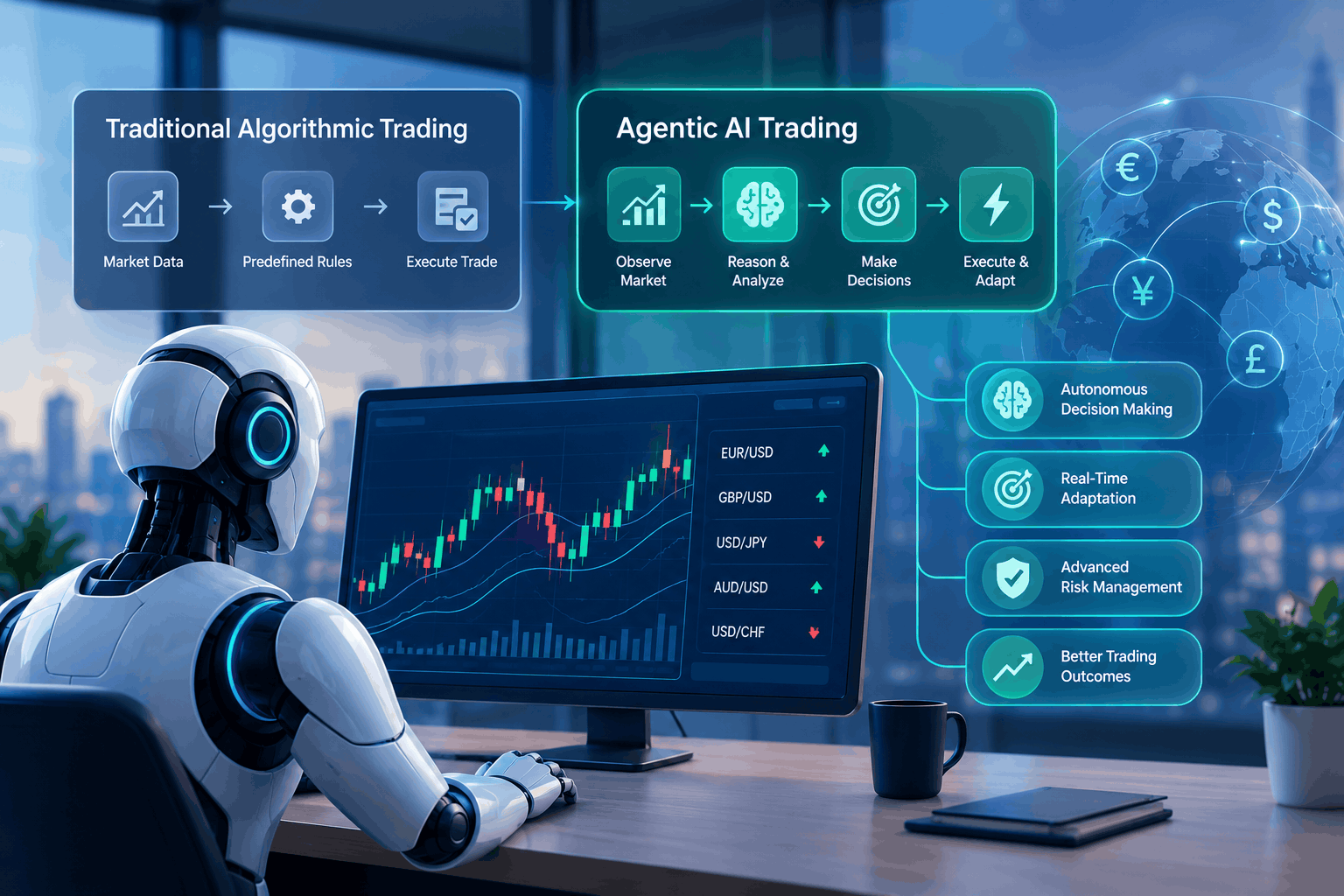
Agentic AI represents a fundamental shift in how automated systems operate within financial markets. Unlike traditional algorithmic trading systems that execute predetermined rules based on static market conditions, agentic AI systems possess autonomous decision-making capabilities that adapt, learn, and respond to dynamic market environments in real time.
Key Takeaways
- Traditional rule-based trading systems follow a linear execution model: if price crosses moving average, execute trade.
- These systems are reactive, bound by the logic their developers encoded.
- They observe market data, evaluate multiple competing objectives simultaneously, and make contextual decisions that weren't explicitly programmed into their instruction set.
- The Architecture Difference Traditional algorithmic trading relies on hardcoded conditional logic and backtested parameters.
The core distinction lies in agency itself. Traditional rule-based trading systems follow a linear execution model: if price crosses moving average, execute trade. If volatility exceeds threshold, reduce position size. These systems are reactive, bound by the logic their developers encoded. Agentic AI systems, by contrast, operate with genuine autonomy. They observe market data, evaluate multiple competing objectives simultaneously, and make contextual decisions that weren't explicitly programmed into their instruction set.
The Architecture Difference
Traditional algorithmic trading relies on hardcoded conditional logic and backtested parameters. A system might contain hundreds of if-then statements, each triggering specific actions. When market conditions fall outside the anticipated range, these systems often fail or produce suboptimal results because they lack the flexibility to recontextualize their approach.
Agentic AI systems employ reinforcement learning, multi-agent frameworks, and continuous optimization loops. They maintain internal models of market dynamics, assess risk across multiple dimensions simultaneously, and adjust their strategies based on observed outcomes. This represents a qualitative leap beyond traditional automation.
Practical Implications for Forex Trading
In forex markets, where currency pairs respond to geopolitical events, central bank decisions, and macroeconomic data releases, agentic AI demonstrates measurable advantages. These systems can:
- Recognize emerging market regimes and shift trading approaches without human intervention
- Manage correlated risk across multiple currency pairs by understanding interdependencies rather than applying static correlation matrices
- Optimize execution timing by modeling order flow dynamics and predicting short-term price movements
- Adapt to regulatory changes and market structure shifts automatically
The evolution from traditional algorithmic trading to agentic systems reflects broader advances in machine learning infrastructure and computational capacity. Organizations developing enterprise-grade AI solutions now recognize that autonomous systems require governance frameworks, continuous monitoring, and sophisticated risk management protocols, elements that distinguish production-grade agentic AI from experimental implementations.
This transition demands understanding not just the technical capabilities of agentic systems, but also their operational requirements, failure modes, and integration challenges within existing trading infrastructure.
Architectural Framework: Building Scalable Agentic Trading Systems
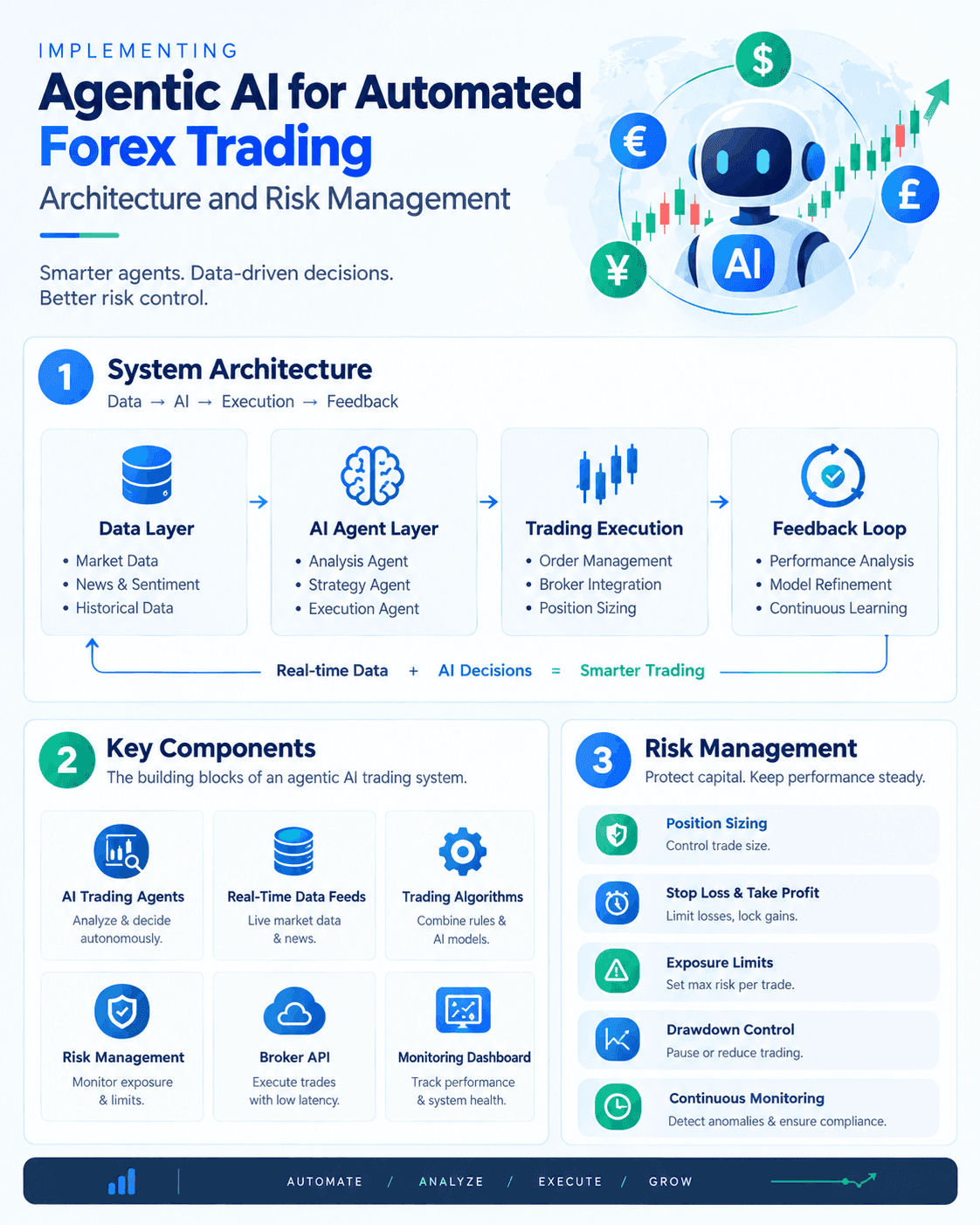
Production-grade autonomous forex trading requires a multi-layered technical infrastructure that separates concerns, isolates risk, and enables real-time decision-making under market volatility. The architectural foundation for agentic AI in forex trading differs fundamentally from traditional algorithmic systems because autonomous agents must perceive market state, reason about uncertainty, execute trades, and adapt strategy without human intervention across millisecond timeframes.
Core Infrastructure Layers
A scalable agentic trading system rests on four interdependent layers: data ingestion, agent reasoning, execution, and monitoring. The data layer must ingest tick-level forex quotes, economic calendars, central bank communications, and alternative data streams with sub-100-millisecond latency. This requires dedicated message brokers (Apache Kafka, RabbitMQ) rather than traditional databases, as agents need streaming data, not batch snapshots.
The reasoning layer houses the autonomous agent itself, typically a large language model (LLM) augmented with specialized tools, memory systems, and decision frameworks. Unlike static trading algorithms, agentic systems maintain contextual memory of recent trades, market regimes, and performance metrics. They invoke tools dynamically: technical analysis calculators, sentiment analyzers, risk validators, and portfolio optimizers. This tool-calling architecture allows agents to decompose complex trading decisions into verifiable steps.
The execution layer abstracts broker connectivity through a standardized interface. Rather than direct API calls, agents submit trade requests to an execution engine that validates position limits, margin requirements, and regulatory constraints before routing orders. This isolation prevents rogue agents from creating catastrophic exposure.
State Management and Persistence
Autonomous agents require persistent state across market sessions. A distributed cache layer (Redis, DynamoDB) stores agent memory, including recent price history, executed trades, performance metrics, and learned patterns. This enables agents to resume reasoning from prior context rather than restarting cold each session. State must be versioned and auditable, every decision the agent makes should be traceable to specific market conditions and reasoning steps.
Risk Isolation and Circuit Breakers
Scalable agentic systems implement hardware-level circuit breakers independent of agent logic. Position size limits, drawdown thresholds, and correlation checks execute at the execution layer, not within agent code. If an agent attempts to exceed maximum daily loss or concentration limits, the system rejects the order before submission to the broker. This architectural separation ensures that even a malfunctioning agent cannot breach risk guardrails.
Agents also operate within isolated virtual environments where they can test strategies against historical data before deploying to live markets. This sandbox layer prevents untested reasoning from directly impacting capital.
Scalability Patterns
Multi-agent systems require orchestration. A central coordinator manages agent lifecycle, allocates capital across agents, and prevents conflicting trades on the same currency pair. Horizontal scaling occurs by spinning up additional agent instances on separate infrastructure, each with its own reasoning engine but sharing the same execution and risk layers. Load balancing distributes market data streams across agents to prevent bottlenecks.
For more details on building production-ready autonomous systems, see AI Agent Startups: Building Production-Ready Autonomous AI Systems.
Observability and Instrumentation
Every agent decision must be logged with timestamps, market state, reasoning steps, and outcomes. Structured logging (JSON format) enables rapid analysis of agent behavior during market stress. Metrics dashboards track agent performance, latency, error rates, and trade profitability in real time. Distributed tracing tools follow requests from market data ingestion through execution, identifying bottlenecks or cascading failures.
This architectural approach transforms agentic AI from experimental concept into operationally sound infrastructure capable of managing capital at scale while maintaining transparency and control.
Risk Management Framework: Protecting Capital in Autonomous Trading
Agentic AI systems operating in forex markets execute trades at machine speed across multiple currency pairs simultaneously. Without a risk management framework, these autonomous agents can amplify losses faster than human traders can intervene. A comprehensive safeguarding strategy must address position sizing, drawdown limits, correlation exposure, and real-time circuit breakers.
Position Sizing and Capital Allocation
The foundation of autonomous trading protection begins with strict position sizing rules. Rather than allowing an agent to allocate capital freely, define maximum exposure per trade as a percentage of total account equity, typically 1% to 3% for individual positions. This constraint prevents catastrophic losses from a single adverse market move.
Implement tiered allocation based on market conditions. During high-volatility periods, reduce position sizes automatically. When volatility normalizes, the agent can scale back to standard allocations. This dynamic approach protects capital during unpredictable geopolitical events or central bank announcements that spike currency volatility.
Drawdown Limits and Pause Mechanisms
Set maximum daily and monthly drawdown thresholds that trigger automatic trading halts. If an agent loses 5% of account equity in a single day, it should cease all trading activity until human review occurs. Monthly limits of 10-15% prevent compounding losses across extended losing streaks.
Implement a recovery protocol: once trading resumes after a drawdown halt, reduce position sizes by 50% for the next 10 trades. This graduated re-entry prevents the agent from immediately recreating losses through overconfident position sizing.
Correlation and Concentration Risk
Autonomous agents often identify similar trading signals across correlated currency pairs. Without safeguards, the system might establish large positions in EUR/USD, GBP/USD, and USD/CHF simultaneously, creating hidden concentration risk. Monitor aggregate exposure to each currency and enforce maximum limits per currency across all pairs.
Use correlation matrices that update hourly. If two pairs show correlation above 0.85, restrict combined exposure to prevent redundant risk. This ensures diversification remains genuine rather than illusory.
Real-Time Monitoring and Circuit Breakers
Deploy continuous monitoring systems that track agent behavior against predefined parameters. Circuit breakers should trigger on: consecutive losing trades exceeding five, slippage exceeding 20 pips on average, or execution latency surpassing 500 milliseconds.
Establish a kill switch accessible to human operators that halts all positions within seconds. Autonomous systems require human oversight checkpoints, particularly during market gaps or liquidity crises when normal risk models fail.
A well-architected risk management framework transforms agentic AI from a potential liability into a controlled, scalable trading instrument. The key is building constraints that protect capital while preserving the agent's ability to capitalize on genuine market opportunities.
Model Validation and Strategy Backtesting
Before deploying any agentic AI system into live forex trading, rigorous model validation and strategy backtesting form the foundation of risk management. These processes ensure that algorithmic decision-making performs reliably across diverse market conditions, not just during favorable periods. Without systematic validation, traders expose themselves to catastrophic losses driven by overfitting, data leakage, or untested edge cases.
Core Validation Methodologies
Agentic AI models require multi-layered validation that extends beyond traditional statistical testing. The first layer involves out-of-sample testing, where the model encounters price data it has never processed during training. This separation prevents the illusion of performance that emerges when algorithms memorize historical patterns rather than learning generalizable trading logic.
Walk-forward validation represents a more sophisticated approach. The model trains on a historical window, validates on subsequent unseen data, then advances both windows forward in time. This rolling methodology mimics real deployment conditions where market regimes shift continuously. A strategy showing 45% win rates in walk-forward tests typically outperforms one claiming 78% accuracy on in-sample data.
Monte Carlo simulation adds another critical dimension. By randomly reshuffling historical price sequences while preserving statistical properties, traders can stress-test whether their agentic AI strategy depends on specific market sequences or possesses genuine predictive capability. If performance collapses under randomized conditions, the strategy likely exploits noise rather than signal.
Backtesting Framework Requirements
Effective backtesting must account for realistic trading friction. Slippage, commission structures, and bid-ask spreads compress theoretical returns significantly. A strategy showing 12% annual gains without transaction costs often produces 3-4% net returns when realistic costs are applied. Agentic systems should model slippage dynamically based on order size and market liquidity conditions at each decision point.
Drawdown analysis reveals psychological and capital constraints. Maximum drawdown, the largest peak-to-trough decline, indicates whether traders can psychologically tolerate the strategy during inevitable losing streaks. A strategy with 35% maximum drawdown requires substantial emotional discipline and sufficient capital reserves to survive extended underwater periods.
Validation Checkpoints
- Verify model performance across multiple currency pairs and timeframes beyond training data
- Test strategy behavior during high-volatility events and market regime changes
- Confirm that agentic decision-making logic remains consistent when market conditions shift unexpectedly
- Validate that position sizing and risk controls activate correctly under stress conditions
- Ensure backtesting incorporates realistic market microstructure and execution delays
Only after passing these rigorous validation gates should agentic AI systems transition to paper trading, then carefully monitored live deployment with position limits.
Regulatory Compliance and Governance
Automated forex trading systems powered by agentic AI operate within a complex regulatory landscape that varies significantly across jurisdictions. In the United States, the primary oversight bodies, the Securities and Exchange Commission (SEC), the Commodity Futures Trading Commission (CFTC), and the Financial Industry Regulatory Authority (FINRA), impose strict requirements on algorithmic trading systems. These regulations exist to prevent market manipulation, ensure fair pricing, and protect retail investors from systemic risks.
Agentic AI systems in forex trading must comply with specific disclosure and documentation standards. Firms deploying autonomous trading agents are required to maintain detailed records of all trading decisions, including the logic, parameters, and real-time decision pathways that led to each transaction. This audit trail becomes essential during regulatory examinations and potential enforcement actions. The CFTC's Rule 15c3-5 establishes risk management controls that apply directly to algorithmic trading, mandating pre-trade risk checks, position limits, and circuit breakers to halt trading during anomalous market conditions.
Key Compliance Requirements for Agentic Systems
- Pre-trade Risk Controls: Agentic AI must incorporate hard stops that prevent orders exceeding predefined position limits, notional exposure thresholds, and maximum loss parameters before execution.
- Market Surveillance and Reporting: Real-time monitoring systems must detect and report suspicious trading patterns that could indicate market manipulation or layering strategies.
- System Testing and Validation: Firms must conduct rigorous backtesting, stress testing, and paper trading phases before deploying live agentic systems, with documented evidence of performance validation.
- Governance Frameworks: Organizations require formal policies governing AI model updates, version control, and human oversight mechanisms to ensure agents operate within intended parameters.
Governance structures must establish clear accountability chains. A designated compliance officer should oversee all agentic AI deployments, with regular audits confirming that autonomous systems remain aligned with regulatory expectations. Firms must implement kill-switch protocols enabling immediate human intervention when agents exhibit unexpected behavior or market conditions deteriorate rapidly.
Cross-border considerations add another layer of complexity. If your agentic AI system executes trades on international forex exchanges, you must understand and address the regulatory requirements of each jurisdiction, including the European Union's Markets in Financial Instruments Directive (MiFID II) and similar frameworks in Asia-Pacific regions.
For organizations building custom AI solutions, establishing AI governance frameworks from inception reduces compliance friction and accelerates regulatory approval timelines.
Implementation Roadmap: From Concept to Production
Deploying agentic AI systems for forex trading requires a structured, phased approach that balances rapid iteration with risk containment. The journey from initial concept to live trading involves multiple validation gates, architectural decisions, and operational safeguards that directly impact system reliability and profitability.
Phase 1: Requirements Definition and Architecture Design
Begin by defining specific trading objectives, risk tolerance, and market conditions your autonomous agent will operate within. Document the exact currency pairs, timeframes, and economic indicators the system will monitor. This clarity prevents scope creep and ensures your development team builds toward measurable outcomes rather than abstract capabilities.
Next, design the core architecture. Agentic AI trading systems typically require three interconnected layers: the perception layer (market data ingestion and preprocessing), Agentic AI in forex trading layer (reinforcement learning models and rule-based logic), and the execution layer (order routing and position management). Each layer must be independently testable and deployable.
Phase 2: Data Pipeline and Backtesting Infrastructure
Establish a data pipeline that ingests real-time and historical forex data with minimal latency. Your backtesting environment must accurately simulate market microstructure, including slippage, spread dynamics, and liquidity constraints specific to your broker and trading hours.
Run extensive backtests across multiple market regimes, trending markets, ranging markets, high-volatility periods, and crisis scenarios. Test your agent's behavior during flash crashes, geopolitical events, and central bank announcements. A system that performs well only in calm conditions will fail when it matters most.
Phase 3: Paper Trading and Live Validation
Deploy your agent to a paper trading environment using real market data but simulated capital. Run this phase for at least 4-8 weeks to observe how the system behaves under genuine market conditions without financial exposure. Monitor for: