
Introduction to How to Build an AI Agent: A Technical Roadmap for Enterprise
Modern enterprises are moving beyond simple chatbots toward autonomous systems capable of executing complex workflows. Understanding how to build an ai agent requires a shift in perspective from static software development to dynamic, goal-oriented architecture. Unlike traditional scripts, an agent perceives its environment, reasons through multi-step tasks, and utilizes tools to achieve specific business outcomes.
Key Takeaways
- Understanding how to build an ai agent requires a shift in perspective from static software development to dynamic, goal-oriented architecture.
- Unlike traditional scripts, an agent perceives its environment, reasons through multi-step tasks, and utilizes tools to achieve specific business outcomes.
- We recognize that the transition to autonomous operations is a significant undertaking.
- As a firm specializing in custom enterprise solutions, we focus on the intersection of AI/ML product development and robust software engineering.
At AllZone Technologies, we recognize that the transition to autonomous operations is a significant undertaking. As a firm specializing in custom enterprise solutions, we focus on the intersection of AI/ML product development and robust software engineering. Building these systems involves more than just selecting a Large Language Model; it demands a rigorous technical roadmap that prioritizes reliability, security, and integration with existing infrastructure.
The Core Components of Agentic Architecture
To successfully deploy these systems, organizations must align their technical strategy with their operational goals. The following table outlines the foundational pillars required for enterprise-grade deployment:
| Component | Technical Function |
|---|---|
| Perception Layer | Data ingestion from APIs, databases, and user inputs. |
| Reasoning Engine | LLM orchestration for decision-making and planning. |
| Action Interface | Tool execution via function calling and API integration. |
| Memory Store | Vector databases for long-term context and retrieval. |
This technical roadmap serves as a guide for engineering teams tasked with scaling intelligent automation. Whether you are refining internal processes or developing customer-facing tools, the ability to orchestrate these components is vital. For those looking to deepen their understanding of system architecture, our guide on Mastering Ai Agent Orchestration For Enterprise Systems provides a comprehensive look at managing these complex workflows.
The journey to build a functional agent begins with defining clear boundaries for the system's autonomy. By focusing on modular design and iterative testing, your team can mitigate risks associated with hallucination and system instability. This section establishes the baseline for the subsequent chapters, where we will examine the specific frameworks and infrastructure requirements necessary to move from prototype to production-ready software.
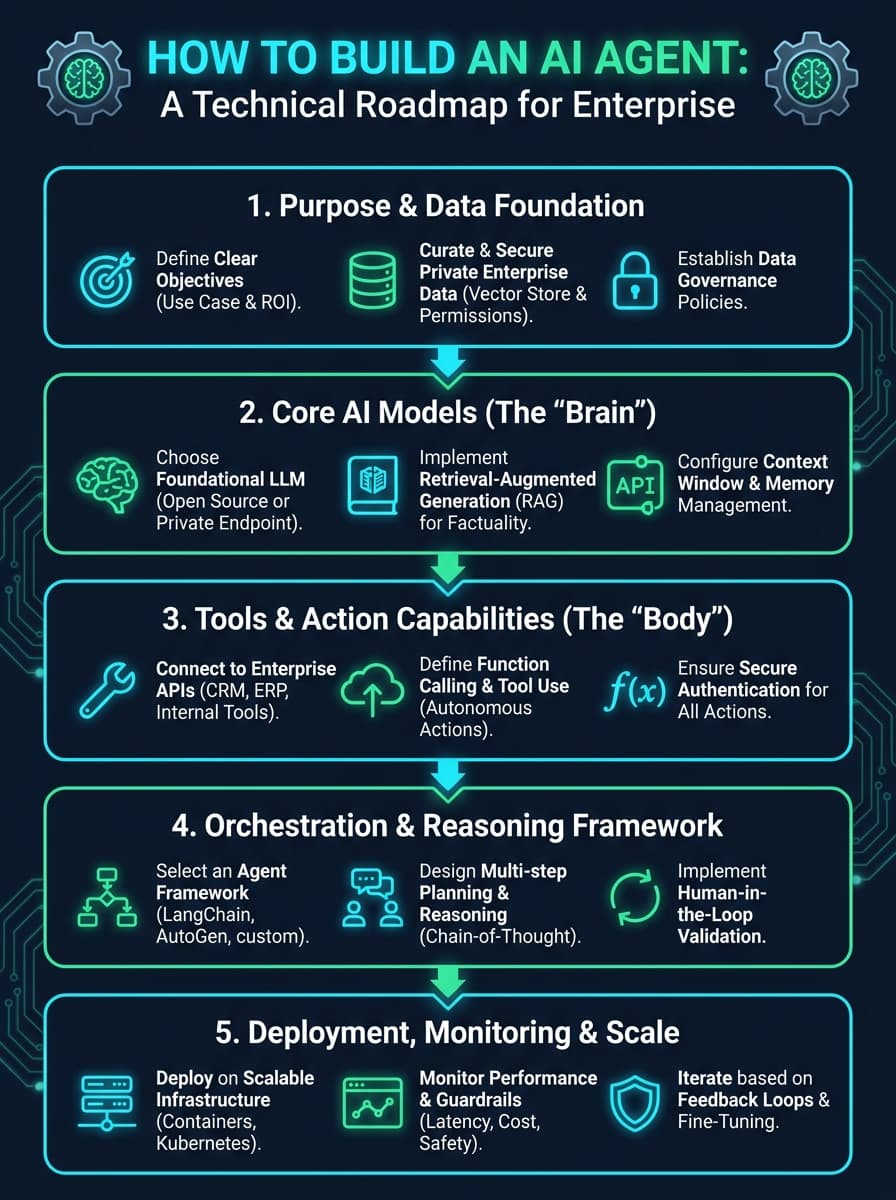
How to build an AI agent
To understand how to build an AI agent, one must first recognize that these systems are not mere chatbots. They are autonomous software entities capable of reasoning, planning, and executing complex workflows without constant human intervention. For enterprise clients in the United States, the architecture of these agents relies on a robust foundation of data integration and model orchestration.
Core Architecture Components
Building a functional agent requires a modular approach. At AllZone Technologies, we emphasize that the intelligence of an agent is only as effective as its access to enterprise data. The following table outlines the essential layers required to deploy a production-ready system.
| Component Layer | Function | Business Impact |
|---|---|---|
| Perception Layer | Data ingestion and parsing | Ensures context-aware responses |
| Reasoning Engine | LLM-based decision logic | Reduces manual operational overhead |
| Action Layer | API and tool integration | Enables direct system execution |
Defining the Scope for Customers
We explain how to build an ai agent clearly by focusing on the specific business objectives of our customers. Whether you are looking to automate customer support or streamline internal IT consultancy processes, the agent must be scoped to handle specific domains. A common pitfall is attempting to build a general-purpose agent when a specialized, high-precision tool would yield better results.
Our team at AllZone Technologies specializes in custom software development that bridges the gap between raw AI models and practical business utility. By integrating AI/ML product development into your existing stack, we ensure that your agents operate within the security parameters required by modern enterprise environments.
- Data Connectivity: Establishing secure pipelines to your proprietary databases.
- Tool Selection: Choosing the right LLM framework to match your latency and accuracy requirements.
- Feedback Loops: Implementing human-in-the-loop validation to refine agent performance over time.
By following this technical roadmap, organizations can transition from experimental prototypes to scalable, autonomous systems. The goal is to create agents that act as force multipliers for your workforce, handling repetitive tasks while allowing your team to focus on high-value strategic initiatives.
By following this technical roadmap, organizations can transition from experimental prototypes to scalable, autonomous systems. The goal is to create agents that act as force multipliers for your workforce, handling repetitive tasks while allowing your team to focus on high-value strategic initiatives.
One must first look beyond simple chatbots. An autonomous agent functions as a self-directed system capable of reasoning, tool usage, and iterative task execution. When organizations partner with firms like AllZone Technologies, the focus shifts from basic automation to building intelligent workflows that integrate directly into existing enterprise ecosystems.
The Architecture of Autonomous Reasoning
Building a functional agent requires a robust foundation. You must define the agent's persona, its access to external data, and the specific tools it can invoke. We explain how to build an ai agent clearly by breaking the development process into three distinct layers:
- The Brain (LLM Core): The foundational model that processes natural language and determines the next logical step.
- The Memory Layer: Long-term storage using vector databases to ensure the agent remembers past interactions and enterprise-specific context.
- The Action Interface: API integrations that allow the agent to execute tasks in third-party software.
For customers seeking to modernize their operations, the transition from static scripts to dynamic agents is significant. As detailed in our guide on Mastering Ai Agent Orchestration For Enterprise Systems, the orchestration layer is what prevents hallucinations and ensures the agent stays within defined business boundaries.
Technical Comparison of Agentic Frameworks
Selecting the right framework depends on the complexity of your enterprise requirements. The following table highlights the primary considerations for development teams:
| Feature | Basic Scripting | Autonomous AI Agent |
|---|---|---|
| Decision Making | Hard-coded logic | Dynamic reasoning |
| Tool Usage | Limited/Fixed | Adaptive/Multi-tool |
| Context Retention | Session-based | Persistent vector memory |
We specializes in AI/ML product development, ensuring that these agents are not just prototypes but production-ready assets. By focusing on custom software development, we help businesses move past the hype and deploy agents that solve actual operational bottlenecks. Whether you are automating supply chain logistics or customer support, the goal remains consistent: creating a system that acts with precision, reliability, and security at scale.
we approach this by mapping specific business logic to autonomous decision-making loops. This process requires moving beyond simple prompt engineering into robust, state-managed workflows that handle complex enterprise data.
Defining the Agentic Framework
When we explain how to build an ai agent clearly to our customers, we emphasize the necessity of a modular stack. An effective agent is not just a model; it is a combination of a reasoning engine, a memory layer, and a set of defined tools. Our team at AllZone Technologies specializes in custom software development that integrates these components into existing infrastructure.
The following table outlines the core components required to build a functional enterprise agent:
| Component | Function | Enterprise Utility |
|---|---|---|
| Reasoning Engine | LLM-based decision logic | Automated task prioritization |
| Memory Layer | Vector database integration | Contextual awareness for users |
| Tool Interface | API/Function calling | Direct execution of business tasks |
Technical Implementation Steps
Building these systems requires a disciplined approach to AI/ML product development. You must ensure that the agent operates within secure, governed environments. We recommend starting with a narrow scope, such as automating customer support ticket routing, before expanding into complex autonomous workflows. For those looking to deepen their technical strategy, Mastering Ai Agent Orchestration For Enterprise Systems provides the necessary framework for managing multiple agent interactions.
Consider these three pillars during your build phase:
- Data Integrity: Ensure your retrieval-augmented generation (RAG) pipelines are fed with clean, structured data.
- Observability: Implement logging for every decision step the agent takes to maintain auditability.
- Human-in-the-Loop: Design checkpoints where the agent requests verification for high-stakes actions.
By focusing on these granular technical requirements, your organization can transition from experimental prototypes to production-grade solutions. Our consultancy firm ensures that each custom software development project aligns with your specific operational goals, removing the ambiguity often associated with deploying advanced machine learning models in a corporate environment.
AI Agent for Clearly Customers
To explain how to build an ai agent clearly for customers, we must look at the architectural requirements for deploying autonomous systems. When you learn how to build an AI agent, you are essentially designing a decision-making loop that connects a Large Language Model (LLM) to external tools and enterprise data. At AllZone Technologies, we emphasize that an agent is only as effective as its integration layer.
Core Components of Agent Architecture
Building a functional agent requires more than just a prompt. It demands a robust framework that handles memory, reasoning, and execution. Our team at AllZone Technologies focuses on these specific layers during the development lifecycle:
- The Brain (LLM): The reasoning engine that interprets user intent and determines the next logical step.
- The Memory Module: Persistent storage that allows the agent to recall previous interactions and context across sessions.
- The Tool Interface: APIs that allow the agent to perform actions, such as querying databases or updating CRM records.
- The Guardrails: Safety protocols that prevent the agent from executing unauthorized commands or hallucinating data.
The following table outlines the technical considerations for enterprise-grade agent deployment:
| Component | Primary Function | Enterprise Requirement |
|---|---|---|
| Orchestration | Task delegation | Mastering Ai Agent Orchestration For Enterprise Systems |
| Data Retrieval | Context injection | Low-latency vector database access |
| Execution | API interaction | Secure, authenticated tool calls |
Custom Software Development for AI
Generic solutions often fail to address the unique complexities of large-scale operations. As a consultancy specializing in custom software development, we ensure that every agent is tailored to your specific business logic. By integrating AI/ML product development directly into your existing infrastructure, we create agents that do not just chat, but actively solve problems. This approach ensures that your technical roadmap remains scalable while maintaining the security standards required by modern enterprises. Whether you are automating customer support or streamlining internal workflows, the focus remains on building reliable, repeatable, and high-performance autonomous systems.
To successfully navigate the complexities of how to build an AI agent, organizations must move beyond theoretical frameworks and focus on rigorous deployment standards. We emphasize that an agent is only as effective as its underlying architecture. When you explain the topic clearly to stakeholders, it becomes evident that integration with existing data pipelines is the primary hurdle for most enterprises.
Operationalizing Your AI Framework
Building a functional agent requires a structured approach to custom software development. You must ensure your agent can access proprietary datasets without compromising security protocols. Our team specializes in AI/ML product development, ensuring that every agent we deploy adheres to strict enterprise governance. Below is a breakdown of the core components required for a production-ready agent.
| Component | Technical Requirement | Business Impact |
|---|---|---|
| Orchestration Layer | Multi-agent coordination | Reduced latency in task execution |
| Data Connectors | API-first integration | Real-time information accuracy |
| Guardrails | Input/Output filtering | Compliance and risk mitigation |
When you begin this process, prioritize modularity. By decoupling the reasoning engine from the execution layer, you allow for future upgrades without rebuilding the entire system. This is a core tenet of our approach to Mastering Ai Agent Orchestration For Enterprise Systems. By maintaining a clean separation of concerns, your technical team can iterate on specific models while keeping the agent interface stable for your customers.
Strategic Implementation Steps
To ensure long-term success, follow these technical milestones:
- Define Scope: Identify specific workflows that require autonomous decision-making.
- Select Infrastructure: Choose a scalable cloud environment that supports high-throughput inference.
- Testing Cycles: Implement rigorous A/B testing to validate agent responses against historical benchmarks.
- Continuous Monitoring: Deploy observability tools to track drift and performance degradation in real-time.
Ultimately, the goal is to create a system that acts as an extension of your workforce. By focusing on robust engineering rather than superficial features, you ensure that your AI initiatives deliver measurable value. Whether you are modernizing legacy systems or launching new products, the path forward requires a commitment to precision and technical excellence.