SMART CITIES AND PUBLIC SAFETY
Smart City Safety Platform
A multi-agent platform that turns an existing municipal camera network into real time incident detection and department routing, with a person on every consequential action.
- PROJECT
- Smart City Safety Platform
- INDUSTRY
- Smart Cities and Public Safety
- STACK
- Computer Vision · NVIDIA Triton · OpenCV · MCP · Kafka · PostGIS · Kubernetes · AWS
OVERVIEW
The project
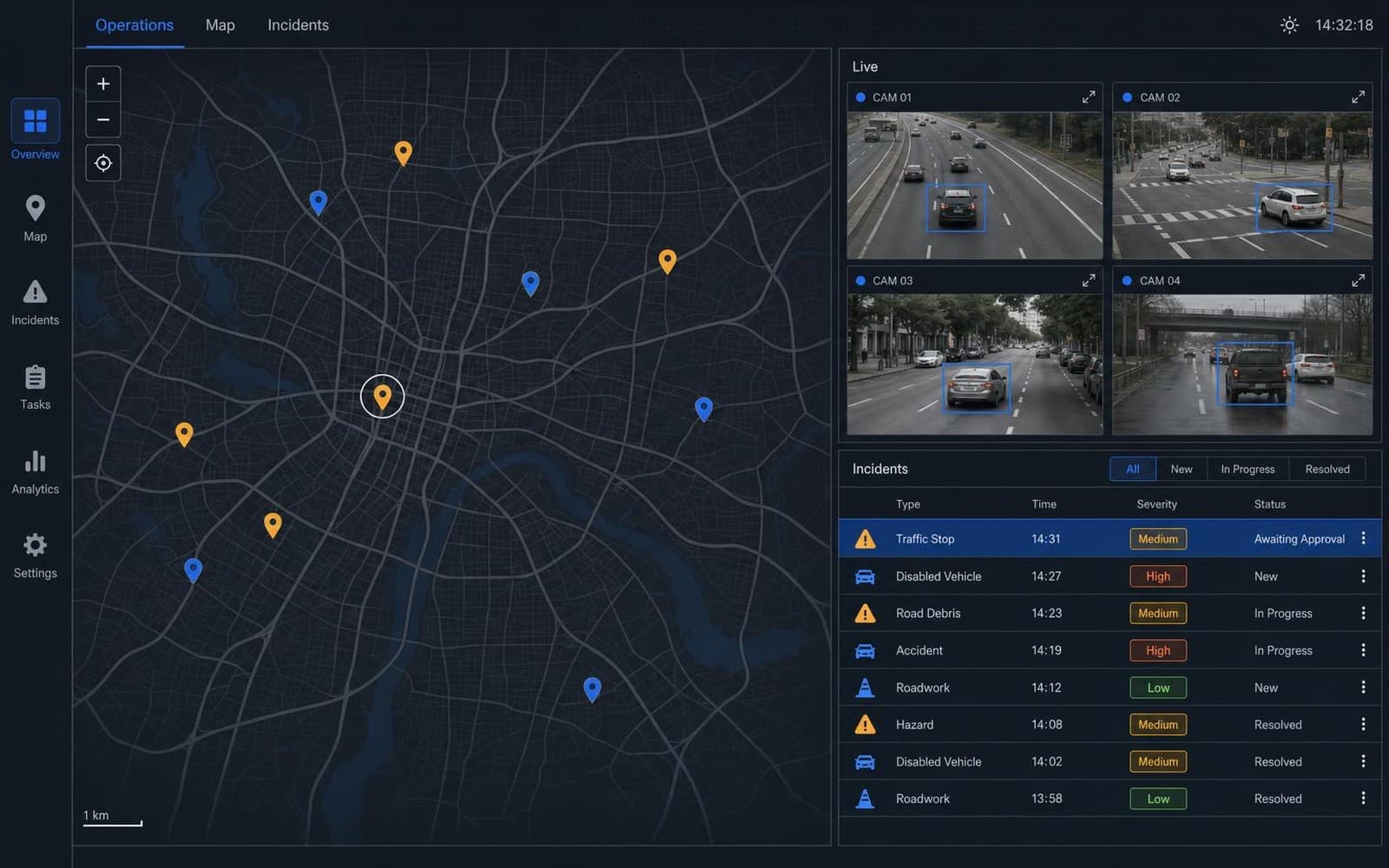
The city already had the cameras. What it did not have was a way to act on what they saw without somebody watching every feed. Allzone built a platform that runs computer vision across the municipal camera network, turns each meaningful detection into a structured geotagged incident, and routes it through department agents to the system that can respond, with a human decision maker on every action carrying public safety consequences.
CHALLENGE
What made it difficult
Detection is only worth something if it lands somewhere. A collision recognised by a model but filed into a queue nobody owns has improved nothing, and the city's systems for police, fire, traffic, public works and citizen reports were never built to talk to each other.
The consequences are also asymmetric. Filing a routine roadworks report automatically is low risk. Dispatching a law enforcement response on a confidence score is not. The platform had to treat those two paths differently rather than apply one automation policy across both.
WHAT WE DID
The work delivered.
- 01
Real time detection
Computer vision across the camera network classifying collisions, fire and smoke, crowd density anomalies, abandoned objects, flooding, illegal dumping and infrastructure damage.
- 02
Event normalisation
Each detection converted into a structured, geotagged incident record carrying type, location, timestamp, confidence score and the supporting clip, so it can be routed and later audited.
- 03
City systems as MCP servers
Police CAD/RMS, fire and EMS dispatch, traffic signal control, public works work orders, 311 citizen reporting and GIS each exposed as an MCP server with permission controlled tools.
- 04
Orchestration and department agents
A central agent that scores severity and routes each incident, with department agents able to coordinate directly over MCP on incidents that involve more than one of them.
- 05
Human in the loop
Approval required on any incident tagged public safety or law enforcement, with the full chain from detection to decision to action logged.
- 06
Control room dashboard
A live view of incidents, agent recommendations and the pending approval queue for the operators running the room.
- 07
Privacy safeguards
Face blurring and retention controls inside the vision pipeline, aligned to public sector data governance requirements.
ARCHITECTURE
How it fits together
- Separate edge vision, event normalisation and agent orchestration layers, so detection models and department integrations evolve independently
- An event streaming backbone moving incident records from camera adjacent inference nodes to orchestration with low latency
- Each department modelled as an agent with its own guardrails, escalation rules and access scope, rather than one agent holding broad access
- Confidence thresholds and severity scoring separating the routine automatic path from the escalated human one
- An extensible MCP integration layer, so another department onboards without changing the orchestration agent
TECHNOLOGY
The stack
- Computer Vision
- NVIDIA Triton
- OpenCV
- MCP
- Kafka
- PostGIS
- Kubernetes
- AWS
OUTCOME
What exists now.
A detection reaches the department that can act on it in seconds, without an operator watching every feed to find it
An incident spanning two departments notifies both at once, replacing ad hoc radio coordination with a logged, reviewable path
Every public safety and law enforcement action still passes a person, and the chain from camera to decision to action is auditable end to end
NEXT STEP
Tell us what you're building.
Bring us the problem with its real constraints attached. We will tell you what we would build, and what we would not.