Introduction
Generative AI has moved from experimental technology into operational reality across American enterprises. Organizations are deploying these systems to automate complex workflows, accelerate product development, and new revenue streams. Understanding practical applications of generative AI, not just the technology itself, is essential for business leaders evaluating competitive positioning and operational efficiency.
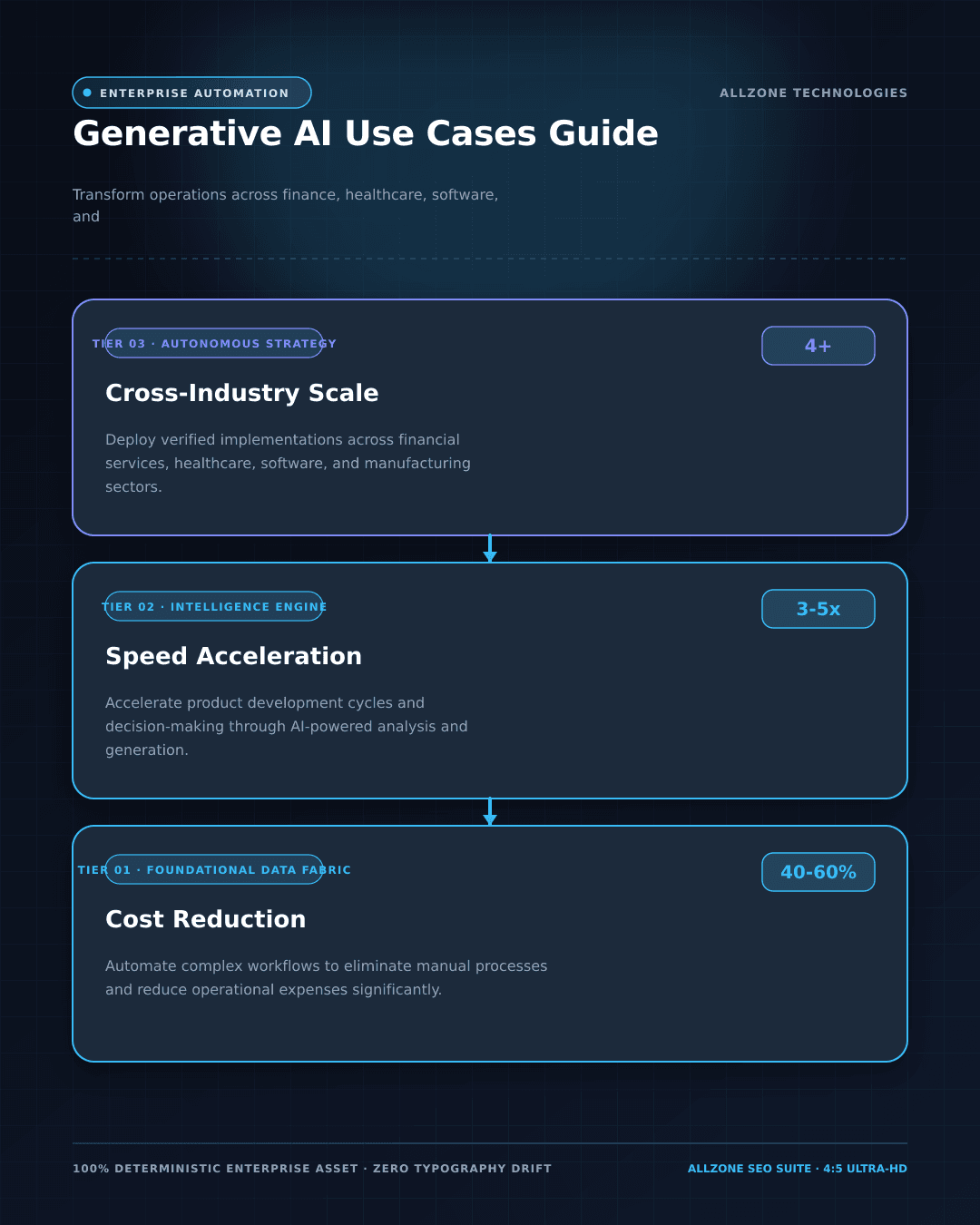
The business impact extends across three primary dimensions: cost reduction, speed acceleration, and capability expansion. Financial services firms use generative models for risk analysis and regulatory compliance. Healthcare organizations deploy these systems for clinical documentation and drug discovery. Software development teams integrate AI-powered coding assistants into workflows. Manufacturing companies apply generative design to optimize product specifications. Generative AI use cases outlines actionable frameworks and real-world implementation strategies to help organizations scale successfully.
This comprehensive guide outlines actionable frameworks, verified engineering standards, and practical step-by-step methodologies to scale successfully. Follow the proven strategies and real-world takeaways ahead to implement with precision and build long-term competitive resilience.
Key Takeaways
- Some implementations streamline routine tasks, while others fundamentally reshape how organizations approach strategic challenges.
- The Latency-Quality Trade-Off Nobody Discusses Teams implementing generative AI solutions rarely quantify the real cost of response time versus output quality.
- Organizations are deploying these systems to automate complex workflows, accelerate product development, and new revenue streams.
- Follow the proven strategies and real-world takeaways ahead to implement with precision and build long-term competitive resilience.
- Financial services firms use generative models for risk analysis and regulatory compliance.
- The business impact extends across three primary dimensions: cost reduction, speed acceleration, and capability expansion.
Introduction to Generative AI Use Cases
At its core, generative AI refers to machine learning models trained on vast datasets to produce original content, code, insights, and solutions based on user prompts. Unlike traditional software that follows predetermined rules, generative systems learn patterns and relationships within data, enabling them to generate contextually relevant outputs across text, images, code, and structured data.
A genuine generative AI use case involves deploying these models to solve specific business problems with measurable outcomes. This differs from experimental pilots or proof-of-concept projects. Effective use cases demonstrate clear ROI, integrate with existing systems, and address real operational constraints. Some implementations streamline routine tasks, while others fundamentally reshape how organizations approach strategic challenges.
Revolutionizing Customer Experience: Generative AI in Retail and E-Commerce
Generative AI is fundamentally reshaping how retailers and e-commerce platforms engage with customers. Rather than simply automating existing processes, these technologies enable entirely new ways to personalize interactions, streamline operations, and drive revenue growth across the customer journey.
Personalized Product Recommendations at Scale
Generative AI systems analyze vast datasets of customer behavior, purchase history, and browsing patterns to deliver hyper-personalized product suggestions in real time. Unlike traditional recommendation engines that rely on collaborative filtering alone, generative models can understand context, seasonality, and emerging trends to surface products customers didn't know they needed.
The technology goes beyond simple "customers who bought X also bought Y" logic. Generative models can synthesize product descriptions, create dynamic landing pages, and generate personalized email campaigns that speak directly to individual customer preferences and purchase patterns.
Intelligent Customer Service and Support Automation
Generative AI powers conversational agents that handle customer inquiries with natural language understanding and contextual awareness. These systems can resolve common issues, returns, shipping questions, and product specifications without human intervention while seamlessly escalating complex problems to live agents.
- Real-time response to customer questions across chat, email, and social channels
- Multilingual support without requiring separate teams for each language
- Consistent brand voice and policy adherence across all touchpoints
- 24/7 availability that reduces response times from hours to seconds
The result is reduced support costs, faster resolution times, and improved customer satisfaction scores.
Dynamic Content and Visual Generation
Generative AI creates product images, lifestyle photography, and marketing copy tailored to different customer segments and channels. E-commerce platforms can generate multiple product descriptions optimized for search engines, social media, or mobile displays without manual copywriting for every variation.
Visual generation tools produce lifestyle images, banner designs, and promotional graphics that adapt to seasonal campaigns, regional preferences, or A/B testing requirements. This capability dramatically reduces time-to-market for new products and campaigns.
Accelerating Healthcare Innovation: Generative AI Transforming Medical Services
Generative AI is reshaping how healthcare organizations operate across diagnostics, treatment planning, and administrative workflows. Unlike traditional machine learning models that classify or predict outcomes, generative AI systems create new content, from synthetic medical imaging to novel drug compounds, enabling clinicians and researchers to work faster and more accurately.
Diagnostic Imaging and Clinical Decision Support
Radiologists and pathologists now deploy generative AI models to augment image analysis workflows. These systems generate high-resolution reconstructions of medical scans, fill in missing data from incomplete imaging studies, and synthesize training datasets when real patient data is scarce. A radiologist reviewing a chest X-ray can receive differential diagnoses ranked by probability, alongside annotated regions highlighting areas of concern.
The practical impact is measurable: diagnostic accuracy improves when AI-assisted workflows combine human expertise with algorithmic precision. Generative models also reduce interpretation time, allowing radiologists to review more cases without burnout. This acceleration directly translates to faster patient triage and earlier intervention.
Drug Discovery and Molecular Design
Pharmaceutical research teams use generative AI to design novel molecular structures with desired therapeutic properties. Rather than screening millions of existing compounds, researchers input target characteristics, binding affinity, toxicity profile, and bioavailability, and the AI generates candidate molecules optimized for those criteria.
- Generative models reduce the time from concept to lead compound from years to months
- AI-designed molecules show higher success rates in preclinical validation
- Researchers can explore chemical space far beyond human intuition, discovering unexpected therapeutic pathways
This capability accelerates the entire drug pipeline, particularly for rare diseases where traditional screening methods yield few viable candidates.
Clinical Operations and Documentation
Healthcare systems deploy generative AI to transform clinical workflows. Natural language processing models automatically generate clinical notes from physician dictation, extract structured data from unstructured records, and flag documentation gaps before billing submission. Administrative staff spend less time on data entry; clinicians reclaim time for patient care.
Generative systems also synthesize patient histories across fragmented electronic health records, creating coherent clinical narratives that improve care coordination and reduce medical errors caused by incomplete information.
Transforming Financial Services: Generative AI Driving Security and Efficiency
Generative AI has fundamentally reshaped how financial institutions approach security, risk management, and regulatory compliance. Rather than treating these as separate operational silos, forward-thinking organizations now deploy AI-powered systems that simultaneously strengthen defenses, accelerate decision-making, and maintain audit trails with unprecedented precision.
Fraud Prevention and Anomaly Detection
Financial fraud evolves constantly, with attackers developing new tactics faster than traditional rule-based systems can adapt. Generative AI models analyze transaction patterns across millions of data points in real time, identifying behavioral anomalies that human analysts would miss. These systems learn from historical fraud cases and legitimate transactions, building probabilistic models that flag suspicious activity without generating excessive false positives.
The technology excels at detecting sophisticated schemes: account takeover attempts, synthetic identity fraud, and money laundering networks. By processing unstructured data, emails, chat logs, and transaction metadata alongside structured records, AI systems construct a holistic risk profile for each customer and transaction. When a pattern deviates from established baselines, the system generates alerts with confidence scores, enabling analysts to prioritize high-risk cases immediately.
Dynamic Risk Assessment and Predictive Modeling
Credit risk assessment traditionally relied on static scorecards updated quarterly or annually. Generative AI models continuously ingest market data, economic indicators, and borrower behavior signals to produce real-time risk scores. These systems can simulate thousands of economic scenarios, recession, interest rate shocks, and sector downturns, and estimate portfolio impact within seconds.
Banks now use generative models to stress-test loan portfolios against hypothetical conditions, adjusting capital reserves and pricing strategies proactively. The AI identifies emerging risk clusters before they materialize, allowing institutions to adjust exposure before losses accumulate.
Compliance Automation and Regulatory Reporting
Regulatory requirements multiply annually, and compliance teams struggle to keep pace. Generative AI automates the extraction, classification, and reporting of compliance-relevant data. These systems read regulatory guidance documents, interpret requirements, and automatically flag transactions or behaviors that violate rules.
- Know Your Customer (KYC) verification accelerates through AI-powered document analysis and identity verification
- Anti-Money Laundering (AML) screening processes millions of transactions against sanctions lists and suspicious activity patterns
- Regulatory reporting generates accurate filings with complete audit trails, reducing manual errors and submission delays
By automating routine compliance tasks, financial teams redirect resources toward strategic risk management and exception handling. The result: lower operational costs, faster time-to-market for new products, and stronger regulatory relationships built on transparent, accurate reporting.
Enhancing Manufacturing and Supply Chain: AI-Powered Operational Excellence
Generative AI use cases in manufacturing and supply chain operations are reshaping how U.S. Industrial enterprises manage production, inventory, and logistics. Unlike traditional automation, which follows rigid programmed rules, generative AI systems learn from operational data, identify hidden patterns, and generate actionable insights that drive measurable cost reductions and efficiency gains across the entire value chain.
Predictive Maintenance: Preventing Equipment Failure Before It Happens
Predictive maintenance powered by generative AI analyzes sensor data from machinery in real time, detecting anomalies that signal imminent failures. Rather than waiting for equipment to break down, which can halt production lines and cost thousands per hour, AI models trained on historical maintenance records and equipment performance metrics forecast when components will fail with high accuracy.
The process works by ingesting continuous streams of vibration data, temperature readings, pressure measurements, and acoustic signals. Generative models synthesize this information to create predictive profiles unique to each machine. When the system identifies degradation patterns matching known failure signatures, it alerts maintenance teams weeks or months in advance, enabling scheduled repairs during planned downtime rather than emergency interventions.
Quality Control: Real-Time Defect Detection and Root Cause Analysis
Generative AI transforms quality assurance by automating visual inspection and identifying defects at production speeds that human inspectors cannot match. Computer vision systems trained on thousands of product images learn to recognize surface imperfections, dimensional inconsistencies, and assembly errors in milliseconds.
Beyond detection, generative AI models analyze defect patterns to pinpoint root causes. If a spike in surface scratches occurs, the system correlates the timing with changes in raw material batches, operator shifts, environmental conditions, or equipment calibration. This diagnostic capability enables manufacturers to address problems at their source rather than simply rejecting defective units downstream.
- Detection rates exceeding 99% for visible defects
- Reduction in false positives through continuous model refinement
- Automated documentation and traceability for regulatory compliance
- Integration with production scheduling to halt lines when quality thresholds are breached
Logistics Optimization: Demand Forecasting and Route Planning
Supply chain visibility improves dramatically when generative AI models forecast demand with contextual accuracy. These systems ingest historical sales data, seasonal trends, market signals, promotional calendars, and external factors like economic indicators to predict product demand at granular levels, by SKU, region, and time period.
Armed with accurate demand signals, logistics networks optimize inventory positioning, warehouse allocation, and transportation routing. Generative models evaluate thousands of possible distribution scenarios simultaneously, accounting for fuel costs, vehicle capacity, delivery time windows, and traffic patterns. The result is measurable reductions in transportation costs and improvements in on-time delivery rates.
For U.S. Manufacturers managing complex multi-tier supply chains, this capability translates to lower working capital tied up in excess inventory and stronger competitive positioning through faster, more reliable fulfillment.
Revolutionizing Content Creation: Generative AI in Marketing and Communications
Generative AI has fundamentally transformed how marketing teams produce, personalize, and optimize content at scale. Organizations across the United States are deploying these technologies to reduce production cycles, increase output quality, and deliver hyper-targeted messaging to diverse audience segments. The shift represents more than incremental improvement; it's a structural change in how content workflows operate.
Content Generation at Enterprise Scale
Generative AI systems now handle the initial drafting phase of marketing collateral with measurable accuracy. Email campaigns, product descriptions, social media posts, and landing page copy can be generated in minutes rather than hours. Teams input brand guidelines, target audience parameters, and campaign objectives, and the system produces multiple variations for A/B testing.
The practical advantage extends beyond speed. Generative models trained on industry-specific data produce contextually relevant content that aligns with brand voice. Marketing departments report significant reduction in time spent on first-draft creation, allowing human writers to focus on strategy, refinement, and creative direction rather than repetitive composition tasks.
Dynamic Personalization and Audience Segmentation
Personalization at scale has moved from theoretical to operational. Generative AI analyzes customer behavior data, purchase history, engagement patterns, and demographic information to create individualized messaging for each recipient. A single campaign can generate thousands of micro-targeted variations without manual intervention.
- Subject lines optimized for open rates based on recipient segments
- Product recommendations tailored to browsing and purchase history
- Dynamic landing pages that adjust copy, imagery, and CTAs based on traffic source
- Personalized video scripts and voiceovers for different audience cohorts
This capability directly impacts conversion metrics. Organizations implementing AI-driven personalization report measurable improvement in click-through rates and increases in customer lifetime value.
Campaign Optimization and Performance Prediction
Generative AI systems analyze historical campaign data to predict which messaging strategies, creative approaches, and distribution channels will perform best for specific audience segments. Rather than relying on intuition or limited historical samples, marketers receive data-backed recommendations before launch.
The optimization cycle accelerates significantly. AI models test thousands of content variations simultaneously, identify high-performing patterns, and recommend adjustments in real time. Teams can pause underperforming campaigns, reallocate budget, and scale winning strategies within hours rather than waiting for weekly or monthly performance reviews.
Empowering Human Resources: Generative AI in Talent Management
Generative AI is fundamentally reshaping how organizations approach talent acquisition, employee development, and workforce planning across the United States. Rather than automating human decision-making, these technologies augment HR professionals' capabilities, enabling them to focus on strategic initiatives while AI handles repetitive, data-intensive tasks.
Recruitment and Candidate Screening
Generative AI applications in recruitment begin with job description optimization. AI systems analyze historical hiring data, competitor postings, and industry benchmarks to craft descriptions that attract qualified candidates while accurately reflecting role requirements. This precision reduces time-to-hire and improves candidate-role fit from the initial application stage.
Resume screening represents another critical use case. Generative models process thousands of applications, identifying candidates whose skills, experience, and career trajectories align with specific organizational needs. Rather than replacing human judgment, these systems surface the most promising candidates for recruiter review, dramatically reducing screening time.
Interview preparation and assessment use generative AI to create customized interview guides, behavioral questions, and technical assessments tailored to each role's unique demands. AI-powered systems can also analyze interview recordings, flagging key competencies discussed and providing objective scoring frameworks that reduce unconscious bias in hiring decisions.
Employee Development and Skill Enhancement
Personalized learning pathways represent a transformative generative AI use case within talent management. These systems analyze individual employee skills, career aspirations, and organizational needs to recommend targeted training programs, certifications, and mentorship opportunities. Unlike one-size-fits-all development programs, learning plans adapt in real time based on employee progress and evolving business requirements.
Conclusion
Generative AI use cases have moved beyond theoretical potential into measurable business impact across retail, healthcare, financial services, manufacturing, marketing, and talent management. Success requires moving beyond obvious applications to identify hidden opportunities: optimizing for total cost of ownership rather than latency alone, redesigning workflows around technical constraints, and recognizing that integration costs typically exceed model costs. Organizations that combine technical rigor with strategic thinking will capture disproportionate value from these transformative technologies.