AI development cost ranges from roughly $10,000 for a simple AI feature built on an existing model to $400,000 or more for complex custom systems, and over $1 million for enterprise multi-agent platforms, based on estimates published by development firms in 2026. What you'll actually pay depends on the problem, your data, integrations, compliance needs and how much the system does on its own.
This guide explains AI development cost by project type, the factors that move the price, running costs after launch, in-house versus outsourced teams, how to estimate your own budget, and how to keep costs under control as you plan for 2027.
Key takeaways
- Most AI features built on existing models cost tens of thousands of dollars, not millions.
- Integration and data preparation often cost more than the AI itself.
- Running costs (model usage, hosting, monitoring) continue every month after launch.
- Agents that take actions cost more to build, test and run than chatbots that answer questions.
- Plan budgets over three years, not just the build.
- A short discovery phase is the cheapest way to get a reliable estimate.
How much does AI development cost?
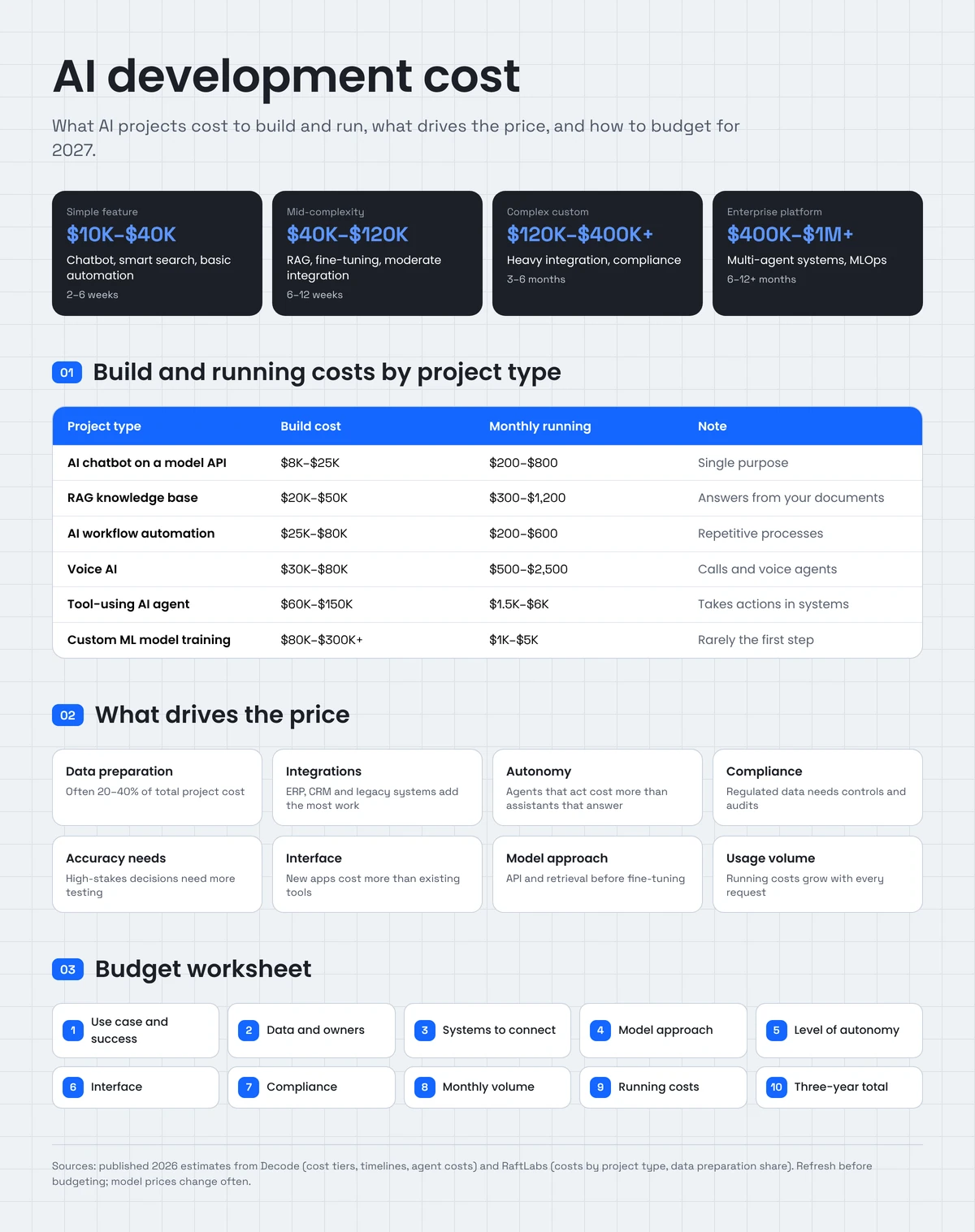
AI development costs about $10,000 to $40,000 for a simple feature on an existing model API, $40,000 to $120,000 for mid-complexity work such as retrieval-augmented generation or fine-tuning, $120,000 to $400,000 or more for complex custom systems, and $400,000 to over $1 million for enterprise multi-agent platforms, according to published 2026 estimates.
These tiers come from Decode's 2026 AI development cost guide; other firms publish similar ranges.
| Project tier | Example | Published cost range | Typical timeline |
|---|---|---|---|
| Simple AI feature | Chatbot, smart search or basic automation on an existing model | $10,000–$40,000 | 2–6 weeks |
| Mid-complexity | RAG over company documents, fine-tuning, moderate integration | $40,000–$120,000 | 6–12 weeks |
| Complex custom system | Proprietary model work, heavy integration, compliance | $120,000–$400,000+ | 3–6 months |
| Enterprise AI platform | Multi-agent systems with ongoing MLOps | $400,000–$1,000,000+ | 6–12+ months |
Ranges are wide because "AI development" covers everything from adding a chat assistant to a website to building a platform that runs a company's operations.
How much do different types of AI projects cost?
Different AI projects cost different amounts because they need different amounts of data work, integration and testing. Chatbots on an existing model are the least expensive. Retrieval systems, voice AI and workflow automation sit in the middle. Custom model training and computer vision on your own data cost the most.
Published 2026 ranges by project type (RaftLabs) and agent type (Decode):
| Project type | Published build cost | Published monthly running cost |
|---|---|---|
| AI chatbot on a model API | $8,000–$25,000 | $200–$800 |
| Chatbot with RAG and several integrations | $25,000–$60,000 | Varies with usage |
| RAG knowledge base | $20,000–$50,000 | $300–$1,200 |
| Generative AI integration into an existing product | $15,000–$40,000 | $500–$2,000 |
| AI workflow automation | $25,000–$80,000 | $200–$600 |
| Voice AI | $30,000–$80,000 | $500–$2,500 |
| Computer vision | $60,000–$200,000+ | $500–$3,000 |
| Custom ML model training | $80,000–$300,000+ | $1,000–$5,000 (inference) |
| Simple single-purpose AI agent | $15,000–$40,000 | $200–$800 |
| Tool-using AI agent | $60,000–$150,000 | $1,500–$6,000 |
| Multi-agent system | $120,000+ | $4,000+ |
For agent projects specifically, our AI agent development cost guide goes deeper.
How much does LLM development cost?
LLM development cost depends on whether you use an existing model through an API, fine-tune one, or train your own. Most business projects use existing models with retrieval or light fine-tuning, which falls in the low-to-mid tiers above. Training a large model from scratch is rarely necessary and costs far more. Our LLM development guide explains when each approach makes sense.
| Approach | Relative cost | When it fits |
|---|---|---|
| Existing model via API with good prompts | Lowest | Most assistants, drafting, classification |
| Existing model plus RAG on your documents | Low to medium | Answers grounded in company knowledge |
| Fine-tuned model | Medium | Consistent style, format or domain language |
| Self-hosted open model | Medium to high | Strict data control or very high volume |
| Model trained from scratch | Highest | Rare; specialized research or products |
What drives AI development cost?
The biggest drivers of AI development cost are the complexity of the problem, the state of your data, the number of systems to integrate, how much the AI acts on its own, accuracy and compliance requirements, the user interface, and the team you hire. Integration and data work are often underestimated.
| Cost driver | Lower cost | Higher cost |
|---|---|---|
| Problem scope | One narrow task | Many tasks across departments |
| Data | Clean, digital, accessible | Scattered, scanned, needs labeling |
| Integrations | One modern API | ERP, CRM, legacy systems |
| Autonomy | Answers and drafts for review | Actions in business systems |
| Accuracy needs | Helpful suggestions | High-stakes decisions with audits |
| Compliance | Internal, non-sensitive data | Health, finance, insurance, personal data |
| Interface | Inside an existing tool | New web and mobile apps |
| Model approach | API with retrieval | Fine-tuning or custom training |
Data preparation
Data preparation commonly takes 20% to 40% of total project cost, according to RaftLabs' 2026 guide. That includes collecting, cleaning, labeling and organizing data so the AI can use it. If your data lives in spreadsheets, scanned documents and several disconnected systems, budget accordingly. Our enterprise analytics solutions guide explains how to get data AI-ready.
Integration
Integration is where many budgets break. Connecting AI to one system with a modern API is straightforward; connecting it to an ERP, CRM and older systems with proper permissions takes much longer. Our guide to AI ERP integration covers what that work involves.
Testing, safety and compliance
AI needs testing against real cases, not just functional tests. Projects that handle regulated data or take actions also need permission controls, approval steps, audit logs and security reviews. These add cost, but they're what makes an AI system safe to use.
What does AI cost to run after launch?
After launch, AI costs money every time it runs. Ongoing costs include model usage (usually charged per token), hosting, vector databases, monitoring, human review of outputs, security updates and testing new model versions. For many features, usage costs are modest, but they grow with volume and with agents that take many steps per task.
What to budget for every month:
- Model usage: priced per token. Decode estimates a support chatbot handling 10,000 conversations a month at about $80 in model costs, rising roughly in line with volume.
- Agent tasks: agents use far more tokens than simple chat. Decode estimates a completed agent task at about 19 times the cost of a simple chatbot conversation.
- Hosting and databases: application servers, vector databases and storage.
- Monitoring and evaluation: tracking accuracy, failures and costs.
- Human review: staff time checking outputs, especially early on.
- Maintenance: fixes, improvements and re-testing when model providers release new versions.
Model prices change often, so check current provider pricing before you budget. Plan over three years: a cheaper build that needs constant human correction can cost more over time than a better-built system that runs mostly unattended.
In-house team or outsourced AI development?
Build in-house when AI is core to your product and you can hire and keep specialists. Outsource when you need to move quickly, lack AI experience or have a defined project. Many companies combine both: a partner builds the first version and trains an in-house team to own it.
| Model | Published 2026 cost reference | Best for |
|---|---|---|
| In-house US ML engineer | Average salary about $188,600 a year plus 20–30% overhead (Decode) | AI as a core, long-term capability |
| US agency, senior AI engineer | $150–$280 per hour (Decode) | Defined projects needing senior skills |
| Eastern Europe agency engineer | $60–$100 per hour (Decode) | Cost-conscious projects with overlap hours |
| Dedicated team of 2–3 engineers (US or Western Europe) | $25,000–$45,000 a month (Decode) | Ongoing development with a stable team |
| Fixed-price project | $10,000–$400,000+ depending on scope (Decode) | Clearly scoped builds |
A US-based partner with an offshore engineering team is another common model: a local contract and meetings in US business hours, with lower build costs than an all-US team. If you'd rather add engineers to your own team, dedicated teams are an option.
How do you estimate the cost of your AI project?
Estimate your AI project's cost by defining one use case and its success measure, listing the data and systems it needs, choosing the simplest model approach that works, deciding what the AI may do alone, and adding running and maintenance costs over three years. A short paid discovery phase turns this into a reliable quote.
Use this worksheet:
- Use case: what task, for whom, and what counts as success?
- Data: where it lives, how clean it is, and who owns it.
- Integrations: which systems the AI must read from or write to.
- Model approach: API, API plus retrieval, fine-tuning or self-hosted.
- Autonomy: answers only, drafts for approval, or actions.
- Interface: inside an existing tool, or a new app.
- Compliance: regulated data, audit needs, data residency.
- Volume: expected users, requests and tasks per month.
- Running costs: model usage, hosting, monitoring, review.
- Three-year total: build plus running plus maintenance.
If you're starting small, our guide to building an AI MVP shows how to prove value before a larger investment.
How do you reduce AI development cost?
Reduce AI development cost by starting with one narrow, measurable use case, using existing models before fine-tuning or training, retrieving from your own documents instead of training on them, reusing integrations across use cases, keeping humans in the loop at first, and choosing smaller models for simple tasks.
- Start narrow. One workflow, proven, then expand.
- Use existing models first. Fine-tune only if prompts and retrieval fall short.
- Use RAG instead of training for company knowledge.
- Build integrations once with a reusable tool layer.
- Match model to task. Smaller, cheaper models for classification and routing.
- Cache repeated answers and limit unnecessary agent steps.
- Set usage budgets and alerts from day one.
- Measure value so you stop or change what isn't paying off.
Real examples of what drives cost
These projects from our portfolio show why scope, data and integrations matter more than the model:
- Insurance Claims RAG Assistant: answers coverage questions from policy and claims documents with the source clause shown, built on PostgreSQL with pgvector. The main work was document preparation and retrieval quality, not the model. See the case study.
- Manufacturing Agent Platform: nine department assistants built from ninety narrowly scoped agents, connected to an enterprise data warehouse and Microsoft 365. Narrow agents were easier to test and validate with staff. See the case study.
- Zonified Connect: voice and SMS agents connected to HubSpot, calendars, Vapi and Twilio. Ongoing costs include telephony and model usage as well as hosting. See the case study.
Get a scoped estimate for your AI project
Published ranges help you plan, but your cost depends on your data, systems and goals. Bring us one use case and we'll tell you what it takes to build, run and maintain, including when a simpler approach will do.
AllZone Technologies builds AI assistants, agents, RAG systems and integrations for businesses. Book a 30-minute call with our CTO, see our AI integration services or contact us for a scoped estimate.