AI automation in healthcare uses AI to handle repetitive, text-heavy work such as patient intake, scheduling, clinical documentation, prior authorisation, coding support and patient questions. The safest and fastest wins are administrative. Clinical decisions stay with clinicians, with AI preparing information rather than making the call.
Most healthcare organisations aren't short of AI ideas. They're short of staff time. Front desks are buried in calls, clinicians spend evenings on notes, and back-office teams re-key the same data into several systems.
This guide covers which tasks AI can automate, where it should stop, what it costs and saves, and how to roll it out responsibly, step by step.
What is AI automation in healthcare?
AI automation in healthcare is the use of AI models and agents to complete or prepare routine healthcare tasks with little manual effort: reading documents, writing drafts, answering standard questions, routing requests and updating systems. It differs from traditional automation because it can handle unstructured input such as free text, voice and scanned forms.
Traditional health care automation follows fixed rules: if a form field says X, do Y. That works for clean, structured data. But a large share of healthcare information arrives as referral letters, faxes, voicemails, emails and conversation notes.
AI and automation work best together:
- AI reads, listens, summarises, classifies and drafts.
- Automation moves the result into the right system, triggers the next step and keeps a record.
- People approve anything clinical, financial or patient-facing that carries risk.
Digital transformation in healthcare often stalls because new tools add more screens. Well-designed AI automation removes steps instead, working inside the systems staff already use.
Which healthcare tasks can AI automate?
AI can automate or speed up patient intake, appointment scheduling, clinical documentation, referral processing, prior authorisation preparation, coding and billing support, patient questions and operational forecasting. The common pattern is high volume, repetitive work with clear rules for what a good result looks like.
Patient intake and registration
AI reads intake forms, insurance cards and referral documents and fills the structured fields in your practice or patient management system. Staff review flagged gaps instead of typing everything from scratch.
Appointment scheduling and reminders
AI voice and chat agents answer booking calls, offer available slots, reschedule, send reminders and follow up on missed appointments, handing anything clinical to a person. We use the same pattern in our own AI voice CRM, Zonified Connect, where voice and SMS agents book appointments on rules the business sets. Related: AI Voice Agents.
AI clinical documentation
AI clinical documentation tools turn a consultation recording or clinician notes into a draft note in the right structure. The clinician reviews, edits and signs. For health information management (HIM) teams, AI can also check records for missing elements before coding.
Referral and document processing
Referral letters, lab reports and correspondence arrive in many formats. AI classifies each document, extracts the key details and routes it to the right queue, so nothing sits unread in a shared inbox.
Prior authorisation and claims preparation
AI gathers the required clinical details from the record, fills the request and flags missing evidence before submission. A person reviews and submits. This is one of the most time-consuming administrative tasks in many practices.
Coding and billing support
AI suggests codes from documentation and highlights mismatches between notes and claims. Certified coders make the final decision. The benefit is fewer rejected claims and faster turnaround, not removing the coder.
AI health assistants for patient questions
An AI health assistant answers routine non-clinical questions (opening hours, preparation instructions, billing, how to access results) from approved content, and passes anything clinical or urgent to staff straight away. Answers should come only from your approved sources, which is what retrieval-augmented generation (RAG) is designed for.
Predictive analytics and hospital operations
Predictive analytics in healthcare uses historical data to forecast things like appointment no-shows, demand on a department, bed occupancy or staffing needs. AI for hospital operations turns those forecasts into earlier actions: extra reminders, adjusted rotas or planned discharges. Related: Data & Analytics.
Where should AI stop and a clinician take over?
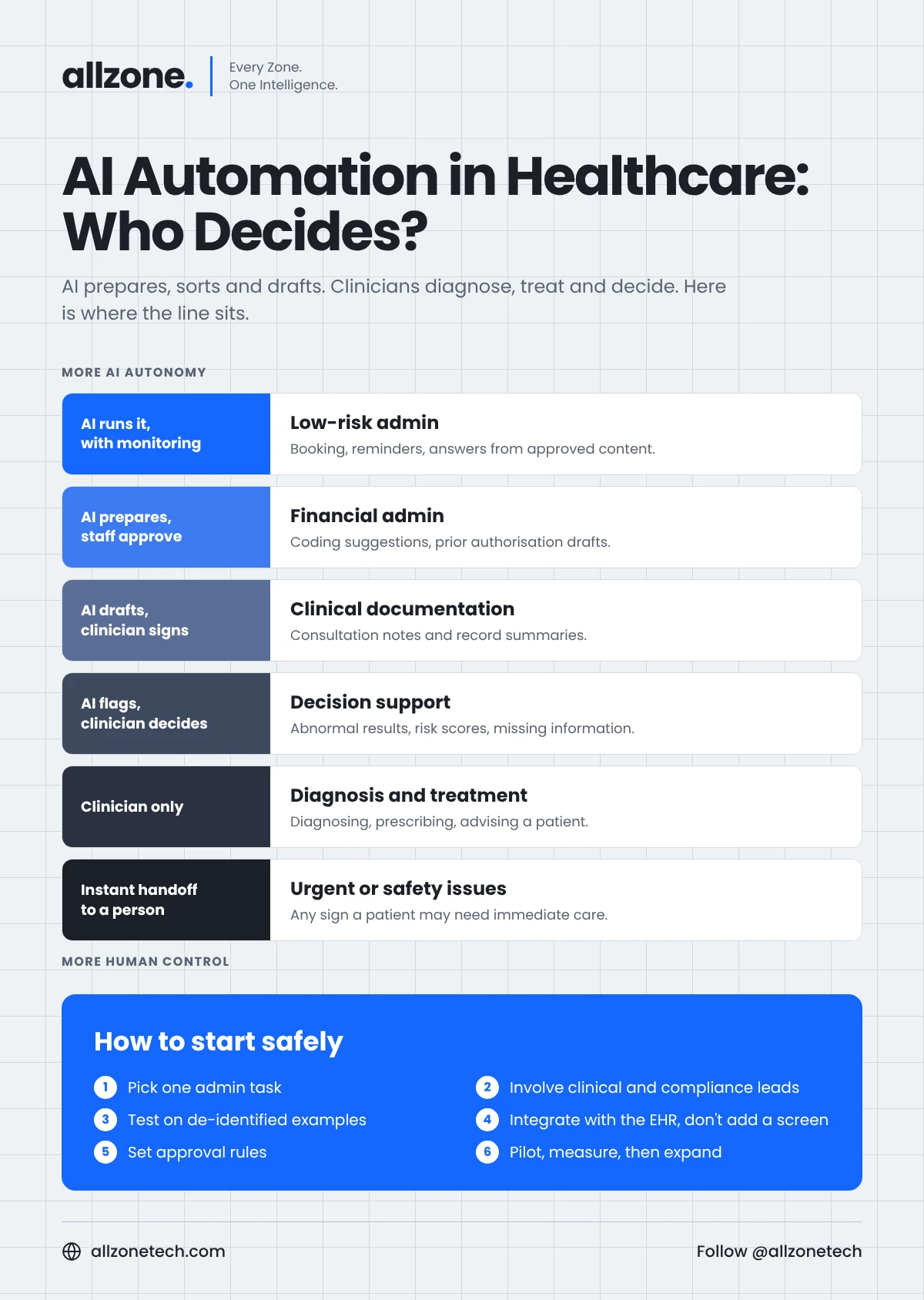
AI should prepare, sort and draft; clinicians should diagnose, treat and decide. A useful rule: AI can complete administrative tasks on its own once tested, can draft clinical content for review, and should never make or communicate a clinical decision without a qualified person approving it.
| Task type | Example | Level of AI autonomy |
|---|---|---|
| Administrative, low risk | Booking, reminders, FAQs from approved content | Can run end to end, with monitoring |
| Administrative, financial | Coding suggestions, prior authorisation drafts | AI prepares, staff approve |
| Clinical documentation | Draft consultation notes, summaries | AI drafts, clinician reviews and signs |
| Clinical decision support | Flagging abnormal results, risk scores | AI highlights, clinician decides |
| Diagnosis and treatment | Diagnosing, prescribing, advising a patient | Clinician only; AI may provide information |
| Urgent or safety issues | Symptoms that may need immediate care | Immediate handoff to a person |
Writing this table for your own organisation, with your clinical leads, is one of the most useful first steps in any AI project.
What are the pros and cons of AI in healthcare?
The main advantages of AI in healthcare are time saved on administrative work, faster responses to patients, more consistent documentation and earlier warning from data. The main disadvantages are errors delivered confidently, bias in data, privacy risk, integration effort and staff over-reliance. Most cons can be reduced with good design and governance.
| Pros | Cons |
|---|---|
| Frees staff from repetitive admin | Can produce confident but wrong output |
| Faster replies to patients, at any hour | May reflect bias in historical data |
| More complete, consistent documentation | Handles sensitive data that must be protected |
| Earlier alerts from operational and clinical data | Needs integration with existing systems |
| Fewer data-entry errors between systems | Staff may stop checking output over time |
| Scales without the same growth in headcount | Needs ongoing monitoring and governance |
How does AI reduce costs in healthcare, and what does it cost?
AI reduces healthcare costs mainly by cutting staff time on administrative tasks, reducing rejected claims and missed appointments, and helping plan capacity. The cost of AI in healthcare depends on scope: using features in existing software costs little extra, while custom AI agents connected to clinical systems need design, integration, testing and governance.
Where the savings usually come from:
- Staff time: fewer hours on calls, data entry, document sorting and drafting.
- Revenue cycle: cleaner claims and fewer denials.
- Missed appointments: better reminders and easier rescheduling.
- Capacity: better forecasts mean fewer last-minute staffing gaps.
What drives the cost:
- Integrations: connecting to the EHR, practice management and billing systems is often the largest piece of work.
- Data preparation: cleaning and organising the content the AI needs.
- Risk level: clinical use needs more testing, review steps and audit trails than administrative use.
- Running costs: model usage, hosting and monitoring each month.
We don't publish fixed prices because scope varies so much. The most reliable way to control cost is to start with one administrative use case, prove it on real data, then expand. Our AI MVP development approach is built around that.
How do you start with AI automation in healthcare, step by step?
Start with one high-volume administrative task, involve clinical and compliance leads from day one, test AI on real (de-identified) examples, connect it to the systems staff already use, keep people approving risky actions, pilot with one team and measure results before expanding.
- Pick one administrative task. Scheduling calls, referral sorting or intake are common starting points. Avoid clinical decisions for a first project.
- Bring the right people in early. A clinical lead, someone from compliance or information governance, and the staff who do the work today.
- Define success. For example, time per referral, call answer rate or share of intake forms completed without re-keying.
- Collect real examples. De-identify them where possible. These become the test set that proves whether the AI is accurate enough.
- Test before you build. Run the examples through the AI and review results with the people who do the job.
- Integrate, don't add a screen. Connect to the EHR, practice management or scheduling system, through standard interfaces such as HL7 or FHIR where available. Our guide on how to integrate AI into existing systems explains the options, and AI Integration Services covers how we do it.
- Set approval rules. Decide what the AI can do alone and what needs a person, using the autonomy table above.
- Pilot, measure, expand. Run with one team, track results and errors, fix what's missing, then roll out to the next task.
What does responsible AI in healthcare look like?
Responsible AI in healthcare means the AI is accurate enough for its task, protects patient data, treats patients fairly, is transparent about how it reached its output, and always has a named person accountable for its use. In practice that comes down to governance: clear rules, regular checks and the ability to switch it off.
A practical AI governance framework for healthcare covers:
- Purpose: what each AI tool is for, and what it must never do.
- Data: what data it can access, where it is processed and how long it is kept, in line with HIPAA, GDPR or your local health privacy law.
- Accuracy: test sets, accuracy targets and regular re-testing as models and processes change.
- Fairness: checks that results don't differ unfairly between patient groups.
- Traceability: every output linked to its source and every action logged.
- Accountability: a named owner, a review process and a way to report and fix problems.
Traceability is the part teams most often skip. In LabelRX, an AI compliance tool we built that checks product labels against FDA and industry standards, every finding maps back to the requirement behind it so a specialist can verify it. The same principle applies to any AI that touches patient care: show the source, don't just give the answer.
Hypothetical example: AI intake and scheduling for a multi-site clinic
This is a hypothetical example, not a client case. A group of outpatient clinics receives a high volume of phone calls and referral documents. Staff spend much of the day answering routine calls and typing referral details into the practice system.
- Goal: answer more calls, book appointments faster and stop re-keying referral data.
- Scope: an AI voice agent for booking, rescheduling and routine questions, plus AI document processing for incoming referrals.
- Controls: the voice agent never gives medical advice; any mention of symptoms or urgency goes straight to staff. Referral extraction is reviewed by staff before the record is created.
- Test: de-identified past calls and referrals are used to check accuracy before go-live.
- Pilot: one site for a few weeks, tracking answered calls, booking time, extraction accuracy and staff feedback.
- Decision: extend to all sites if targets are met; otherwise fix the gaps first.
Nothing here replaces the practice management system or a clinician. The AI removes the repetitive steps around them.
Ready to take admin work off your healthcare team?
AllZone Technologies builds AI automation for healthcare, from scheduling and intake agents to document processing and documentation support, connected to the systems you already use and designed with clinicians in control. See our healthcare software development services or talk to our team.