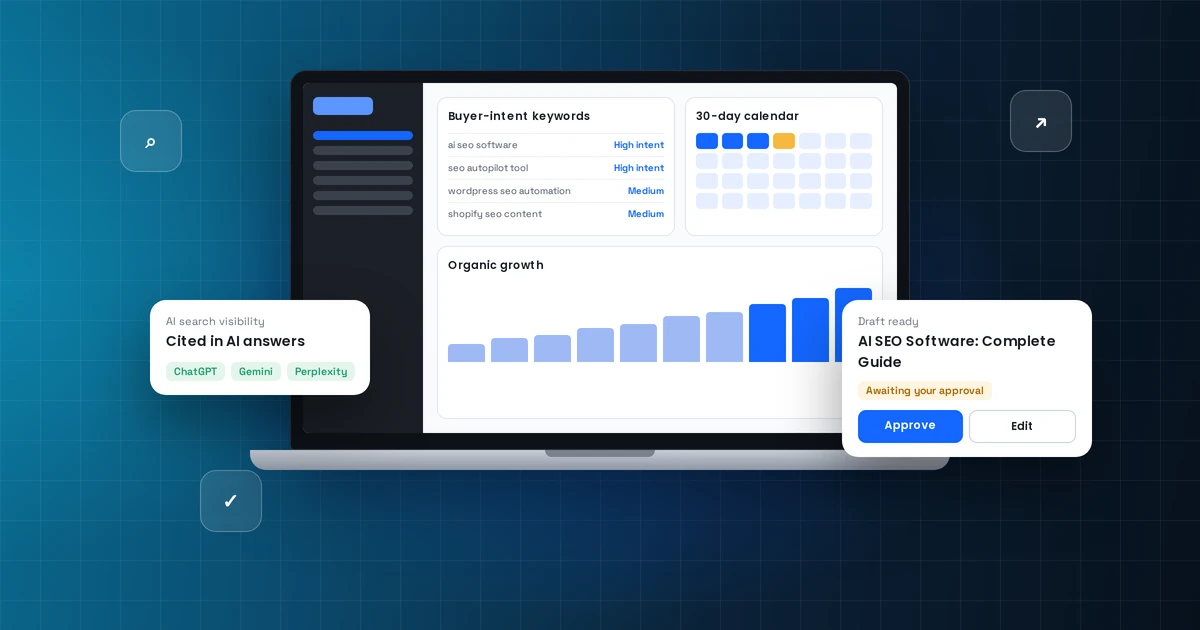
AI SEO software uses artificial intelligence to handle the repetitive work of search engine optimization: finding keywords people use when they're ready to buy, planning content, writing drafts, publishing to your website, earning links and tracking rankings in Google and AI answers. The best tools run that whole loop on a schedule while a person approves what goes live.
This guide explains everything you need to know about AI SEO going into 2027: what it is, how it differs from traditional SEO, SEO automation, GEO, AEO and AIO, how it works step by step, when and where to start, how to do each part well, which free tools help, how to choose software, common problems and fixes, best practices, a 90-day plan, interview-style questions and answers, and what's changing next year.
Last updated: November 2026
Key takeaways
- AI SEO software automates research, planning, writing, publishing and tracking, but your expertise and approval still decide quality.
- Google rewards helpful content however it's produced, and penalizes mass-produced pages made mainly to manipulate rankings.
- Start with keywords that signal buying intent, not the biggest search volumes.
- Topical authority comes from covering a subject thoroughly and consistently, which a rolling 30-day calendar makes manageable.
- Getting cited in ChatGPT, Gemini, Perplexity and Google's AI Overviews is now part of SEO.
- Approval-first publishing protects your brand; switch to auto-publish only once the output has earned trust.
- Measure leads and revenue from organic search, not just rankings and traffic.
What is AI SEO software?
AI SEO software is a tool that uses large language models and search data to plan, create, publish and measure content that ranks in search engines and AI assistants. Instead of switching between separate tools for keyword research, writing, publishing and reporting, it connects these steps into one workflow that runs continuously.
Traditional SEO tools give you data and leave the work to you. A keyword tool shows search volumes; you decide what to write. A rank tracker shows positions; you work out why they changed. AI SEO software goes further: it turns the data into actions, such as a content plan, a draft, a published page or an internal link, and repeats the cycle.
Most AI SEO software covers some or all of these jobs:
- Keyword research: finding the terms your future customers search, grouped into topics.
- Content planning: turning topics into a calendar of articles.
- Writing: drafting articles in your brand voice, with headings, FAQs and sources.
- On-page optimization: titles, meta descriptions, internal links, images and schema markup.
- Publishing: sending finished articles to WordPress, Shopify or another CMS.
- Link building: finding and tracking backlinks from relevant websites.
- Visibility tracking: monitoring rankings in Google and mentions in AI answers.
- Reporting: showing what's working and what to write next.
A platform that runs all of these on its own, with you as the final checkpoint, is often called an autonomous SEO platform or SEO command center. That's what we built Zonified to be.
How is AI SEO different from traditional SEO, SEO automation, SEO autopilot, GEO, AEO and AIO?
Traditional SEO is done mostly by people using separate tools. SEO automation uses software to handle repeated tasks. SEO autopilot runs the whole content loop on a schedule. GEO, AEO and AIO focus on being cited in AI answers, featured snippets and Google's AI Overviews. AI SEO software combines all of these in one workflow.
The terms overlap, which causes confusion. Here's how they differ:
| Term | What it means | Main focus | Who does the work |
|---|---|---|---|
| Traditional SEO | Optimizing a site to rank in search engines | Google rankings | People, using separate tools |
| SEO automation | Software that runs repeated SEO tasks, such as audits, reporting or rank checks | Saving time on tasks | Software, set up by people |
| AI SEO | Using AI models for research, writing and analysis | Speed and scale of content | AI, guided by people |
| SEO autopilot | Software that runs the full loop from keywords to publishing on a schedule | Consistent publishing | Software, with optional review |
| GEO (generative engine optimization) | Making your brand easy for AI assistants to understand, trust and recommend | Mentions in ChatGPT, Gemini, Perplexity | People and software |
| AEO (answer engine optimization) | Writing direct answers for snippets, voice search and AI answers | Being the quoted answer | Mostly content teams |
| AIO (AI Overviews optimization) | Shaping content so Google's AI Overviews pull and cite it | Citations in AI Overviews | Mostly content teams |
SEO vs GEO: do you need both?
Yes. GEO is not a replacement for SEO. AI assistants still rely heavily on content that search engines can find and trust, so the foundations are the same: helpful pages, clear answers, consistent business information and mentions on reputable sites. GEO adds new checks, such as whether AI crawlers can access your site, whether your brand appears for the questions buyers ask assistants, and which of your pages get cited.
AI SEO software vs AI writing tools
An AI writing tool helps you draft one article faster. AI SEO software decides which articles to write, writes them in a structure built for search, adds internal links and schema, publishes them, and tracks the results. The difference is the loop: a writing tool stops at the draft.
How does AI SEO software work, step by step?
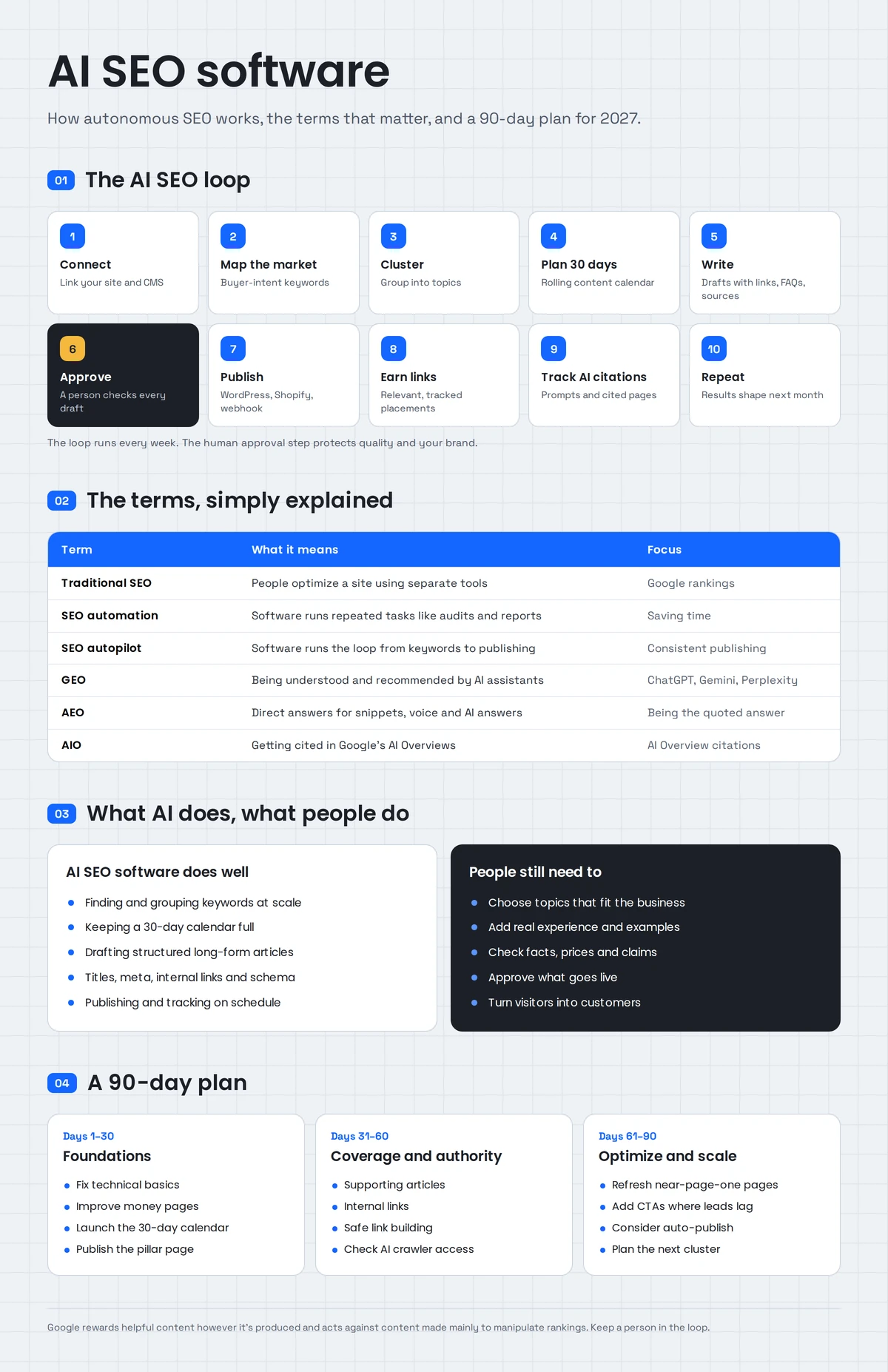
AI SEO software works in a repeating cycle: it reads your website and market, finds keywords with buying intent, groups them into topics, plans a content calendar, writes drafts, adds links and schema, publishes after approval, tracks rankings and AI citations, and uses the results to plan the next round.
Here's how the cycle looks in Zonified:
- Connect your site. Paste your URL and connect WordPress, Shopify or a webhook. Setup takes about five minutes.
- Map the market. The platform reads your business and finds what buyers type when they're comparing options, with volume and competition in one view.
- Build topic clusters. Keywords are grouped into clusters so your content covers each subject thoroughly.
- Fill a 30-day calendar. A rolling month of articles is planned and kept moving forward.
- Write drafts in your voice. Long-form articles arrive with images, internal links, FAQ schema and citations for statistics and bold claims.
- Approve or edit. Drafts stay private until you approve them. Rewrite with an AI command or by hand.
- Publish. Approved articles go live on your CMS, on the schedule you set.
- Earn and track links. Backlink placements are tracked on the dashboard.
- Track AI visibility. See which AI engines mention you, the prompts that surface your brand, and which pages get cited compared with competitors.
- Repeat. Performance data shapes the next month's plan.
The value isn't any single step. It's that the steps keep happening every week without someone copying drafts between five tools.
What can AI SEO software do, and what can't it do?
AI SEO software can research keywords, plan calendars, draft and optimize articles, publish, track links and report at a speed no small team can match. It can't supply your first-hand experience, verify every fact on its own, know your customers better than you do, or make an unhelpful business rank. Those still need people.
| AI SEO software does well | People still need to do |
|---|---|
| Finding and grouping keywords at scale | Choosing which topics fit the business |
| Planning and maintaining a calendar | Setting priorities and seasonal campaigns |
| Drafting structured long-form articles | Adding real experience, examples and opinions |
| Writing titles, meta descriptions and FAQs | Approving what goes live under your name |
| Adding internal links and schema | Checking facts, prices and claims |
| Publishing on a schedule | Deciding when to switch to auto-publish |
| Tracking rankings, links and AI citations | Turning visitors into customers |
Think of it as a fast, tireless team that needs an editor. The editor is you.
Is AI-generated content bad for SEO?
No, AI-generated content isn't bad for SEO by itself. Google has said it rewards helpful, reliable content regardless of how it's produced. What it penalizes is content made mainly to manipulate rankings, including large volumes of low-value pages, whether written by AI or people. Quality, accuracy and real usefulness decide the outcome.
Google's own guidance on AI-generated content is clear on this point. Its spam policies separately target what they call scaled content abuse: producing many pages mainly to rank, with little value for readers.
The practical difference between helpful AI content and spam:
| Helpful AI-assisted content | Scaled content abuse |
|---|---|
| Answers a real question better than other pages | Repeats what's already ranking |
| Includes specific facts, examples and sources | Vague, generic statements |
| Reviewed and approved by someone accountable | Published without review |
| Published at a pace you can keep quality up | Hundreds of pages at once |
| Built around what customers need | Built around keyword lists alone |
That's why we made approval-first publishing the default in Zonified and require citations for statistics and bold claims. Speed only helps if quality holds.
When is the best time to start with AI SEO?
The best time to start with AI SEO is as soon as your website clearly explains what you sell, your main service or product pages are in good shape, and you can commit to reviewing content every week. SEO compounds over months, so starting earlier means results arrive earlier, but starting before the basics are fixed wastes effort.
You're ready to start when:
- Your homepage and main service or product pages say clearly what you do and who it's for.
- Your site loads quickly, works on phones and can be crawled.
- Google Search Console is connected.
- Someone can spend about an hour a week reviewing drafts.
- You know how a visitor becomes a lead or customer.
It's worth waiting a few weeks if your site is mid-redesign, if you're changing domains, or if your offer is about to change significantly. Fix those first, then start.
What about seasonality?
Publish seasonal content two to three months before the season peaks, so it has time to be indexed and gain trust. For evergreen topics, there's no best month: the best time is now, because every week of consistent publishing adds to the next.
Where should you start?
Start where the money is closest: the pages and keywords that bring buyers, not just readers. For most businesses that means improving key service or product pages first, then publishing content that answers the questions buyers ask before they purchase. The right starting point depends on the type of business.
| Business type | Where to start | First 30 days |
|---|---|---|
| Local service business | Google Business Profile, service pages, reviews | Service pages per offering, local FAQs, review requests |
| B2B services or software company | Service pages and comparison content | "How to choose", cost and comparison articles |
| E-commerce store | Category and product pages | Buying guides, product comparisons, care and how-to content |
| SaaS product | Use-case and integration pages | Use-case articles, alternatives pages, templates |
| Agency managing clients | One client pilot | A 30-day calendar for the client with the clearest goals |
| New website | Core pages and a narrow topic | One topic cluster done thoroughly before expanding |
A useful rule: if a page could bring you a customer this month, improve it before writing new blog posts.
How do you research keywords that buyers actually search?
Research keywords for buyers by starting from what you sell, then finding the searches people make when they're comparing options or ready to act: "best", "cost", "vs", "for [industry]", "near me" and problem-based questions. Group them into topics, check how competitive each is, and prioritize terms a new page can realistically rank for.
Search intent matters more than search volume. A keyword with 200 monthly searches from people ready to buy can be worth more than one with 20,000 from people who just want a definition.
| Intent | What the searcher wants | Example | Business value |
|---|---|---|---|
| Informational | To learn | "what is topical authority" | Low to medium |
| Commercial | To compare options | "best SEO autopilot software" | High |
| Transactional | To buy or sign up | "AI SEO software free trial" | Very high |
| Navigational | To find a specific site | "Zonified login" | Brand only |
A simple process:
- List what you sell and the problems it solves.
- Collect keyword ideas from Search Console, competitor pages, customer questions and keyword tools, including our free LSI Keyword Generator for related terms and question variations.
- Label the intent of each keyword.
- Group keywords into topics that one page or one cluster can cover.
- Check difficulty against your site's authority. Newer sites should start with lower-difficulty, specific terms.
- Prioritize by business value first, then volume. See where you already rank with the free Keyword Rank Checker.
Zonified does this automatically when you connect a site, showing high-intent opportunities with volume and competition in one view and building the topic clusters for you.
How do you build topical authority with a 30-day content calendar?
Topical authority is the trust search engines and AI tools give a site that covers a subject thoroughly and consistently. Build it by choosing one core topic, publishing a main pillar page, surrounding it with supporting articles that answer related questions, linking them together, and keeping a steady publishing rhythm, such as a rolling 30-day calendar.
A topic cluster has three parts:
- Pillar page: a complete guide to the main topic, like this one for AI SEO software.
- Supporting articles: narrower pieces that go deep on one question each, such as "GEO vs AEO" or "how to write meta descriptions".
- Internal links: every supporting article links to the pillar, and the pillar links back to each.
Why a 30-day calendar works: it's long enough to cover a cluster properly, short enough to adjust based on results, and it keeps publishing consistent. In Zonified the calendar rolls forward, so there are always 30 days of planned articles ahead. To plan a single article by hand, the free Blog Outline Generator and Content Brief Generator give you headings, questions to answer and semantic keywords.
An example month for a company selling AI SEO software:
| Week | Focus | Example articles |
|---|---|---|
| 1 | Pillar and definitions | AI SEO software guide, GEO vs AEO vs AIO, what is SEO autopilot |
| 2 | Comparisons | AI SEO software vs SEO agency, approval-first vs auto-publish |
| 3 | How-to | How to build a topic cluster, how to write AI-ready FAQs |
| 4 | Buyer guides | How to choose AI SEO software, AI SEO software for Shopify stores |
What makes an AI-written article rank in Google and AI answers?
An AI-written article ranks when it answers the searcher's question better than existing pages: a direct answer near the top, clear question-based headings, specific facts with sources, real examples, sensible internal links, accurate titles and descriptions, FAQ sections, and a person who reviewed it. Structure helps search engines; substance earns the ranking.
A quality checklist for every article:
- Direct answer first. Two or three sentences that fully answer the main question.
- Question headings. Phrase H2s and H3s the way people ask, with a 40–60 word answer under each.
- Keyword placement without stuffing. Use the main keyword in the title, meta description, first paragraph and one or two headings, then write naturally. Test titles with the Headline Analyzer and SEO Title Generator or brainstorm options with the Blog Title Generator. Draft snippets with the Meta Description Generator and preview them in the Google SERP Preview Tool. The Keyword Density Checker flags over-optimization.
- Specific claims. Names, numbers, steps and examples instead of general statements.
- Sources for statistics and bold claims. Link to the original source.
- Experience. Something only your business knows: a case, a process, a mistake you've seen.
- Internal links that point the reader to the next useful page.
- FAQ section with schema for questions people search. The free FAQ Generator drafts 40–60 word answers you can edit.
- Images with descriptive alt text. The Alt Text Generator keeps it accessible and under 125 characters.
- Author and reviewer names with relevant experience.
- Last-updated date, refreshed when facts change.
Zonified's drafts follow this structure by design: keywords in titles, meta and openings without stuffing, internal links, Q&A blocks, citations for statistics and bold statements, and depth where the topic needs it rather than filler. If you write or edit by hand, check the Readability Checker and Word Counter, and run pasted AI text through the AI Text Cleaner to remove hidden characters.
How should you publish: approval-first or auto-publish?
Start with approval-first publishing, where every draft waits for a person to approve it, until you've reviewed enough articles to trust the output. Then consider auto-publish for content types that consistently need no changes, while keeping approval for anything sensitive, such as pricing, legal, medical or financial topics.
| Approval-first | Auto-publish | |
|---|---|---|
| How it works | Drafts stay private until approved | Articles publish on schedule |
| Best for | New accounts, sensitive topics, strong brand voice | Proven content types, high-volume calendars |
| Main benefit | Full control and quality assurance | Speed and consistency |
| Main risk | Bottleneck if nobody reviews | Errors go live unnoticed |
In Zonified, approval-first is the default. You can switch to auto-publish when you trust the queue and switch back anytime. Edits can be made with an AI command or by hand in the editor.
Publishing to WordPress and Shopify
Direct publishing removes the slowest manual step: copying drafts into the CMS, fixing formatting, uploading images and filling SEO fields. Zonified connects to WordPress, Shopify or any system through a webhook, so approved articles arrive with formatting, images, internal links and FAQ schema in place. If you publish by hand, create clean URLs with the URL Slug Generator and social previews with the Open Graph Generator.
How do you build backlinks safely?
Build backlinks safely by earning links from relevant, real websites through useful content, partnerships, guest articles, digital PR and genuine business relationships. Avoid buying links that pass ranking credit, link exchanges at scale and private blog networks, which Google treats as link spam. If a placement is paid or sponsored, mark it with rel="sponsored".
Safe link sources:
- Original data and tools that others want to reference, such as free calculators or checkers.
- Guest articles on relevant industry sites, written to help their readers.
- Partners, suppliers and customers who link to businesses they work with.
- Digital PR: expert comments for journalists and industry publications.
- Business and industry directories that real buyers use.
Warning signs of risky link building:
- Guaranteed numbers of links per month from unrelated sites.
- Links from sites that exist only to sell links.
- Identical anchor text across many links.
- Sudden spikes of links from low-quality domains.
Whatever method you use, track every link. Zonified shows each backlink placement on the dashboard, so you can see where links come from and judge their quality.
How do you get cited by ChatGPT, Gemini, Perplexity and AI Overviews?
To get cited by AI assistants and Google's AI Overviews, let AI crawlers access your site, publish clear and specific answers to the questions buyers ask, keep your business information consistent across the web, earn mentions on trusted sites, use structured data, and track which prompts and pages surface your brand so you can fill the gaps.
Practical steps:
- Check crawler access. Make sure robots.txt doesn't accidentally block the crawlers you want, such as Googlebot, Bingbot, OAI-SearchBot, PerplexityBot or ClaudeBot. Decide deliberately which AI crawlers to allow. The Robots.txt Checker tests permissions for Googlebot and AI crawlers, and the Robots.txt Generator builds a clean file.
- Answer questions directly. Short, quotable answers under question headings are easier for AI tools to use.
- Be specific and current. Named products, prices, steps and dates beat general claims.
- Build consistent entity signals. The same company name, description and details on your site, profiles and directories.
- Earn mentions. Reviews, comparisons, industry articles and community discussions shape what assistants say about you.
- Track prompts and citations. Monitor which questions bring up your brand, which pages are cited, and where competitors appear instead.
Zonified's AI visibility tracking covers mentions across AI engines, the prompts that surface your brand and your cited pages compared with competitors. The free AI Visibility Checker also audits crawler permissions, structured data and llms.txt, a proposed file that summarizes your site for AI tools; support for it varies between AI providers.
Which technical SEO basics still matter?
Technical SEO still matters because content can't rank if search engines can't crawl, render and index it. The basics are a clean robots.txt, an XML sitemap, correct canonical tags, fast pages that pass Core Web Vitals, mobile-friendly design, HTTPS, working internal links, structured data and no broken or duplicate pages.
| Area | What to check | Free tool |
|---|---|---|
| Crawling | robots.txt rules, blocked pages | Robots.txt Checker, Google Search Console |
| Crawl rules | Safe defaults for Googlebot, Bingbot and AI crawlers | Robots.txt Generator |
| Rendering | What Googlebot actually sees, status codes, headers | Googlebot Simulator, URL Inspection in Search Console |
| Indexing | Pages indexed or excluded | Google Search Console |
| Canonicals | One preferred URL per page | Googlebot Simulator, site crawler |
| Speed | Largest Contentful Paint, Interaction to Next Paint, Cumulative Layout Shift | PageSpeed Insights |
| Structured data | Valid JSON-LD for articles, FAQs, products | Schema Markup Generator, Rich Results Test |
| URLs | Short, readable, keyword-based slugs | URL Slug Generator |
| Images | Descriptive, accessible alt text | Alt Text Generator |
| Sitemaps | Up-to-date list of important URLs | Search Console, Bing Webmaster Tools |
A common, costly mistake: a canonical tag pointing to the wrong domain or URL, which quietly tells Google to rank a different page. Check canonicals whenever you launch or migrate pages.
Free SEO tools that help at every step
You can handle much of SEO with free tools. Google Search Console, Bing Webmaster Tools, Google Analytics 4 and PageSpeed Insights cover performance and technical health, while Zonified's free SEO tools hub offers 41 tools for content, technical SEO, AI visibility, rank tracking and social content, with no signup required.
Free tools from search engines
- Google Search Console: search queries, clicks, indexing status, Core Web Vitals and manual actions.
- Bing Webmaster Tools: the same for Bing, which also feeds several AI assistants. Supports IndexNow for faster indexing.
- Google Analytics 4: what visitors do after they arrive, including conversions.
- PageSpeed Insights: page speed and Core Web Vitals scores with fixes.
- Rich Results Test: whether your structured data qualifies for rich results.
Zonified free tools by task
SEO doesn't stop at publishing. Every article is also raw material for social posts, and search engines and AI tools notice brands that are discussed widely. Turn each new article into a LinkedIn post, a short video description and a few captions with the social tools above, then use the engagement calculators to see which formats your audience responds to.
Paid tools and where they fit
All-in-one suites such as Semrush and Ahrefs are strong for deep keyword and backlink research; content optimizers such as Surfer and Frase help writers match search intent; crawlers such as Screaming Frog audit large sites. AI SEO platforms such as Zonified sit on top: they turn research into a running calendar, finished articles and published pages. Many teams use one research suite plus one AI SEO platform.
How do you choose AI SEO software?
Choose AI SEO software by matching it to the work you want removed: research only, writing only, or the whole loop from keywords to published pages. Then check content quality, control over publishing, CMS integrations, AI visibility tracking, how it handles links, data ownership and support. Test it on your own site before committing.
AI SEO software by category
| Category | What it does | Best for | Limitation |
|---|---|---|---|
| SEO suites | Keyword, backlink and competitor data, audits | Teams with SEO specialists | You still write and publish |
| Content optimizers | Score drafts against top-ranking pages | Writers and editors | No planning or publishing |
| AI writers | Draft articles from prompts | Fast first drafts | No strategy, linking or tracking |
| SEO autopilot tools | Generate and publish articles on a schedule | Small teams wanting volume | Quality and control vary widely |
| SEO command centers | Research, calendar, writing, approval, publishing, links and AI visibility in one place | Teams wanting results without managing five tools | Needs a reviewer, at least at first |
Checklist before you buy
- Does it find keywords by buying intent, not just volume?
- Does it plan topic clusters and a rolling calendar?
- Can you match your brand voice, and edit easily?
- Are drafts private until approved, with optional auto-publish?
- Does it publish directly to your CMS with images, links and schema?
- Does it cite sources for statistics and claims?
- Does it track rankings and AI search citations?
- Is its link building transparent and within search engine guidelines?
- Do you own the content, and can you export it?
- Can you cancel easily?
Common AI SEO problems and how to solve them
The most common AI SEO problems are generic content, factual errors, pages that don't get indexed, keyword cannibalization, rankings without leads, risky backlinks, and invisibility in AI answers. Each has a practical fix, usually combining better inputs, human review and a technical check.
| Problem | Likely cause | Solution |
|---|---|---|
| Articles sound generic | No brand voice or first-hand input | Add your examples, opinions and processes; set a voice profile |
| Factual errors | No source checking | Require citations; review numbers, prices and claims before approval |
| Pages not indexed | Thin content, crawl blocks or wrong canonicals | Check Search Console, robots.txt and canonicals; improve thin pages |
| Two pages compete for one keyword | Overlapping topics | Assign one keyword per page; merge or redirect duplicates |
| Traffic but no leads | Informational keywords only, weak calls to action | Add commercial-intent topics; add CTAs mid-article with the CTA Generator |
| Rankings dropped after an update | Low-value pages or over-optimization | Prune or improve weak pages; focus on helpfulness |
| No AI search mentions | Blocked crawlers, vague content, few external mentions | Allow crawlers, add direct answers, earn mentions |
| Risky backlinks | Paid or irrelevant link sources | Use relevant, editorial links; mark sponsored links |
| Publishing bottleneck | Manual copy-paste into the CMS | Connect direct publishing |
| Calendar runs dry | Planning done in bursts | Use a rolling 30-day calendar |
| Nobody reviews drafts | Unclear ownership | Assign a reviewer and a weekly review slot |
| Duplicate or broken canonicals | CMS or template settings | Audit canonicals after every launch |
AI SEO best practices for 2027
- Lead with buyer intent. Prioritize keywords that bring customers.
- Fix money pages first. Service, product and category pages before blog posts.
- Build clusters, not one-offs. Pillars plus supporting articles, all linked.
- Publish consistently. A steady rhythm beats occasional bursts.
- Keep a human checkpoint. Approval-first until the output has earned trust.
- Add experience. Every article should contain something only you know.
- Cite your sources. Link statistics and bold claims to the original.
- Answer first. Two or three sentence answers at the top and under each heading.
- Use structured data. Article, FAQ, product and organization schema where relevant.
- Show who's behind it. Author and reviewer names with real expertise.
- Update content. Refresh facts, dates and examples at least twice a year.
- Link internally on purpose. Point every article to the next useful page.
- Earn links honestly. Relevance and real relationships over volume.
- Track AI visibility. Treat AI citations as a second results page.
- Measure revenue. Judge SEO by leads and sales, not traffic alone.
How do you measure AI SEO results?
Measure AI SEO results in three layers: visibility (impressions, rankings and AI citations), engagement (clicks, click-through rate and time on page), and business results (leads, sign-ups, sales and revenue from organic search). Early months show visibility; business results usually follow later as rankings strengthen.
| Layer | Metric | Where to find it |
|---|---|---|
| Visibility | Impressions and average position | Google Search Console |
| Visibility | Keywords in the top 10 | Rank tracker |
| Visibility | AI engine mentions and cited pages | AI visibility tracking |
| Engagement | Clicks and click-through rate | Search Console |
| Engagement | Engaged sessions from organic search | Google Analytics 4 |
| Authority | New referring domains | Backlink tracking |
| Business | Leads, sign-ups and sales from organic | GA4 conversions, CRM |
| Efficiency | Articles published per month, hours saved | Your content calendar |
Set expectations honestly: new content often takes weeks to be indexed and months to reach strong positions, especially on competitive terms and newer sites. Tag links you share in newsletters and social posts with the free UTM Builder so Google Analytics shows which campaigns bring visitors.
A 90-day AI SEO plan
A 90-day AI SEO plan spends the first month on foundations and the first content cluster, the second month on expanding coverage and links, and the third on optimizing what's working and scaling the calendar. Each month ends with a review of rankings, AI citations and leads.
| Period | Focus | Actions |
|---|---|---|
| Days 1–30 | Foundations and first cluster | Fix technical basics, improve money pages, connect Search Console, launch the 30-day calendar with approval-first publishing, publish the pillar page |
| Days 31–60 | Coverage and authority | Publish supporting articles, add internal links, start safe link building, check AI crawler access and track AI mentions |
| Days 61–90 | Optimize and scale | Refresh pages close to page one, add CTAs where traffic lacks leads, consider auto-publish for proven content types, plan the next cluster |
AI SEO interview questions and answers
Whether you're hiring an SEO specialist, preparing for an interview, or testing a vendor, these questions show who understands SEO in 2027.
1. What is AI SEO?
AI SEO is the use of artificial intelligence to research keywords, plan and write content, optimize pages, publish, build authority and track results in search engines and AI assistants. It speeds up SEO work, but strategy, expertise and quality control still come from people.
2. How is GEO different from SEO?
SEO focuses on ranking pages in search results. GEO focuses on being understood, trusted and recommended by AI assistants like ChatGPT, Gemini and Perplexity. They share foundations, such as helpful content and authority, but GEO adds AI crawler access, prompt tracking and citation monitoring.
3. What is the difference between AEO and AIO?
AEO, answer engine optimization, means writing direct answers that featured snippets, voice search and AI tools can quote. AIO, AI Overviews optimization, focuses specifically on being cited in Google's AI Overviews. AIO is one part of the broader AEO practice.
4. Does Google penalize AI-generated content?
No, not because it's AI-generated. Google rewards helpful content however it's made. It acts against content produced mainly to manipulate rankings, including scaled, low-value pages. The answer is quality and review, not avoiding AI.
5. What is topical authority?
Topical authority is the trust a site earns by covering a subject thoroughly and consistently. It's built with pillar pages, supporting articles that answer related questions, strong internal linking and regular publishing on the same subject.
6. How do you choose which keywords to target?
Start with business value and search intent, then check difficulty against the site's authority. Prioritize commercial and transactional keywords a new page can realistically rank for, grouped into topics, rather than chasing the highest volume.
7. What is search intent?
Search intent is the reason behind a search: to learn, compare, buy or find a specific site. Matching the content type and depth to the intent, such as a comparison for "vs" searches, is one of the strongest ranking factors you control.
8. What is keyword cannibalization, and how do you fix it?
Keyword cannibalization happens when two or more of your pages target the same keyword and compete. Fix it by assigning one primary keyword per page, merging overlapping pages, redirecting the weaker one, and updating internal links and anchors.
9. How do you make content more likely to be cited by AI tools?
Answer questions directly near the top, use specific facts and sources, keep business details consistent everywhere, allow the right AI crawlers, add structured data, and earn mentions on reputable sites. Then track which prompts and pages surface your brand.
10. What are Core Web Vitals?
Core Web Vitals are Google's page experience metrics: Largest Contentful Paint for loading, Interaction to Next Paint for responsiveness, and Cumulative Layout Shift for visual stability. They're measured from real user data and shown in Search Console and PageSpeed Insights.
11. What does a canonical tag do?
A canonical tag tells search engines which URL is the preferred version of a page when similar versions exist. An incorrect canonical, such as one pointing to another domain, can stop the right page from ranking. A Googlebot Simulator shows the canonical Google actually sees.
12. How do you build backlinks safely?
Earn links from relevant, real websites through useful content, partnerships, guest articles and digital PR. Avoid buying links that pass ranking credit or joining link networks, and mark paid placements with rel="sponsored".
13. Should AI-written articles be published automatically?
Start with approval-first publishing so a person reviews every draft. Once a content type consistently needs no changes, auto-publish can work, but keep human review for sensitive topics like pricing, health, finance and legal.
14. How do you measure SEO success?
Track visibility (impressions, rankings, AI citations), engagement (clicks, click-through rate) and business results (leads, sales and revenue from organic). Business results are the real goal; visibility metrics show whether you're on the way.
15. What is structured data?
Structured data is code, usually JSON-LD, that describes a page's content to search engines, such as an article, FAQ, product or organization. It can make pages eligible for rich results and helps machines understand your content. A Schema Markup Generator creates valid JSON-LD for common types.
16. How long does SEO take to work?
Indexing can take days to weeks, and strong rankings usually take months, depending on competition and site authority. Consistent publishing and improvements compound over time, which is why starting early matters.
17. What is E-E-A-T?
E-E-A-T stands for experience, expertise, authoritativeness and trustworthiness, concepts from Google's quality rater guidelines. Showing real experience, credible authors, accurate sources and a trustworthy site helps content meet these standards.
18. How do you handle a ranking drop?
Check for technical issues first (indexing, canonicals, robots.txt, speed), then compare with known algorithm updates and competitors. Improve or consolidate weak pages, strengthen the most valuable ones and avoid reacting with large, untested changes.
19. What's the role of internal linking?
Internal links help search engines discover pages, show how topics relate and pass authority between pages. They also guide readers to the next useful page, which supports engagement and conversions.
20. What's the biggest SEO mistake teams make with AI?
Publishing large volumes of unreviewed, generic content. It wastes crawl attention, can trigger spam policies and damages trust. Use AI for speed, but keep strategy, experience and approval with people.
What will change in SEO in 2027?
In 2027, SEO will continue shifting toward AI-driven search experiences, where Google's AI features and assistants like ChatGPT, Gemini and Perplexity answer more questions directly. That raises the value of being cited, of clear and specific content, of consistent brand information and of first-hand expertise, while basic, generic content becomes easier to replace.
What we expect to matter most:
- AI answers as a second results page. Tracking citations and prompts will be standard reporting.
- Brand and entity signals. Consistent information and mentions across the web will shape what assistants say.
- Experience over volume. Generic content gets summarized away; original insight gets cited.
- Faster, continuous publishing. Rolling calendars replace occasional content pushes.
- Tighter guardrails. Search engines will keep acting against scaled low-value content and manipulative links.
- Measurement beyond clicks. Some value will come from mentions and assisted conversions, not only visits.
The businesses that win won't be the ones publishing the most. They'll be the ones publishing consistently useful content, verified by people, in a system that keeps running.
Start your first 30 days
You don't need five tools and a spreadsheet to grow organic traffic. You need buyer-intent keywords, a month of content that keeps rolling forward, articles built for Google and AI answers, and the final say on what goes live.
Zonified, built by AllZone Technologies, researches, plans, writes and publishes your content with you as the last checkpoint. Get your free 30-day growth plan or try the free SEO tools.