To build an AI MVP, pick one workflow where AI clearly saves time or money, prove the model works on your real data, then build the smallest product real users can try. Measure quality and running cost from day one. Done well, you get evidence to scale, change or stop within weeks rather than quarters.
That sounds simple. In practice, most AI MVPs go wrong in the same few places: the scope grows, the AI is never tested on messy real inputs or the monthly model bill shows up after launch as a surprise.
This guide walks through the full process we use: what an AI MVP is, how it differs from a proof of concept, the steps, what drives cost and timeline and what changes if your users are in the USA, Canada or the UK.
What is an AI MVP and how is it different from a regular MVP?
An AI MVP is the smallest working version of an AI product that real users can try. It tests two things at once: whether people want the product and whether the AI produces output that is accurate, safe and affordable enough to rely on. A regular MVP only tests the first.
A regular MVP is mostly deterministic. A button either saves the record or it doesn't. You test demand, usability and pricing.
An AI MVP adds uncertainty at the core. The same question can get a slightly different answer each time. The model can sound confident and still be wrong. And every request has a cost, because you pay a model provider for each call or run your own model on paid infrastructure.
That changes what "done" means. A finished AI MVP needs:
- A quality target, written before the build (for example, the share of test questions the AI must answer correctly, with a cited source)
- An evaluation set, a collection of real inputs with known good outputs, used to score the AI
- A run-cost estimate, what one user or one task costs per month at expected volume
- Guardrails, rules that stop the AI doing something harmful or embarrassing
- A human fallback, a way for a person to step in when the AI is unsure
Skip these and you have a demo, not an MVP.
What is the difference between an AI MVP, a proof of concept and a prototype?
A proof of concept (PoC) answers "can the AI do this task at all?" A prototype answers "will users understand how the product works?" An AI MVP answers "will real users use it and does the AI hold up when they do?" Most teams need a short PoC step inside the MVP, not a separate project.
| Proof of concept | Prototype | AI MVP | |
|---|---|---|---|
| Core question | Is it technically possible? | Is the flow clear? | Is it useful, reliable and affordable? |
| Audience | Internal team | Test users, stakeholders | Real users or a pilot group |
| Data | Small sample | Often fake | Real, with permissions |
| Code | Often thrown away | Little or none | Kept and extended |
| What you learn | Feasibility | Usability | Demand + AI quality + run cost |
| Good next step | Prototype or MVP | MVP | Scale, pivot or stop |
One practical rule: if your use case is well known (summarising documents, answering questions from a knowledge base), you can usually skip a standalone PoC and fold it into the first weeks of the MVP. If the use case is new or depends on unusual data, run the PoC first and keep it short.
Do you actually need an AI MVP?
You need an AI MVP when there is a real chance the AI won't work well enough, users won't adopt it or the run cost won't make sense. If the use case is proven and low risk, such as a standard FAQ chatbot, you may be better off buying a tool and configuring it.
An AI MVP is a good fit when most of these are true:
- The task involves reading, writing, sorting or deciding on unstructured input (emails, documents, calls, images)
- People do the task often enough that saving time matters
- You have or can get, real examples of the task done well
- A wrong answer is fixable or a person can review output before it's used
- No off-the-shelf tool does it well for your workflow
- You need evidence before committing a larger budget
If you tick fewer than three, talk to someone before you build. Sometimes the honest answer is a workflow fix or plain software, not AI.
How do you build an AI MVP step by step?
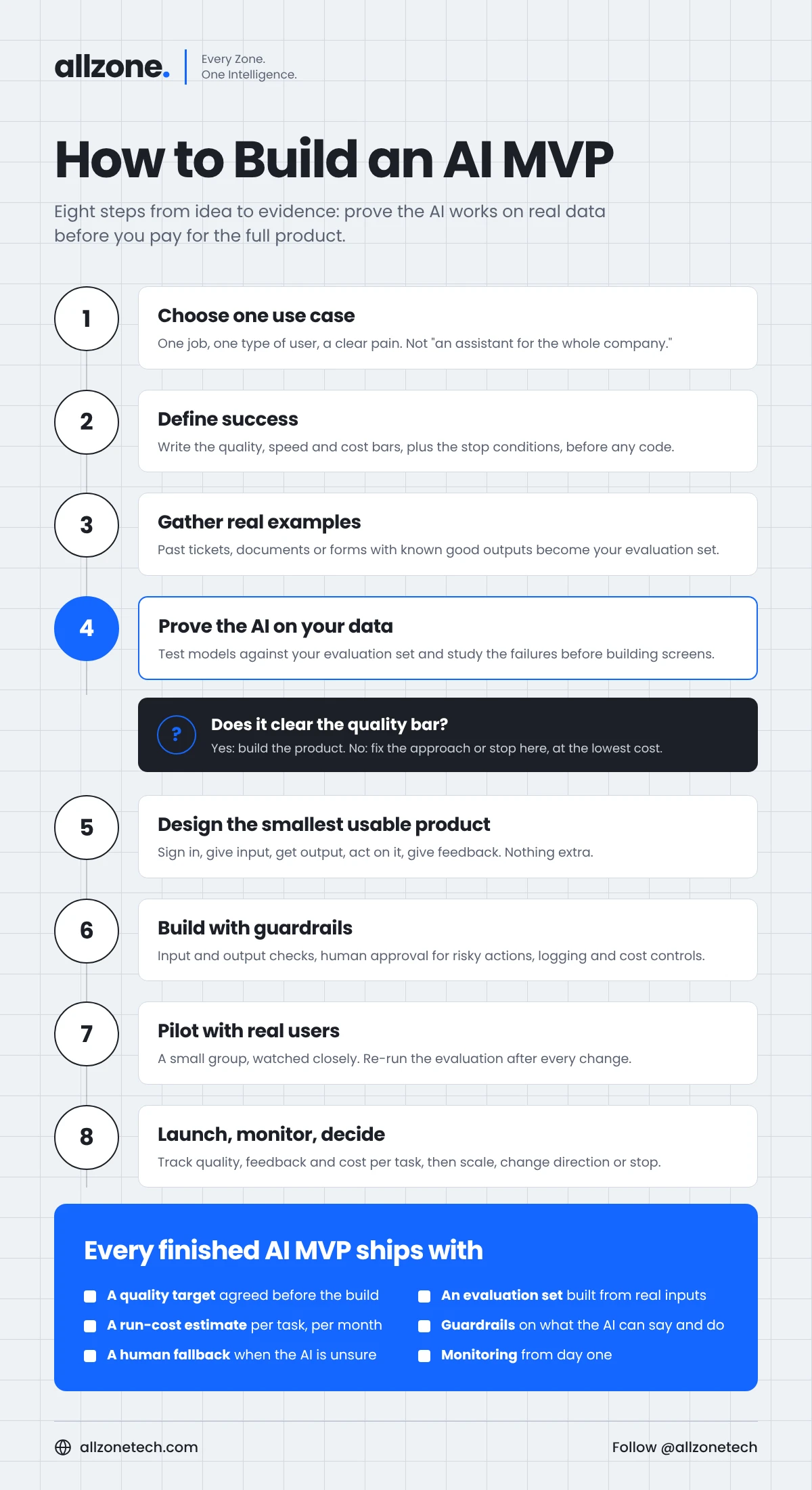
Building an AI MVP takes eight steps: choose one painful use case, define success, collect test data, prove the AI on that data, design the smallest workable product, build it with guardrails, test with a pilot group, then launch with monitoring. The order matters most at step four: prove before you build screens.
Step 1 — Choose one use case with a clear pain
Start with one job, done by one type of user. "An assistant for our whole company" is not an MVP. "Draft a first reply to warranty claims for the support team" is.
Good MVP use cases share three traits: the task is frequent, the current process is slow or costly and someone can judge whether the AI's output is right.
Step 2 — Define what success looks like
Write the success criteria before any code. Include:
- A quality bar (accuracy, correct citations, task completion rate)
- A speed bar (how fast an answer must arrive for users to keep using it)
- A cost bar (the most you can pay per task and still make the numbers work)
- Stop conditions (what result means you pause or drop the idea)
Stop conditions sound negative, but they protect your budget. Without them, AI projects drift into endless tuning.
Step 3 — Gather real examples for testing
Collect real inputs and the outputs a good employee would produce. Past tickets, documents, call notes or forms all work. Remove or mask personal data you don't need.
This set becomes your evaluation set. Even a modest number of good examples tells you far more than a polished demo.
Step 4 — Prove the AI on your data
Before building the full interface, run the AI against your test set. Try a couple of models and prompting approaches. Add retrieval (RAG) if the answers must come from your documents.
Score the results against your quality bar. Look closely at the failures: are they rare edge cases or a pattern? This step is where you find out, cheaply, whether the idea works.
Step 5 — Design the smallest product users can actually use
Now design the product around what the AI can reliably do. Keep it to the core flow: sign in, give the input, get the output, act on it, give feedback.
Leave out dashboards, admin panels, dark mode and integrations nobody needs yet. A thumbs-up/thumbs-down button on every AI answer is more valuable at this stage than ten extra features.
Step 6 — Build with guardrails and cost controls
Build the application, the back end and the integrations. At the same time, add:
- Input and output checks, so the AI can't be pushed into harmful or off-topic answers
- Human approval for any action that sends, pays, deletes or changes records
- Logging of prompts and responses (with privacy rules applied)
- Caching and model routing, so simple requests use cheaper models
- A design that lets you switch model providers without rewriting the product
Step 7 — Test with a pilot group
Give the MVP to a small group of real users. Watch what they do, not just what they say. Re-run the evaluation set after every change so fixes don't quietly break something else.
Step 8 — Launch, monitor and decide
Launch to a wider group with monitoring in place: quality scores, user feedback, response times and cost per task. After a set period, review the evidence and decide to scale, change direction or stop.
How much does an AI MVP cost?
AI MVP cost depends mainly on architecture: an MVP built on an existing model API costs far less than one needing custom model training, complex agents or heavy integrations. Published industry estimates range from the low tens of thousands of US dollars to well over $100,000. You also pay ongoing model and hosting costs after launch.
We don't publish fixed prices because scope varies so much. What we can do is show what pushes cost up or down.
Typical AI MVP cost tiers
The ranges below are rough, published third-party estimates (2025–2026 cost guides), quoted in US dollars. Treat them as directional only.
| MVP type | What it usually includes | Rough cost range (estimate) |
|---|---|---|
| API-based AI tool | One LLM workflow, simple web UI, no custom training | ~$10k–$35k |
| RAG assistant or copilot | Document ingestion, retrieval, citations, user roles | Between the API-based and agent tiers |
| AI agent with integrations | Tool calling, CRM/ERP connections, human approval steps | Higher; rises with each integration |
| Custom model / regulated data | Training or fine-tuning, compliance work, audit trails | ~$80k–$300k+ |
Ranges are drawn from published 2025–2026 industry cost guides. They are market estimates, not a quote.
What drives AI MVP cost up or down?
- Data work. Clean, accessible data is cheap. Scattered PDFs, scanned forms or data locked in old systems are not.
- Integrations. Each system the AI must read from or write to adds design, testing and security work.
- Model choice. Using an existing API is cheaper to build than training your own model.
- Risk level. Health, finance, insurance and hiring use cases need more review, logging and testing.
- Interfaces. Web only is cheaper than web plus native mobile apps.
- Team location and model. Onshore senior teams cost more per hour than nearshore or offshore teams (more on this below).
Don't forget the run cost
An AI MVP costs money twice: once to build and then every month to run. Run cost includes model API usage, hosting, vector database storage, monitoring tools and any third-party APIs such as voice or speech-to-text.
Estimate it early. Work out cost per task (for example, per answered ticket) and multiply by expected volume. If the number breaks your business model, fix the design now: shorter prompts, caching, smaller models for simple steps or batching non-urgent jobs.
How long does it take to build an AI MVP?
Most AI MVPs take from several weeks to a few months. A focused LLM tool with one workflow and no integrations sits at the short end; an agent that connects to several business systems or any product handling regulated data, sits at the long end. The data and integration work usually decide the timeline, not the AI itself.
An example shape for a mid-sized AI MVP (actual phases vary by project):
- Discovery and success criteria: 1–2 weeks
- Test data and proving the AI: 1–3 weeks
- Product build with guardrails: 3–6 weeks
- Pilot testing and fixes: 1–3 weeks
- Launch and handover: about 1 week
Timelines slip for predictable reasons: access to data or systems takes weeks to approve, nobody owns the decision on what "good enough" means or scope grows mid-build. Settle all three in week one.
Is your AI MVP just a ChatGPT wrapper?
An AI MVP is "just a wrapper" when its only value is a nicer screen on top of a public model. It becomes defensible when it uses something competitors can't easily copy: your proprietary data, a specific workflow, deep integrations or trust built through evaluation and audit trails.
The wrapper worry is common in founder forums and it's fair. If anyone can rebuild your product in a weekend with the same API, you don't have much of a business.
Ways to build real value into an MVP:
- Use your own context. Ground answers in your documents, history or domain rules.
- Own the workflow. Do the whole job, not one step, inside the tools users already use.
- Make it checkable. Show the source behind every answer so professionals can trust it.
- Keep a feedback loop. Every correction from users improves your evaluation set and prompts.
That said, starting on an existing model API is still the right move for most MVPs. It's the fastest way to learn. The moat comes from what you build around the model, not from training your own on day one.
How does AI MVP development differ in the USA, Canada and the UK?
The build process is the same in all three countries, but the rules, the buyers and the team costs differ. US teams face a mix of sector and state rules, Canadian teams work under privacy law with no federal AI act yet and UK teams follow UK GDPR plus regulator guidance on AI.
This section is a general summary, not legal advice. AI rules are changing quickly, so confirm current requirements with a legal adviser before launch.
AI MVP development in the USA
The US has the largest pool of AI startups, buyers and investors, which means competition for both customers and engineers is high.
There is no single federal AI law. Instead, an AI MVP has to respect:
- Sector rules, such as HIPAA for health data and financial privacy rules for banking and lending products
- State privacy laws, such as California's consumer privacy rules
- State AI laws, a growing set of rules on automated decisions in areas like hiring and lending, with effective dates that have shifted, so check the states where your users are
For a US MVP, plan for consent screens, data retention rules and an audit log from the start, especially in health, insurance, finance and HR.
US buyers often expect a US time-zone overlap and US contracts. Many teams solve this with a US-based lead plus a distributed engineering team.
AI MVP development in Canada
Canada has strong AI research and a growing startup scene, with clusters around Toronto, Montréal, Waterloo and Vancouver.
On rules, Canada has no dedicated federal AI law. The proposed Artificial Intelligence and Data Act (AIDA) died when Parliament was prorogued in January 2025,and as of mid-2026 it had not been reintroduced. AI is instead covered by:
- PIPEDA, the federal private-sector privacy law
- Quebec's Law 25, with stricter rules on personal data and automated decisions
- Provincial and sector rules, including Ontario rules on public-sector AI use and on disclosing AI in hiring
New federal bills on privacy modernisation and online safety were tabled in June 2026 and, as of October 2026, were not yet law.
For a Canadian MVP, build privacy-by-design in from the start: collect only the data you need, explain automated decisions in plain language and keep a record of how the AI reached its output. If you serve Quebec users, treat Law 25 as your baseline.
AI MVP development in the UK
The UK has a mature tech and fintech market and active AI adoption in financial services, healthcare and the public sector.
The UK has taken a regulator-led approach rather than one AI act. For an AI MVP that means:
- UK GDPR and the Data Protection Act apply to any personal data the AI processes
- The ICO (Information Commissioner's Office) publishes guidance on AI and data protection, including fairness and explaining AI decisions
- Sector regulators such as the FCA (financial services) set expectations for their industries
- The EU AI Act may apply if you also sell to users in the EU
For a UK MVP, run a data protection impact assessment (DPIA) early if the AI processes personal data in a risky way and check where your model provider stores and processes data.
Quick comparison: USA, Canada and UK
| USA | Canada | UK | |
|---|---|---|---|
| Dedicated national AI law | No | No (AIDA died Jan 2025) | No single AI act |
| Main privacy framework | Sector + state laws | PIPEDA, Quebec Law 25 | UK GDPR, Data Protection Act |
| Extra watch-outs | State AI laws on automated decisions | Provincial rules, pending federal bills | ICO guidance, sector regulators, EU AI Act if selling to EU |
| Build-in from day one | Consent, retention, audit log | Data minimisation, decision explanations | DPIA, data residency checks |
Should you use an onshore, nearshore or offshore team for an AI MVP?
Use onshore teams when you need deep local regulation knowledge or daily in-person work and nearshore or offshore teams when you need senior skills at a lower cost. Many companies in the USA, Canada and the UK combine both: local product leadership with a distributed engineering team.
| Team model | Strengths | Trade-offs | Works best when |
|---|---|---|---|
| Onshore (same country) | Same time zone, local legal context, easy meetings | Highest hourly cost, harder hiring | Regulated MVPs, heavy stakeholder workshops |
| Nearshore (close time zone) | Good overlap, mid-range cost | Smaller talent pool for niche AI skills | Daily collaboration matters |
| Offshore / distributed | Lower cost, larger talent pool, follow-the-sun progress | Needs clear specs and overlap hours | Clear scope, strong project management |
| Hybrid | Local lead + distributed build team | Needs good coordination | Most AI MVPs |
Whatever the model, check four things before signing: who owns the code, how quality will be measured, how often you'll see working software and what happens to the team after launch.
What do real AI products teach us about building MVPs?
The AI products we've built share one lesson: users trust AI output only when they can check it. Every product below was designed so a person can verify or approve what the AI does, which is the single most useful design rule for any AI MVP.
Traceable answers in compliance. We built LabelRX, an AI tool that checks product labels against FDA and industry standards. A bare "pass/fail" verdict wasn't good enough for compliance specialists, so each finding maps back to the specific requirement behind it. If your MVP serves professionals, build for verification from the first version.
Cited sources in insurance. Our Insurance Claims RAG Assistant answers claims questions in plain language and attaches the policy clause to each point. The citation is the feature: it lets a claims professional confirm the answer in seconds.
Human control in automation. In Zonified Rank, our own SEO and content platform, there is a switch for whether a person approves each post before it goes live. In Zonified Connect, our AI voice CRM, voice and SMS agents follow rules the business sets. Autonomy you can dial up or down makes adoption far easier.
Configuration over rebuilds. SparkUp AI, an AI workflow marketplace we built, uses a drag-and-drop builder so new AI tools reach the catalogue without a custom front end each time. For an MVP that may change direction, flexible configuration saves weeks of rework.
The common thread: build checking, citing and approving into the first version, not the third.
Illustrative example: a support-reply AI MVP
This is a hypothetical example, not a client case. A mid-sized software company in the UK wants AI to draft replies to support tickets.
- Use case: first-draft replies for billing questions only
- Success bar: agents accept the draft with light edits most of the time and no draft shares another customer's data
- Proof step: run past billing tickets through two models with retrieval from the help centre; score drafts with two senior agents
- Build: a side panel in the existing help desk, with a "use / edit / reject" button
- Pilot: five agents for a few weeks; track acceptance rate and time per ticket
- Decision: expand to shipping questions if the targets hold; otherwise fix retrieval before expanding
Notice what's missing: no new app, no dashboard, no multi-language support. Those come later, if the evidence supports them.
What are the most common AI MVP mistakes?
The most common AI MVP mistakes are building too many features, skipping evaluation, ignoring run cost, using demo-quality code that can't grow and launching without a human fallback. Each one is cheap to avoid early and expensive to fix after launch.
- Feature factory. Founders add auth providers, dashboards and integrations before anyone has used the core feature.
- Demo-driven decisions. The AI looks great on five hand-picked examples and fails on the sixth real one.
- No owner for "good enough." Without a named decision-maker, the quality bar keeps moving.
- Surprise bills. Long prompts, no caching and the largest model for every task.
- Locked to one provider. The whole product breaks when a model changes or a price rises.
- Throwaway code. AI-generated or rushed code that nobody can maintain once real users arrive.
- No way out for users. The AI gets stuck and there is no path to a person.
AI MVP launch checklist
Use this checklist in the week before launch. If any item is unchecked, decide whether it's a launch blocker or a known risk you accept.
- One use case, one user type, written down
- Success criteria and stop conditions agreed and signed off
- Evaluation set built from real examples, with a current score
- Known failure cases listed and shared with pilot users
- Guardrails on inputs and outputs tested
- Human approval for risky actions
- Cost per task measured and projected at expected volume
- Personal data minimised; privacy notice updated for your market
- Logging and monitoring live
- Code in your repository with setup and deployment notes
- Feedback button on AI output
- Review date set to decide: scale, change or stop
Have an AI product idea you want to test?
AllZone Technologies builds AI MVPs that prove the AI works on your real data before the big spend: a working product, an evaluation report, a run-cost estimate and a clear next step. We work with teams across the USA, Canada and the UK.
See our AI MVP development services or book a call with us.