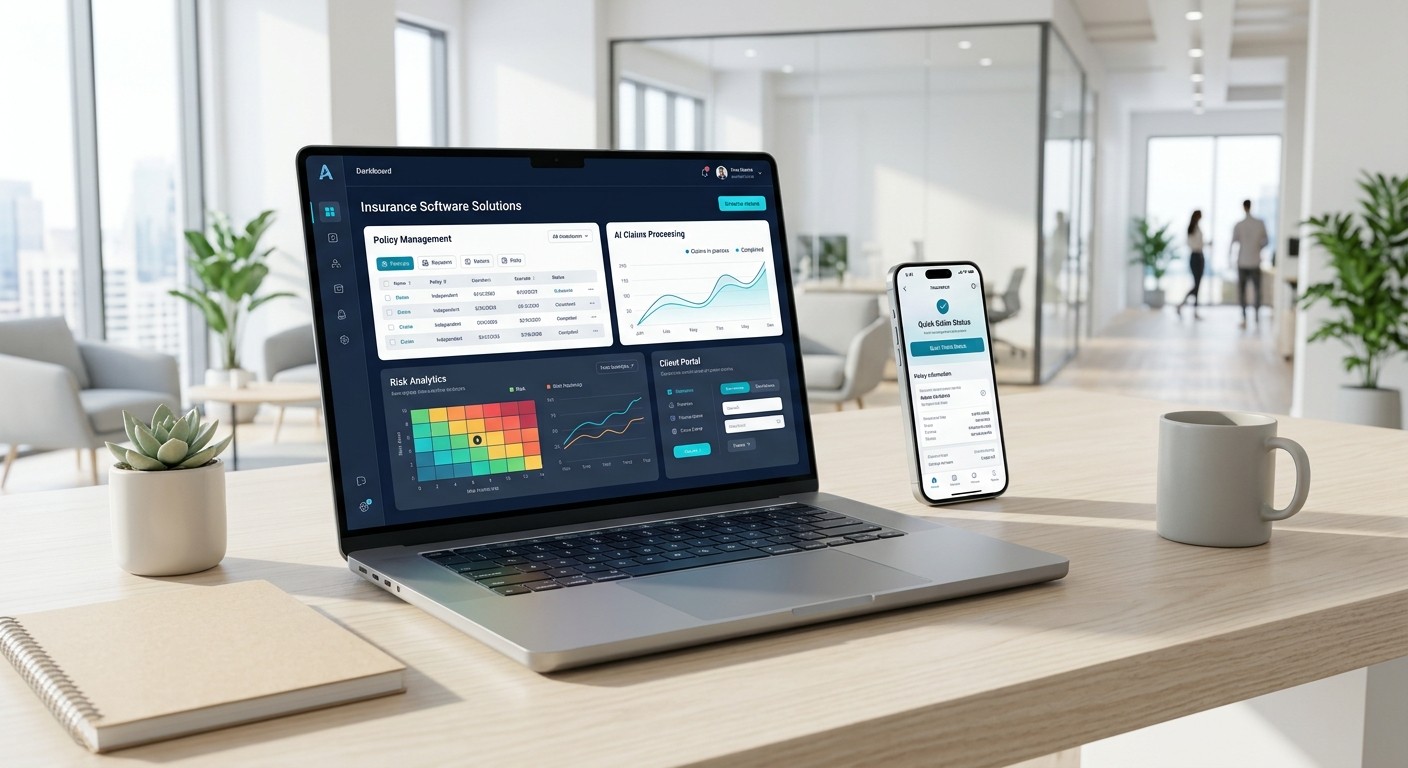
A carrier in Texas wants to launch a new specialty product, but its policy system takes months to change. An MGA is running quotes through spreadsheets and email. A growing agency has leads spread across three portals, and none of them talk to its management system. Each of these teams eventually searches for an insurance software development company, often a custom insurance software development company in the USA that can work in their time zone.
The problem is that the results look alike. Every firm says it builds "scalable, secure insurance solutions." Very few explain what they actually build, how they handle state regulation, or what happens when the software has to connect to a 15-year-old core system.
This guide is written for insurance leaders in Austin, across Texas and throughout the USA who are comparing development partners. It explains what an insurance software development company should do, which Texas and US rules your software has to support, how AI fits in without creating new risk, what drives cost, and how to choose between local, offshore and hybrid teams. Along the way we share real projects we've delivered and the questions we'd ask if we were in your seat.
Quick answer: An insurance software development company designs, builds and maintains software for carriers, MGAs, agencies, brokers and insurtechs. Typical projects include policy administration, claims, rating and quoting, customer and agent portals, mobile apps, integrations and AI. Choose a partner with real insurance projects, experience integrating with your existing core systems, a clear approach to state regulation and data security, and a delivery model that fits your time zone and budget. For Texas insurers, familiarity with Texas Department of Insurance (TDI) expectations, including its June 2026 bulletin on AI, is now part of that checklist.
What does an insurance software development company do?
An insurance software development company builds the systems insurers and distributors use to sell, issue, service and settle policies. Some firms only build one type of product, such as mobile apps. A full-service partner covers the whole lifecycle, from discovery and design through development, integration, testing, launch and long-term support.
Here's what that usually includes:
| Area | What gets built | Who uses it |
|---|---|---|
| Policy administration | Product setup, policy issuance, endorsements, renewals, cancellations | Carriers, MGAs |
| Rating, quoting and underwriting | Rating engines, quote flows, underwriting workbenches, referral rules | Underwriters, agents, customers |
| Claims management | First notice of loss (FNOL), intake, assignment, reserves, payments, documents | Claims teams, adjusters, TPAs |
| Customer and broker portals | Self-service quotes, policy documents, payments, claims status | Policyholders, brokers |
| Agency management and CRM | Client records, pipeline, renewals, commissions, lead follow-up | Agencies, brokers |
| Billing and payments | Invoicing, installments, collections, commissions | Finance teams |
| Regulatory reporting and analytics | Statutory and internal reports, dashboards, loss ratios, data warehouses | Compliance, actuarial, leadership |
| Mobile apps | Policyholder, agent and field adjuster apps | Customers, agents, adjusters |
| AI and automation | Claims triage, document Q&A, service assistants, underwriting support | All of the above |
| Integration and modernization | APIs, data migration, connecting legacy cores to new tools | IT and operations |
Our insurance software development services cover each of these areas, from core systems and apps to AI and integration.
Is insurance software development different from general software development?
Yes, in four important ways.
The domain is complex. Insurance products have rating rules, coverage options, endorsements, state-specific forms and long policy lifecycles. A developer who doesn't understand the difference between a quote, a bind and an endorsement will build the wrong thing, however good their code is.
Regulation is state by state. In the USA, insurance is regulated mainly by the states. Rates, forms, claims handling, privacy and now AI use can all carry state-level rules. Software has to support these differences without becoming a tangle of exceptions.
The data is sensitive. Policyholder data can include personal, financial and sometimes health information. Security, access control and audit trails aren't optional extras.
Nothing starts from a blank slate. Most insurance businesses already run a core system, a rating engine, an agency management system or all three. New software almost always has to work alongside them.
Who hires an insurance software development company?
Different parts of the industry hire development partners for different reasons. Here are the most common, with the problems we hear most often.
Insurance carriers
Carriers usually need to move faster than their core systems allow. Common requests include new digital front ends on an existing policy system, claims intake and triage, underwriting workbenches, data platforms that pull together information from several systems, and AI that summarizes documents for adjusters and underwriters.
Typical problem: a product change takes months because every update goes through a vendor's release cycle.
MGAs and program administrators
Managing general agents and program administrators often need specialty products launched quickly, with their own rating, underwriting rules and broker portal, while still reporting cleanly to carriers.
Typical problem: quoting is done in spreadsheets, and bordereaux reporting to carriers is manual.
Agencies and brokers
Agencies need better ways to manage leads, renewals and client service across several carriers and systems.
Typical problem: leads arrive from websites, comparison sites and referrals, and slow follow-up loses them. Agents also re-key the same data into carrier portals and the agency management system.
Insurtech startups
Insurtechs need a product built fast, usually a quote-and-bind experience, an app or an embedded insurance flow, without cutting corners on security and compliance.
Typical problem: the team needs to launch an MVP to raise money or prove demand, but must keep the architecture strong enough to scale.
Third-party administrators (TPAs) and claims service firms
TPAs need claims systems, document handling and reporting that work for several clients with different rules.
Typical problem: each client wants different reports and workflows, and the current system can't be configured quickly.
Signs it's time to invest in new insurance software
Not every frustration needs a new system. But these signs usually mean your current software is costing more than it saves:
- Product launches are slow. A new coverage, state or program takes months because of system limits.
- People re-key the same data. Staff copy information between the agency management system, carrier portals, spreadsheets and email.
- Customers and brokers call for basic information. Policy documents, ID cards, payment status and claim updates aren't available in self-service.
- Reporting is manual. Building bordereaux, loss runs or leadership reports means exporting and stitching spreadsheets together.
- Claims teams spend their time searching. Adjusters dig through long files and guidelines to find answers.
- Leads go cold. New enquiries wait hours or days for a first response.
- Compliance answers are hard to produce. When an auditor or regulator asks who changed what and when, nobody can answer quickly.
If several of these sound familiar, the next step isn't necessarily a big replacement project. Start by identifying which problem costs the most, then decide whether to fix it with configuration, integration, a focused custom build or a new platform.
Why work with an Austin, Texas–based insurance software partner?
Plenty of insurance software firms will work with you remotely from anywhere. So why does location matter at all? For many insurers it does, for practical reasons.
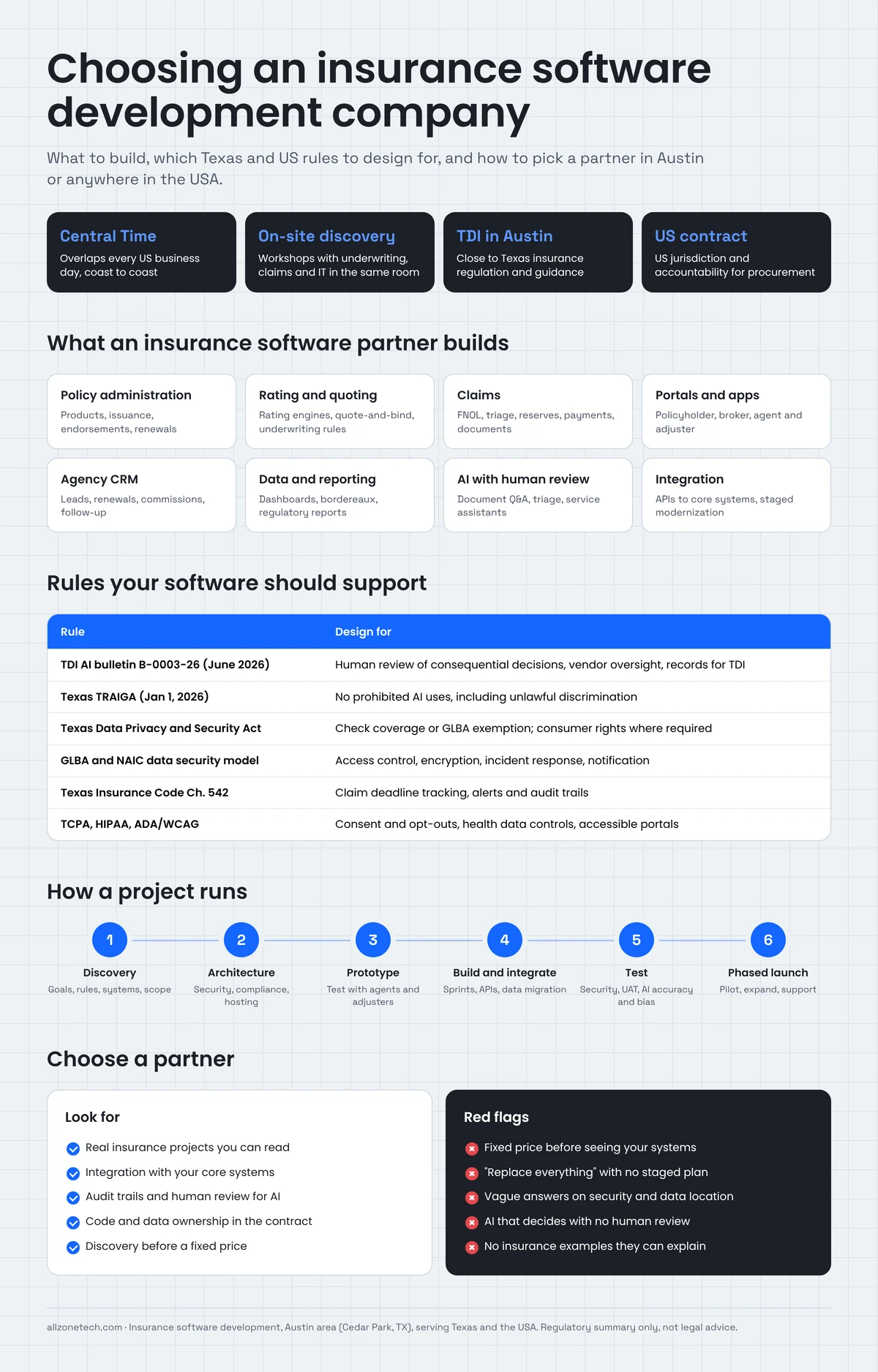
Same or overlapping time zone. Austin runs on Central Time, which overlaps with every US business day from the East Coast to the West Coast. Questions get answered in your working hours, and production issues don't wait until the next morning.
Face-to-face discovery when it counts. The most important meetings in an insurance software project are the early ones, when business rules, edge cases and integration details are mapped out. Being able to sit in the same room with underwriters, claims managers and IT for a workshop saves weeks of back-and-forth later.
Familiarity with the Texas regulatory environment. The Texas Department of Insurance is headquartered in Austin, and Texas carriers, agencies and MGAs work under the Texas Insurance Code and TDI guidance. A partner who already follows TDI bulletins and Texas privacy and AI laws will design for them from the start rather than discovering them during testing.
US contracts, US accountability. Working with a US-based company gives you a US contract, US legal jurisdiction and a team accountable in your market. For many procurement and compliance teams, that is a requirement, not a preference.
It still works nationwide. An Austin-based partner can serve insurers in Dallas, Houston, San Antonio and the rest of Texas in person, and clients in other states remotely, with on-site visits for key milestones.
Our US headquarters is in Cedar Park, in the Austin area, and we work with insurance clients across the USA. For teams that need to balance cost and speed, we also run delivery teams outside the US under US project leadership. We cover that hybrid model in more detail below.
Custom insurance software or an off-the-shelf platform?
Before you choose a development partner, be clear about what you want them to build. Very few insurers need to build everything from scratch. The most common approach today is hybrid:
- Buy proven platforms for standard, heavily regulated core functions where differentiation doesn't matter much.
- Build custom software where it creates an advantage or removes daily friction: customer and broker experiences, specialty products, integrations, analytics and AI.
A good insurance software development company will tell you honestly when not to build something. If a partner wants to rebuild a working core system with no clear business case, that's a warning sign.
We've written a full guide to custom insurance software: when to build, when to buy and how to combine both, including a scoring checklist you can use component by component. In short, custom software usually makes sense when:
- your product, distribution model or underwriting approach is different from what packaged software supports
- your team relies on spreadsheets, email and manual re-keying to get around system limits
- you need one experience across several systems and carriers
- license fees keep rising while the software fits less and less
- you want to own your roadmap, your code and your data
Which Texas and US regulations should insurance software support?
Insurance software doesn't just need to work; it needs to support the rules your business operates under. A development partner isn't your compliance officer or your lawyer, but they should design software that makes compliance easier to prove, not harder.
Below are the main areas we plan for on US and Texas insurance projects. Laws and guidance change, so confirm current requirements with your compliance team and counsel.
| Area | What it covers | What it means for your software |
|---|---|---|
| TDI bulletin on AI (June 2026) | How Texas-regulated entities use AI | Governance, human review of consequential decisions, vendor oversight, records you can produce for TDI |
| Texas Responsible AI Governance Act (TRAIGA, effective January 1, 2026) | Prohibited uses of AI, including unlawful discrimination | Design and test AI so it can't be used in prohibited ways; keep records of intent and testing |
| Texas Data Privacy and Security Act (effective July 1, 2024) | Consumer data rights and processing rules | Check whether your entity or data is covered or exempt (for example, under GLBA), then support access, deletion and consent where required |
| Gramm-Leach-Bliley Act (GLBA) | Privacy and safeguards for nonpublic personal financial information | Privacy notices, access controls, encryption, vendor safeguards |
| NAIC Insurance Data Security Model Law | Information security programs and breach notification for licensees, in states that have adopted it | Risk assessments, security controls, incident response and notification workflows |
| State rate and form filing rules | Approval of rates, rules and forms | Version control of rating rules and forms by state and effective date |
| Claims handling standards (e.g., Texas Insurance Code Chapter 542) | Timelines for acknowledging, investigating and paying claims | Deadline tracking, alerts and audit trails in claims workflows |
| HIPAA (health and some benefits lines) | Protected health information | Access logging, encryption, business associate agreements with vendors |
| TCPA and telemarketing rules | Automated calls and texts to consumers | Consent capture, opt-out handling, calling-hour controls in outreach tools |
| Accessibility (ADA, WCAG) | Usable digital experiences for people with disabilities | Accessible portals and apps from the design stage |
What does the TDI AI bulletin mean for insurance software?
On June 12, 2026, TDI issued Commissioner's Bulletin B-0003-26 on the use of artificial intelligence. It applies to all regulated entities and their agents and representatives. The bulletin says that AI-driven decisions must not be inaccurate, arbitrary, capricious or unfairly discriminatory, and that strong governance, risk controls and internal audit play a central role. For consequential decisions, TDI expects a person to review and agree with all decisions before action is taken. The bulletin also makes clear that these expectations extend to third parties working with a regulated entity, which includes software and AI vendors.
For software design, that translates into a few practical requirements:
- Human-in-the-loop by design. Claims, underwriting and coverage decisions that AI supports should go to a person for review and approval before anything happens. The software should make that step easy, not something staff can skip.
- Explainable outputs. When AI flags a claim or summarizes a file, it should show the source documents and reasoning so reviewers can check the work.
- Logs and audit trails. Record what the AI saw, what it suggested, who reviewed it and what was decided.
- Testing for unfair outcomes. Test models and rules for bias before launch and monitor them afterwards.
- Vendor documentation. Your partner should be able to describe how its AI components work, which models they use, where data goes and how they are tested.
If you're a Texas insurer, ask any development company you're considering how its software supports these points. The answer will tell you a lot about how seriously it takes insurance work.
Where does AI fit in insurance software today?
AI is now part of most insurance software conversations, but it works best when it supports people on specific, well-defined tasks. These are the areas where we see real value:
| Use case | What AI does | What stays with people |
|---|---|---|
| Claims intake (FNOL) | Collects details by chat, phone or form, extracts data from photos and documents | Coverage decisions and settlement |
| Claims triage and routing | Sorts claims by complexity and urgency, routes them to the right adjuster | Final assignment rules and exceptions |
| Document Q&A | Answers questions from policies, claims files and guidelines, with links to the source | Interpretation and decisions |
| Underwriting support | Summarizes submissions, pulls key data, flags missing information | Risk selection and pricing decisions |
| Fraud indicators | Flags patterns worth a closer look | Investigation and outcome |
| Customer and agent service | Answers routine questions, takes payments, gives policy and claim status | Complaints, complex cases, advice |
| Lead follow-up for agencies | Contacts new leads quickly, qualifies them and books appointments | Quoting, advice and closing |
The right way to add AI is usually to connect it to the systems and documents you already have, rather than rebuild everything. Our guide to AI in insurance covers use cases, risks and how to build AI your team will trust. For the technical side, retrieval-augmented generation (RAG) is the approach we use when AI needs to answer from your own policy and claims documents rather than from general knowledge.
How should insurance software integrate with your existing systems?
Integration is where most insurance software projects succeed or fail. Your new claims portal, broker app or AI assistant is only useful if it can read and write data in your core systems reliably.
Most insurers we talk to run some mix of:
- a core policy administration, billing and claims system (from a major vendor or built in-house years ago)
- an agency management system on the distribution side
- a rating engine, sometimes in spreadsheets
- document management, email and telephony
- CRM, marketing and data warehouse tools
A strong insurance software development company will:
- Map your systems first. Document what each system owns, how data moves today and where people re-key information.
- Build an integration layer. Use secure APIs and event-driven patterns so new tools don't connect directly to every system. This makes future changes far less risky.
- Plan data migration carefully. Clean, map and reconcile data before moving it, and run old and new systems in parallel where needed.
- Modernize in stages. Replace or wrap legacy parts one at a time, rather than attempting a single "big bang" switch.
Our AI integration services and enterprise software development teams handle this layer, which is often the most valuable custom piece in an insurance project.
How do you keep insurance software secure?
Security in insurance software isn't one feature. It's a set of decisions made at every stage of the build. When you evaluate a development partner, ask how they handle each of these:
Access control. Every user should see only what their role needs. An agent shouldn't see another agency's clients, and a customer service rep shouldn't be able to change rating rules. Role-based access, single sign-on and multi-factor authentication should be standard.
Encryption. Policyholder and payment data should be encrypted in transit and at rest, with keys managed properly rather than stored in code.
Audit trails. Every important action, such as a policy change, claim payment, data export or AI recommendation, should be logged with who did it and when. Audit trails support regulatory exams, internal investigations and disputes.
Secure development. Code reviews, dependency scanning, secrets management and security testing should be built into the development process, not added at the end.
Data minimization. Collect and keep only the data the business needs, and send AI tools only the data a task requires. The less sensitive data a system holds, the smaller the risk.
Vendor and hosting choices. Know where data is hosted, which third-party services touch it and what agreements are in place. This is especially important for AI services that process documents or conversations.
Incident response. Plan how the software will help you detect, investigate and report a security incident, including the notification timelines in your states.
Our DevOps and managed services team handles hosting, monitoring and security operations after launch, so these controls keep working once the project is live.
Real insurance software projects we've delivered
We prefer to show real work rather than make claims. Here are three projects that represent the types of insurance software we build. None of the pages below reports performance metrics, so we describe what was built rather than promise outcomes.
SelectQuote: a digital insurance comparison experience
The challenge: customers needed to compare insurance products that are hard to compare, without losing the details that matter. The experience had to be fast while it queried rated products, return accurate quotes, and be discoverable in search rather than hidden behind a login.
What we built: we contributed the customer-facing journey for comparing and selecting coverage online, and the frontend architecture behind it. It uses a React and Next.js frontend with server-rendered pages, TypeScript across the application, a Node.js service layer on AWS Lambda for quoting and data access, and a Material UI component layer for a consistent experience.
Why it matters: customers can compare and act on coverage options directly, and the serverless quoting path scales with demand. Read the SelectQuote project.
Insurance Claims RAG Assistant
The challenge: claims and policy teams spend a lot of time searching long documents for the right clause or guideline.
What we built: a retrieval assistant over policy and claims documentation. It answers questions in plain language and attaches the source passage, so the reviewer can check every answer against the original text.
Why it matters: the approach matches what regulators now expect: AI that supports people, shows its sources and leaves decisions with a human. See the Insurance Claims RAG Assistant.
Zonified Connect: AI lead follow-up for agencies
The challenge: agencies lose leads when nobody follows up quickly, especially in the evenings and at weekends.
What we built: an AI voice and SMS system that contacts new leads using a sequence the business configures, logs every conversation to the lead record, books appointments only after the lead confirms a time and email address, and stops automated contact once the lead reaches the Quoted stage so the team takes over. It integrates with Google Calendar, Outlook Calendar and HubSpot. Explore Zonified Connect.
How does an insurance software project work?
Every project is different, but a well-run insurance software project usually follows these stages:
- Discovery. Workshops with business, operations, compliance and IT to define goals, users, business rules, integrations and success measures. The output is a written scope and a prioritized roadmap.
- Architecture, security and compliance planning. Choose the architecture, integration approach, hosting, data protection controls and how regulatory needs will be supported.
- Design and prototyping. Map user journeys and build clickable prototypes for portals, apps and internal tools. Test them with real users such as agents, adjusters or policyholders.
- Development in short cycles. Build in sprints with working software demonstrated regularly, so you can change priorities early.
- Integration and data migration. Connect to core systems and third-party services, and migrate and reconcile data.
- Testing. Functional, integration, performance, security and user acceptance testing. For AI features, add accuracy and bias testing.
- Phased launch. Start with a pilot group, line of business or state, then expand.
- Support and improvement. Monitoring, fixes, updates for regulatory changes and new features.
How long does insurance software development take?
It depends on scope. A focused component, such as a broker portal, a claims intake flow or an AI document assistant connected to existing systems, takes far less time than replacing a core policy system. That's one reason we recommend starting with a high-impact component and expanding from there. Ask any partner for a timeline tied to a written scope, not a number given before discovery.
How much does insurance software development cost?
There's no honest single price, because insurance projects vary enormously. What you can expect from a good partner is a clear explanation of what drives the cost and a written estimate after discovery.
| Cost driver | Why it matters |
|---|---|
| Scope and number of modules | A single portal costs far less than policy, billing and claims together |
| Number and age of integrations | Older systems without APIs take more work to connect |
| Data quality and migration | Messy or duplicated data adds cleanup and reconciliation work |
| Lines of business and states | Each adds rules, forms and testing |
| Compliance and security requirements | Audit trails, encryption, access control and testing add effort, and they're worth it |
| User types and channels | Customers, agents, brokers, adjusters and admins each need their own experience |
| AI features | Model usage, retrieval setup, evaluation and human review workflows |
| Team location and engagement model | US-only, offshore or hybrid teams have different rates |
Ongoing costs matter too: hosting, licenses, AI model usage, monitoring and support. Our guide to AI development cost explains how AI features affect budgets in more detail.
Local, offshore or hybrid: which delivery model is right for you?
Insurance companies in Austin and across the USA have three broad options for who builds their software.
| Model | Strengths | Trade-offs | Best for |
|---|---|---|---|
| US-only local team | Same time zone, on-site access, US contracts | Highest cost per hour | Highly sensitive work, heavy on-site needs |
| Offshore-only team | Lowest cost per hour | Time zone gaps, communication risk, harder oversight | Well-defined work with strong internal product ownership |
| Hybrid (US leadership, global delivery) | US accountability and overlapping hours with cost efficiency | Needs a disciplined process and clear ownership | Most mid-size projects and long-term product teams |
Our model is hybrid. Projects are led from our US headquarters in the Austin area, with delivery teams in other locations working overlapping hours. That gives clients a US point of contact and contract while keeping the budget practical.
Which engagement model should you choose?
- Fixed-scope project. Best when requirements are clear and stable, such as a defined portal or integration.
- Dedicated team. Best for ongoing product development, where priorities change. See our dedicated development teams.
- Staff augmentation. Best when you have a strong internal team and need specific skills added.
- White label development. Best for agencies, consultancies and insurtech platforms that want software delivered under their own brand. See white label software development.
- AI MVP. Best when you want to test an AI idea quickly before committing to a full build. See our AI MVP development services.
How to choose an insurance software development company
Use this checklist when you compare partners, whether they're in Austin, elsewhere in Texas or anywhere in the USA.
What should you look for?
- Real insurance projects you can read about, not just generic portfolios
- Integration experience with core systems, agency management systems and third-party data
- A clear compliance approach covering state rules, data security, privacy and, now, AI governance
- Security practices they can describe: access control, encryption, audit logs, secure development and testing
- A discovery phase before a fixed price or timeline
- Code and data ownership written into the contract
- Transparent communication: who your contact is, what hours they work, how progress is reported
- Support after launch, including updates when regulations change
What questions should you ask on the first call?
- Which insurance projects have you delivered, and what did you build?
- How will you integrate with our current policy, claims or agency management system?
- How do you handle state-specific rules, forms and rating?
- How do you support audit trails and human review for AI-assisted decisions?
- What security standards and testing do you follow?
- Who owns the code, the data and any AI models or prompts?
- Who will we work with day to day, and in what time zone?
- What does support look like after launch?
What are the red flags?
- A fixed price or timeline before anyone has seen your systems
- Promises to "replace everything" with no staged plan
- No real insurance examples, or examples they can't explain
- Vague answers about security, data location or AI testing
- Reluctance to put code ownership in writing
- AI pitched as making decisions on its own, with no human review
Talk to an insurance software team in the Austin area
Whether you're a Texas carrier modernizing claims, an MGA launching a specialty program, an agency fixing lead follow-up or an insurtech building its first product, start with the part of your business where better software will make the biggest difference. We'll help you scope it, connect it to the systems you already run and build it with compliance in mind from day one.
See everything we build for the industry on our insurance software development page or book a discovery call to talk through your project.