AI in real estate is the use of machine learning and language models to handle work that slows property teams down: answering enquiries, reading leases, sorting tenant requests, writing listings and spotting patterns in portfolio data. It works best where input is messy and a person checks the output.
That last part matters. Most real estate businesses don't need a futuristic platform. They need replies to leads in minutes instead of hours, leases they don't have to read line by line, and a property team that isn't buried in routine messages.
This guide covers where AI genuinely helps, which kinds of tools exist, when to buy versus build, and how to roll AI out without losing control of decisions that affect clients and tenants.
What is AI in real estate?
AI in real estate is software that can read, write, classify, predict or hold a conversation, applied to property work such as sales, leasing, property management, investment and development. It sits inside real estate technology (proptech) alongside CRMs, listing portals and property management systems, and usually works through them rather than replacing them.
Three kinds of AI show up most often:
- Language models (generative AI) read and write text: emails, listings, lease summaries, chat replies.
- AI agents use language models plus your tools to complete a task, such as qualifying a lead and booking a viewing.
- Predictive models learn from historical data to score leads, flag arrears risk or estimate demand.
The common thread is unstructured input. Real estate runs on enquiries, documents, photos and conversations. That is exactly where traditional software struggles and AI is useful.
How is AI used in real estate today?
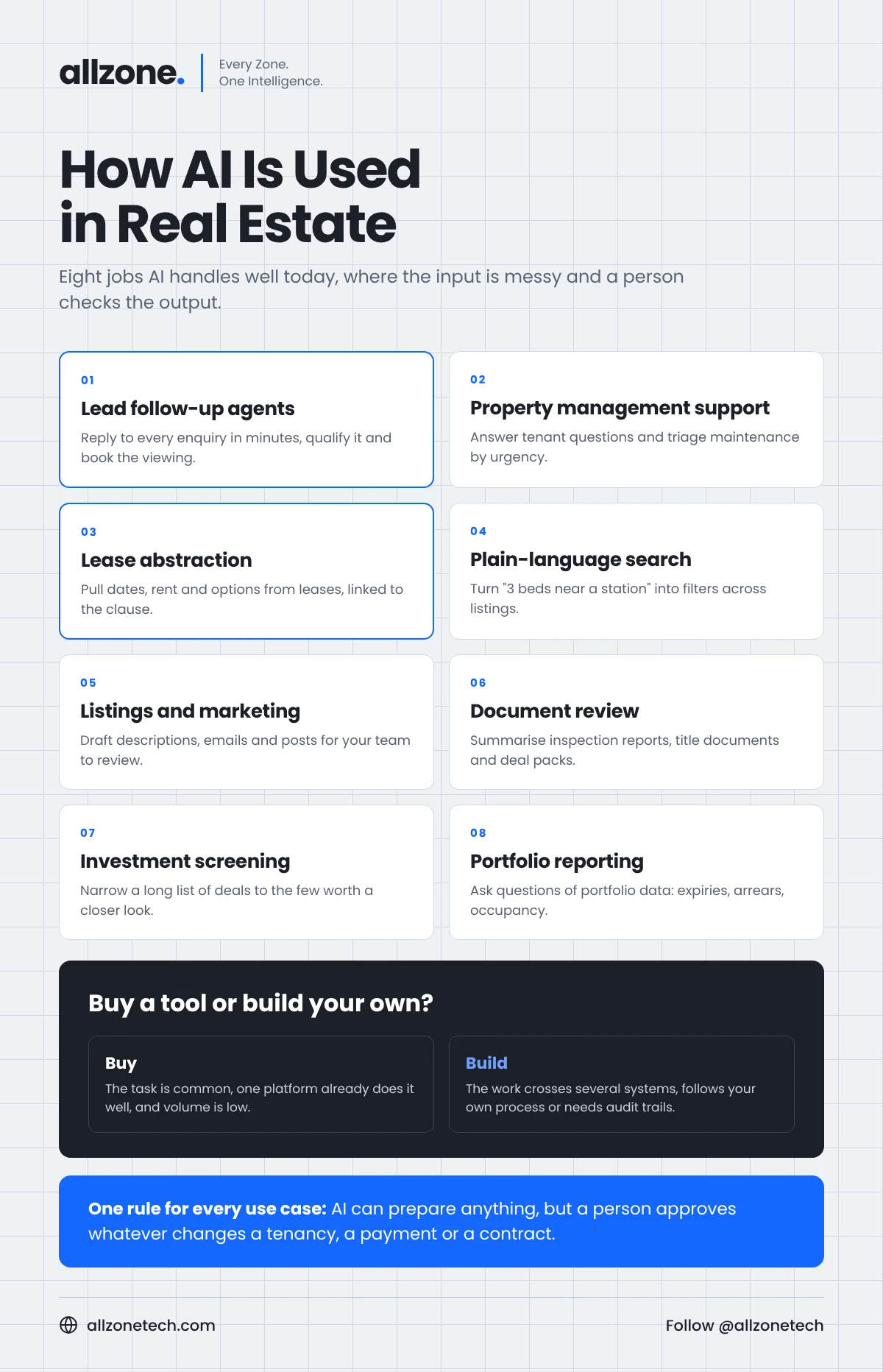
AI is used in real estate for lead follow-up, property management support, lease abstraction, property search, listing and marketing content, document review, investment analysis and portfolio reporting. The strongest results come where the task is frequent, mostly text-based and easy for a person to check.
AI agents for real estate lead follow-up
Speed of response wins listings and tenants. AI agents for real estate answer new enquiries by phone, text or chat at any hour, ask qualifying questions (budget, timing, area, financing), book viewings into an agent's calendar and pass the lead over with the conversation attached.
The agent doesn't negotiate or advise. It makes sure no enquiry waits until Monday morning. We built this pattern into our own AI voice CRM, Zonified Connect, where voice and SMS agents work a new lead from first contact to a booked appointment on rules the business sets.
AI for property management
AI for property management takes routine load off the team:
- Answering common tenant questions (rent dates, rules, how to report a repair)
- Triaging maintenance requests by urgency, and asking for photos up front
- Drafting notices, reminders and replies for staff to approve
- Summarising a tenant's history before a call
The rule we apply: AI can prepare anything, but a person approves anything that changes a tenancy, a payment or a legal notice.
AI lease abstraction
AI lease abstraction reads a lease and extracts key terms into structured fields: parties, dates, rent, escalations, renewal options, break clauses, service charges and obligations. It matters most in commercial real estate, where leases are long, non-standard and amended over years.
Good lease abstraction links every extracted value to the clause it came from. That way an analyst checks the source in seconds rather than trusting a number. It's the same approach we use in our Insurance Claims RAG Assistant, which answers questions from long policy documents with the source passage attached. The technique behind it is called retrieval-augmented generation; more on that in our RAG development page.
AI real estate search
AI search lets buyers and renters describe what they want in plain language, such as "three bedrooms, quiet street, ten minutes from a train station, under budget", and turns it into filters across listings. It also helps agents search their own inventory and past deals the same way.
Generative AI for listings and marketing
Generative AI in real estate is most often used to draft listing descriptions, email campaigns, social posts and neighbourhood summaries from property data. It saves writing time, but every draft needs a human check for accuracy and for fair, non-discriminatory language.
Document review and due diligence
AI can read inspection reports, title documents, financial packs and contracts, summarise what matters and flag items for review. It speeds up the first pass; it doesn't replace legal or professional sign-off.
AI in real estate investing
Investors use AI to screen deals faster: pulling data from listings and offering memorandums, comparing them against criteria and highlighting the few worth a closer look. Predictions still depend on data quality, so the model's job is to narrow the list, not make the decision.
Portfolio data and reporting
For owners and asset managers, AI can answer plain-language questions over portfolio data ("which leases expire in the next 18 months with no renewal option?") and draft commentary for reports, provided the underlying data is clean and connected.
Which AI tools are good for real estate?
The best AI tool for real estate depends on the job. General AI assistants are good for drafting and research; AI features inside your CRM or property management platform suit standard workflows; and custom AI agents fit when the work crosses several systems or follows your own process.
| Tool type | Good for | Limits | Best fit |
|---|---|---|---|
| General AI assistants (ChatGPT, Claude, Gemini) | Drafting listings, emails, research, summaries | No access to your systems by default; data handling needs care | Individual agents and small teams |
| AI features inside CRM or property software | Standard tasks within that one platform | Limited to what the vendor built; little control over logic | Teams happy with their current platform |
| Point AI tools (chatbots, listing writers, lease readers) | One task done well, quick to start | Another login and data silo; may not fit your process | A single clear problem |
| Custom AI agents and assistants | Work across several systems, your rules, your data | Needs design, testing and ownership | Brokerages, managers and owners with their own process or scale |
A practical rule: start with tools you already pay for. Move to a custom build when the work crosses several systems, when off-the-shelf tools can't follow your process, or when the volume makes the time saved worth it.
Should you buy an AI tool or build your own?
Buy an AI tool when your need is common and the tool fits your workflow; build when the task depends on your own data, crosses several systems or is part of how you compete. Many real estate businesses do both: buy for standard tasks and build where their process is different.
| Question | If yes, lean towards | Why |
|---|---|---|
| Does an existing tool already do this well in your platform? | Buy | Faster, cheaper, maintained by the vendor |
| Does the AI need data from several systems (CRM, property, accounting)? | Build | Point tools rarely join systems up well |
| Is this process part of your edge (how you win or keep clients)? | Build | You keep control of logic and data |
| Do you need audit trails or approvals your tools don't offer? | Build | You design the controls |
| Is the volume small or the task occasional? | Buy | Custom work won't pay back |
If you do build, start small. A focused first version, often called an AI MVP, proves the AI works on your real data before you commit a bigger budget. We cover that approach in AI MVP development.
How do you use AI in a real estate business, step by step?
To use AI in real estate, pick one frequent, time-consuming task, set a measurable goal, test AI on real examples, connect it to the systems your team already uses, keep a person approving important actions, then measure results before expanding. Most failures come from starting too broad.
- Pick one task. Choose something frequent and painful: lead response, tenant questions, lease abstraction or listing writing. Not "AI for the whole business."
- Set a goal you can measure. For example, response time to new leads, hours spent per lease, or share of tenant questions answered without staff.
- Collect real examples. Past enquiries, leases, tenant messages or listings. These become the test set that shows whether the AI is good enough.
- Test before you build. Run the examples through the AI and review the results with the people who do the work today.
- Connect it to your systems. AI that can't see your CRM or property data creates more copy-paste, not less. Our guide on how to integrate AI into existing systems explains the options.
- Keep people in control. Decide which actions AI can take alone and which need approval. Anything touching money, tenancies or legal notices should need a person.
- Pilot with a small team. Watch what happens in real use and fix the misses.
- Measure, then expand. If the goal is met, extend to the next task or team.
How is AI changing commercial real estate?
AI in commercial real estate is mainly changing how lease, property and market data is collected and used. The biggest gains are in lease abstraction, portfolio reporting, deal screening and tenant service, where teams spend long hours reading documents and joining data from different sources.
Commercial portfolios carry long, heavily negotiated leases. Key dates and obligations often live only in PDFs. AI that extracts them, with links back to the clauses, gives asset managers a live view of expiries, rent reviews and risks without a manual abstraction project every quarter.
On the investment side, AI helps teams read more deal materials in less time. On the operations side, it helps facilities and property teams handle tenant requests and building data faster. The common limit is data quality: AI can only report on what it can see and trust.
What is the impact of AI on rental business models?
AI is changing rental businesses by making it cheaper to serve each tenant and faster to fill each unit. Automated enquiry handling, faster applications and AI-assisted maintenance mean a team can manage more units without the same growth in headcount, and tenants get quicker answers.
In practice that shows up in a few ways:
- Leasing: enquiries answered at any hour, viewings booked automatically and applications pre-checked for completeness.
- Operations: maintenance requests triaged and routed before a person reads them.
- Retention: renewal reminders and tenant questions handled on time, which reduces avoidable move-outs.
- Pricing and planning: better use of occupancy and demand data, with people making the final call.
The model shift is gradual. Businesses that connect AI to their property systems tend to see the benefit; those that add one more standalone tool often just move the work around.
What are the risks of AI in real estate?
The main risks of AI in real estate are wrong answers delivered confidently, biased or discriminatory output, misuse of personal data, and AI taking actions nobody approved. Each can be managed with clear limits, human approval, source citations and careful handling of client and tenant data.
| Risk | What it looks like | How to reduce it |
|---|---|---|
| Wrong answers | AI misstates a lease term or a property detail | Link answers to source documents; human review of key facts |
| Bias and fair housing | Ads, screening or replies that treat people differently | Keep protected characteristics out of decisions; review templates and outputs |
| Data privacy | Tenant or client data sent to tools without controls | Limit what data AI can access; use approved environments; log access |
| Unapproved actions | AI changes a record, sends a notice or commits to terms | Approval steps for anything touching money, tenancies or contracts |
| Over-reliance | Staff stop checking AI output | Spot checks, clear ownership and regular review of results |
Illustrative example: AI lead follow-up for a brokerage
This is a hypothetical example, not a client case. A mid-sized residential brokerage gets a steady flow of website, portal and phone enquiries. Many arrive in the evening and at weekends, and some wait until the next working day for a reply.
- Goal: reply to every new enquiry within minutes and book more viewings.
- Test: run past enquiries through an AI agent and have two senior agents review the replies and qualification questions.
- Build: an AI agent connected to the CRM and agents' calendars, replying by text and chat, with phone calls added later.
- Controls: the agent never discusses price negotiation or advice; it hands over to a person when asked or when unsure.
- Pilot: one team for a few weeks, tracking response time, viewings booked and agent feedback.
- Decision: roll out to the whole brokerage if goals are met; otherwise adjust the questions and handover rules first.
Nothing about this requires replacing the CRM. The AI works inside the tools the team already uses, which is why adoption is easier.
Want AI that works inside your real estate systems?
AllZone Technologies builds real estate software, apps and AI, from lead follow-up agents to lease abstraction and property management tools, connected to the systems you already use. See our real estate software development services or talk to our team.