On November 19, 2026, after more than a decade of waiting, two delays and the most-watched game trailer in YouTube history, Rockstar Games released Grand Theft Auto VI on PlayStation 5 and Xbox Series X|S. Within a day, market intelligence firm Sensor Tower estimated that the game had sold about 24.6 million copies worth roughly $2.36 billion, counting pre-orders. That's nearly three times the opening-day total of GTA V in 2013. Neither Rockstar nor its publisher, Take-Two Interactive, has confirmed those figures, but the scale is clear.
GTA 6 is more than a game launch. It's one of the largest software projects ever shipped: years of engineering, a custom engine, a huge open world, thousands of people across several studios, and a launch day that put enormous pressure on digital stores, download networks and online services.
That makes it a useful case study for anyone who builds software, from game studios and startups to enterprise teams launching an app or an AI product. This guide covers what we know about how GTA 6 was made: its timeline, engine, budget estimates, team, launch and the role of AI in modern game development. It then turns those facts into practical lessons for planning, building, testing, launching and scaling your own software.
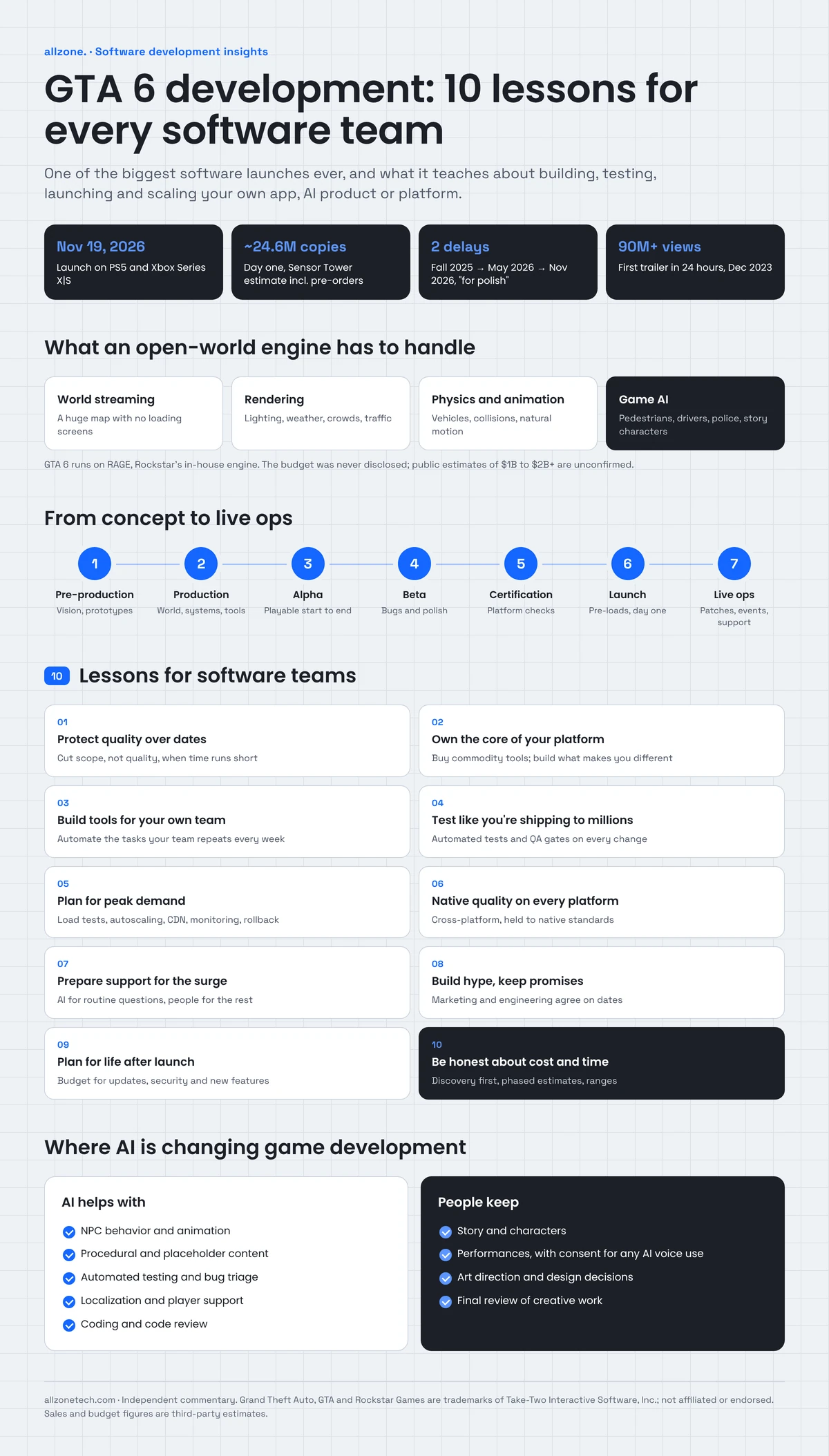
Quick answer: GTA 6 was developed by Rockstar Games on its in-house RAGE engine and published by Take-Two Interactive. It launched on November 19, 2026, for PS5 and Xbox Series X|S, after delays from fall 2025 and May 2026. Rockstar has never published the budget. Fan and analyst estimates range from $1 billion to well over $2 billion. Its biggest lessons for software teams: protect quality over deadlines, invest in your core platform, test at scale, plan launch capacity for peak demand, and keep the product alive after release.
Grand Theft Auto, GTA and Rockstar Games are trademarks of Take-Two Interactive Software, Inc. This article is independent commentary and is not affiliated with or endorsed by Rockstar Games or Take-Two Interactive.
Key takeaways
- GTA 6 launched on November 19, 2026, on PS5 and Xbox Series X|S. A PC release date had not been announced at launch.
- The first trailer, released in December 2023, drew more than 90 million YouTube views in 24 hours and set three Guinness World Records.
- Rockstar delayed the game twice, saying the extra time was needed to reach "the level of polish you have come to expect and deserve."
- The budget has never been confirmed. Public estimates are guesses built from company filings and industry comparisons.
- GTA 6 runs on RAGE, Rockstar's proprietary engine. A former Rockstar developer has suggested the engine was probably heavily rebuilt, but Rockstar hasn't said so.
- AI is changing game development in testing, animation, content creation, localization and player support. Rockstar hasn't detailed how it used AI in GTA 6.
- The same principles behind a successful AAA launch apply to business software: quality gates, strong platforms, automated testing, launch readiness and live operations.
GTA 6 at a glance
| Fact | Detail |
|---|---|
| Full title | Grand Theft Auto VI |
| Developer | Rockstar Games |
| Publisher | Take-Two Interactive |
| Release date | November 19, 2026 |
| Platforms at launch | PlayStation 5, Xbox Series X|S |
| PC version | Not announced at launch |
| Engine | RAGE (Rockstar Advanced Game Engine), Rockstar's in-house engine |
| Setting | The fictional state of Leonida, including Vice City |
| First trailer | December 2023: more than 90 million YouTube views in 24 hours |
| Delays | Fall 2025 to May 26, 2026, then to November 19, 2026 |
| Day-one sales (estimate) | About 24.6 million copies and $2.36 billion, according to Sensor Tower, including pre-orders; not confirmed by Rockstar or Take-Two |
| Previous main game | Grand Theft Auto V, released in 2013 |
The GTA 6 timeline: why it took so long
GTA V launched in September 2013 and went on to become one of the best-selling games ever, helped by the long-running GTA Online. Its success shaped what came next: the bar for the sequel was extraordinarily high, and Rockstar also had Red Dead Redemption 2 (2018) and years of online updates to deliver along the way.
Key public milestones for GTA 6:
| Date | Milestone |
|---|---|
| February 2022 | Rockstar confirmed that development of the next GTA was "well underway" |
| September 2022 | Early development footage leaked online, and Rockstar said it was "extremely disappointed" |
| December 2023 | The first official trailer was released and broke YouTube viewing records |
| May 2025 | Release moved from fall 2025 to May 26, 2026; a second trailer followed |
| November 6, 2025 | Release moved again to November 19, 2026, announced alongside Take-Two's quarterly results |
| November 19, 2026 | GTA 6 launched on PS5 and Xbox Series X|S |
Why big software projects take this long
For a game of this size, years of development aren't unusual. They reflect:
- Scale of content: a large, detailed open world with cities, countryside, interiors, characters, vehicles, missions, dialogue and music
- Simulation depth: traffic, pedestrians, police, weather, day-night cycles and physics all running together
- Technology upgrades: new hardware generations, rendering techniques and engine features
- Quality expectations: polish, performance and stability that players and critics measure closely
- Parallel work: online services, previous games and live updates all competing for the same teams
When Rockstar announced the second delay, it said: "These extra months will allow us to finish the game with the level of polish you have come to expect and deserve." That decision, to protect quality over a date, is the first lesson for any software team, and we'll come back to it.
How was GTA 6 made?
Rockstar shares very little about its internal tools and processes, so it's important to separate what's confirmed from what's informed speculation. What follows explains how open-world AAA games are generally built, and where GTA 6 fits.
The RAGE engine
GTA 6 runs on RAGE, the Rockstar Advanced Game Engine, which the studio has used across its major games for years. Owning its engine gives Rockstar full control over rendering, physics, animation, streaming and tools, instead of depending on a licensed engine such as Unreal or Unity.
In 2026, a former Rockstar audio engineer who worked on GTA V said he believed the team had "probably rebuilt the entirety of the Rage Engine," while admitting he had no inside knowledge of GTA 6's development. Treat that as an educated guess, not a fact. What's certain is that a game of this scale needs major engine work between generations.
What an open-world engine has to handle
| System | What it does in a game like GTA 6 |
|---|---|
| World streaming | Loads and unloads parts of a huge map as the player moves, without loading screens |
| Rendering | Lighting, shadows, reflections, weather, crowds and traffic at a stable frame rate |
| Physics | Vehicles, collisions, water, destruction and ragdoll movement |
| Animation | Thousands of character movements blended together so motion looks natural |
| AI behavior | Pedestrians, drivers, police and story characters reacting to the player and each other |
| Audio | Dialogue, radio stations, music, ambient sound and positional effects |
| Mission scripting | Story missions, side activities and events triggered by player actions |
| Tools | Internal editors that let artists, designers and writers build content efficiently |
Every one of these systems is software that has to be designed, built, tested, optimized and maintained, much like the components of a large enterprise platform.
Proprietary engine or off-the-shelf engine?
Most studios don't build their own engine. They license one, such as Unreal Engine or Unity, and spend their effort on the game itself. Rockstar is one of a few studios large enough to justify a proprietary engine.
| Approach | Advantages | Trade-offs |
|---|---|---|
| Proprietary engine (like RAGE) | Full control, built for the studio's specific games, no licensing dependency | Very expensive to build and maintain; needs a large engine team |
| Licensed engine (like Unreal or Unity) | Faster start, mature tools, large talent pool, regular updates | Licensing terms, less control over core technology, features shaped by the engine vendor |
Engine licensing terms change over time, so studios should always check current terms before committing.
The same decision appears in business software as "build vs buy." Most companies should buy proven platforms for standard needs and build only where custom technology creates a real advantage, just as most studios license an engine and focus on making a great game.
Pre-production, production and polish
Most AAA games follow a similar lifecycle:
- Concept and pre-production: story, setting, core gameplay, technical targets and prototypes
- Production: building the world, characters, missions, systems and tools at scale
- Alpha: features complete enough to play from start to finish
- Beta: content complete; focus moves to bugs, performance and balance
- Certification: platform holders such as Sony and Microsoft check that the game meets their technical requirements
- Launch: digital and physical release, preloads and day-one updates
- Live operations: patches, online content, events and support for years afterward
The delays happened in the final stages, where "polish" means fixing thousands of bugs, improving performance on each console, and making sure every part of the world holds together.
A team spread across studios
Rockstar Games operates several studios in different countries, with Rockstar North in Edinburgh leading the Grand Theft Auto series. Large AAA projects are usually built by multiple studios working on shared tools and content pipelines, with outside partners for specialist work. Coordinating that many people on one codebase and one world is as much an engineering challenge as building the game itself.
Who builds a game like GTA 6?
A AAA open-world game brings together dozens of disciplines. The table below shows the main roles. Business software teams have close equivalents for most of them.
| Game role | What they do | Business software equivalent |
|---|---|---|
| Game director and producers | Own the vision, scope, schedule and priorities | Product owner and project managers |
| Game designers | Design missions, systems, rules and balance | Product designers and business analysts |
| Engine and tools engineers | Build the engine, editors and pipelines | Platform and backend engineers |
| Gameplay engineers | Turn designs into working features | Application developers |
| Artists and animators | Create environments, characters, vehicles and motion | UI and UX designers |
| Writers and narrative designers | Write the story, dialogue and world details | Content strategists and UX writers |
| Audio team | Music, sound effects, dialogue and radio | Media and content production |
| QA and test engineers | Find bugs, test performance and verify fixes | QA engineers and test automation |
| Online and live ops engineers | Run servers, accounts, updates and events | DevOps and site reliability engineers |
| Player support | Help players with access, purchases and issues | Customer support and success teams |
The biggest coordination challenge in both worlds is the same: getting many specialists to work on one product without blocking each other.
How much did GTA 6 cost to make?
There's no official figure. Rockstar and Take-Two have never disclosed GTA 6's budget, and Take-Two's leadership has avoided giving one when asked.
Public estimates vary widely:
- Many reports and analysts place development costs at $1 billion or more, based on team size, development length and comparisons with other AAA games.
- In 2026, a YouTuber analyzed Rockstar's public company filings in the UK and suggested the studio likely spent over $2 billion across the period, with higher estimates going further. The analysis was widely reported, but it was clearly speculation. Company-wide spending also covered GTA Online, Red Dead Online and other work, not just GTA 6.
What we can say with confidence is that the biggest cost in any AAA game is people: salaries for designers, engineers, artists, animators, writers, testers, producers and support staff over many years. Other major costs include:
- motion capture, voice acting and music licensing
- technology, tools and engine development
- testing and certification
- marketing and launch
- infrastructure for online services
- post-launch support and live operations
The same is true of business software. For most custom software projects, the largest cost is the team's time, which is why scope, clear requirements and good process matter so much. We explain how software and AI costs are calculated in our guide to AI development cost.
The GTA 6 launch: a lesson in scale
On launch day, millions of players tried to download, install and start the game at the same time. A launch like this tests far more than the game itself:
- Digital stores and payment systems processing millions of purchases
- Content delivery networks serving huge downloads worldwide
- Pre-load systems that let players download early and unlock at release time
- Online services, from account systems to multiplayer infrastructure
- Customer support handling questions about orders, downloads and access
According to Sensor Tower's estimate, about three in four day-one copies were sold on PlayStation 5, with the remainder on Xbox Series X|S. These are third-party estimates, but they show how concentrated demand becomes around a single release moment.
Most businesses will never launch to 24 million people in a day. But many will face their own spikes: a product launch, a marketing campaign, an enrollment deadline, a holiday sale or a viral moment. The principles are the same: plan for peak demand, test under load, and make sure support can handle the surge.
Live operations: what happens after launch
For a game like GTA 6, launch is the beginning of a long service life. GTA V's online mode kept the game selling and earning for over a decade through updates, events and new content. Rockstar also runs GTA+, a membership program; launch-period buyers of GTA 6 were offered a free month of it as a pre-order bonus.
Running a game as a service involves:
- Patches and stability updates to fix bugs found by millions of players
- New content and events to keep players engaged
- Server operations for online play, with monitoring around the clock
- Anti-cheat and safety to protect fair play and the community
- Player support for accounts, purchases and technical issues
- Analytics to understand how players behave and what to improve next
Business software works the same way. After launch, the most successful products are the ones teams keep improving based on real usage data, with reliable operations behind them.
AI in game development: what's changing
AI has been part of games for decades. Non-player characters (NPCs) that patrol, chase or take cover all run on game AI. What's new is the use of machine learning and generative AI across the production process.
Rockstar hasn't published details about how, or whether, it used generative AI in GTA 6. The examples below describe how the wider industry uses AI today.
1. Smarter NPC behavior
Game AI decides how characters react: a pedestrian fleeing danger, a driver honking in traffic, a police unit coordinating a chase. Studios use behavior trees, planning systems and, increasingly, machine learning to make crowds and characters feel more natural without hand-scripting every situation.
2. Animation
Machine learning techniques, such as motion matching, help characters move naturally by selecting and blending the right animation from large motion capture libraries in real time.
3. Procedural and AI-assisted content
Algorithms help generate terrain, vegetation, building layouts and city details, which artists then refine. Generative AI tools can speed up concept art, textures and placeholder assets, though many studios restrict their use for final content because of quality, copyright and labor concerns.
4. Automated testing and QA
Testing an open world by hand is enormous work. Studios use automated bots that play the game, explore the map, look for crashes, measure performance and flag broken areas. AI can also sort and summarize thousands of bug reports.
5. Localization and voice
Big games ship in many languages. AI can support translation workflows and help manage dialogue at scale. Using AI to recreate or generate actors' voices is sensitive: in 2025, video game performers represented by SAG-AFTRA ended a long strike with an agreement that includes consent and disclosure protections around AI use of their voices and likenesses.
6. Player support and community
AI assistants help answer common player questions, route issues, and detect cheating or abuse in online games, with human teams handling complex or sensitive cases.
7. Engineering productivity
Developers increasingly use AI coding assistants to write and review code, generate tests and document systems. In large codebases, the challenge is making sure AI-assisted changes are understood, tested and reviewed before they ship.
Where AI shouldn't replace people
Even as AI tools improve, studios keep people in charge of the work that defines a game: the story, characters, performances, art direction and design decisions. AI is most useful when it removes repetitive work, such as testing, sorting bug reports or generating placeholder content, so creative teams can spend more time on what players actually notice.
The same balance applies in business: let AI handle routine, high-volume tasks, and keep people responsible for judgment, relationships and anything with legal, financial or safety impact.
What this means beyond games
These same capabilities, AI agents, automated testing, content generation, support assistants and coding tools, are now used in every industry. We build them as part of our AI development services and AI agent development services.
Planning a big launch of your own?
Whether it's a consumer app, an AI product or a platform that has to handle sudden demand, our team can review your plan, architecture and launch readiness in a free 30-minute call. See our AI development services
A security lesson: the 2022 leak
In September 2022, a hacker leaked a large amount of early GTA 6 development footage online, years before the game's reveal. Rockstar said it was "extremely disappointed" and confirmed that development would continue as planned.
The leak is a reminder that pre-release software is a valuable target. Source code, design documents, customer data and unreleased product plans all need protecting, especially in large teams with many tools and outside partners.
What every software team should do:
- Limit access by role, so people and contractors can reach only the code and systems their work needs
- Use multi-factor authentication everywhere, especially on code repositories, chat tools and cloud consoles
- Separate environments, so test and staging systems don't expose production data or credentials
- Monitor for unusual activity, such as large downloads or logins from new locations
- Train staff on social engineering, because many breaches start with a convincing message, not a technical exploit
- Plan your response, including who decides what to say publicly if something leaks
The same principles apply when AI agents work on your codebase. In our Agentic Engineering Platform, agents work in isolated branches and workspaces and reach engineering systems through permission-controlled tooling, not production credentials.
10 lessons from GTA 6 for every software team
You don't need a billion-dollar budget to learn from GTA 6. These lessons apply to startups, product companies and enterprise teams building apps, platforms and AI.
Lesson 1: Protect quality, even when it costs time
Rockstar delayed GTA 6 twice rather than ship something unfinished. For most businesses, delays are painful, but launching a broken product costs more: bad reviews, support overload, refunds and lost trust.
What to do: define clear quality gates before launch, covering critical bugs, performance targets, security checks and user testing, and don't launch until they're met. If the date is fixed, reduce scope instead of cutting quality.
Lesson 2: Own the core of your platform
Rockstar builds on its own engine because the engine is central to what makes its games different. Businesses face the same choice: buy off-the-shelf software, or build the parts that make them unique.
What to do: buy commodity tools, such as email, accounting and standard CRM, and build or customize the parts that give you an edge, such as customer experience, workflows, data and AI. We help clients make this decision in our enterprise software development work.
Lesson 3: Build tools for your own team
Behind every great game are internal tools that let designers and artists work quickly without waiting for engineers. In business software, admin panels, content tools and automation often matter more to productivity than customer-facing features.
What to do: list the tasks your team repeats every week, and build simple internal tools or automations for the biggest time sinks.
Lesson 4: Test like you're shipping to millions
Open-world games need automated testing because no human team can check every corner. Business software is the same: as products grow, manual testing can't keep up.
What to do: automate unit, integration and regression tests, run them on every change, and add human approval for risky releases.
Real example: Agentic Engineering Platform. We built an AI software development environment where specialized agents take a plain-language requirement through planning, implementation and review to a pull request. A QA layer runs unit, integration, regression, lint, type, security and CI checks, and human approval gates cover requirements, high-risk changes, pull requests, database and infrastructure operations, and deployment. A failed check returns to the stage that caused it, instead of restarting the whole workflow. Read the Agentic Engineering Platform case study.
Lesson 5: Plan launch capacity for peak demand
GTA 6's launch day concentrated years of demand into a few hours. Your launch, campaign or seasonal peak can do the same on a smaller scale.
What to do: load-test before launch, use cloud infrastructure that scales automatically, put a content delivery network in front of static content, set up monitoring and alerts, and have a rollback plan. Our cloud and DevOps services cover all of this.
Lesson 6: Deliver a native-quality experience on every platform
GTA 6 launched on two consoles with different hardware and requirements. For businesses, the equivalent is delivering a great experience on iOS, Android and the web without tripling the cost.
What to do: consider cross-platform frameworks, but hold them to native standards for performance and design.
Real example: PowerStation. We handled the React Native architecture and implementation for PowerStation's consumer mobile app, using TypeScript and Node.js. The goal was a native standard of performance and interaction quality on a shared codebase, and we raised improvements during delivery so the client could adjust its approach mid-engagement. The client said: "They offered valuable input that improved both performance and design quality." Read the PowerStation case study, or see our mobile app development services.
Lesson 7: Prepare support for the surge
When millions of people start using something new on the same day, questions spike: downloads, accounts, payments and how-tos. Slow support turns excitement into frustration.
What to do: prepare answers to the top questions before launch, add an AI assistant for routine queries, and make sure complex cases reach a person quickly.
Real example: Customer Support Agentic Platform. We built a multi-agent support platform where specialized agents handle triage, support, escalation and engagement, sharing context so customers don't repeat themselves. It connects language models to enterprise knowledge with retrieval and conversation memory, and includes an explicit path to a human agent when a conversation needs one. Read the Customer Support Agentic Platform case study.
Lesson 8: Build anticipation, but keep promises realistic
GTA 6's trailers built record-breaking attention, and two delays tested fans' patience. For any product, marketing should build excitement without promising dates or features the team can't deliver.
What to do: align marketing with engineering on dates and scope, and share updates honestly when plans change. Content automation can help you keep a steady stream of updates across channels without overloading your team.
Real example: content automation. Our Social Media Automation Engine turns published site content into platform-specific posts for LinkedIn, Instagram and Facebook, and tracks what it has sent. Our YouTube Shorts Generator turns a one-line video idea into a generated short with a title and hashtags.
Lesson 9: Plan for life after launch
For Rockstar, launch day is the start, not the end. GTA V's long life came from years of updates and online content. Business software is the same: most of its value, and cost, comes after release.
What to do: budget for maintenance, monitoring, security updates and new features from the start, and collect usage data to decide what to improve next.
Lesson 10: Be honest about cost and time
Nobody outside Rockstar knows exactly what GTA 6 cost, but everyone knows it took far longer than first expected. Software estimates are hard at any scale.
What to do: start with discovery, estimate in phases, deliver a focused first version, and update estimates as you learn. A short discovery workshop is the most reliable way to turn a big idea into a realistic plan.
A launch-readiness checklist for apps and platforms
Use this checklist before any big release, whether it's a new app, a major update or a campaign that will drive a traffic spike.
| Area | Ready when… |
|---|---|
| Quality | Critical and high-priority bugs are fixed, and key user journeys pass end-to-end tests |
| Performance | Load tests show the system handles expected peak traffic, with headroom |
| Scalability | Infrastructure scales automatically, and limits on databases and third-party APIs are known |
| Monitoring | Dashboards and alerts cover uptime, errors, response times and payments |
| Security | Security testing is done, secrets are protected and access is limited |
| Rollback | You can roll back a bad release quickly, and the team has practiced it |
| Support | Answers to top questions are ready, AI assistants are trained, and escalation paths are clear |
| Communication | Status page, social channels and email templates are ready in case something goes wrong |
| Data | Analytics events are in place, so you can measure adoption from day one |
| Team | On-call schedules are set for launch day and the days that follow |
How to estimate a big software project (without a Rockstar-sized delay)
GTA 6 missed two release targets. Most software projects miss deadlines too, usually for the same reasons: unclear scope, underestimated complexity and late surprises in testing. A few habits make estimates far more reliable:
- Start with discovery. Map users, workflows, integrations and risks before you estimate. Most budget overruns trace back to work nobody listed at the start.
- Estimate in ranges, not single numbers. Give a best case, a likely case and a worst case, and explain what drives the difference.
- Break work into phases. Commit firmly to the first phase, and estimate later phases more loosely until you've learned from the first.
- Prototype the riskiest parts first. If an integration, AI model or performance target is uncertain, test it early.
- Leave time for testing and fixes. Teams often plan for building and forget that testing, bug fixing and polish can take a large share of the schedule.
- Re-estimate regularly. Update the plan every few weeks as you learn, and share changes early rather than late.
- Cut scope before cutting quality. If the date can't move, remove features instead of shipping something unstable.
How GTA 6's development compares with business software
| Game development (GTA 6) | Business software equivalent |
|---|---|
| Custom engine (RAGE) | Core platform, data model and architecture |
| Internal content tools | Admin panels, workflow tools and automation |
| Open world with many systems | Enterprise platform with many integrated modules |
| QA teams and automated test bots | Automated testing, QA gates and code review |
| Platform certification (PlayStation, Xbox) | App store review, security reviews and compliance |
| Launch-day surge | Product launch, campaign or seasonal peak |
| GTA Online live operations | Post-launch updates, support and new features |
| Player community and feedback | Customer feedback, analytics and product roadmap |
Is game technology useful for business?
Some of the most interesting business software borrows from games:
- Gamification: points, streaks and progress tracking in learning, fitness, sales and customer loyalty apps
- 3D and interactive visualization: product configurators, virtual property tours and digital twins of factories or buildings
- Simulation and training: safe practice environments for equipment, emergency response or customer service
- Real-time engines used in architecture, film and automotive design
The skills behind these, real-time performance, great user experience, scalable back ends and AI, are the same skills behind modern apps and platforms. Our development team builds mobile apps, AI features and cloud back ends for consumer and business products. If you're planning an app with game-like features, tell us what you have in mind.
Lessons for indie studios and gaming startups
Most game companies will never have Rockstar's resources. But the parts of a game business that sit around the game itself are often where small teams lose the most time, and where standard software and AI can help:
- Player accounts and back ends: sign-in, cloud saves, purchases and leaderboards built on scalable cloud services instead of custom servers
- Companion apps and web portals: news, player stats, stores and community features on mobile and web
- Player support: an AI assistant that answers common questions about installs, accounts and purchases, with a clear path to a person
- Community and content: automated posting of patch notes, trailers and updates across social channels
- Analytics: dashboards that show where players drop off, what they spend time on and what to fix first
- Internal automation: bug report triage, build pipelines and test automation that free developers to focus on the game
Our development team builds these surrounding systems: mobile and web apps, cloud back ends, AI assistants and automation. Teams that need extra engineers for a launch can also add developers through our dedicated teams service.
How much does it cost to build an app or interactive product?
A AAA game like GTA 6 sits at the extreme end of the scale. Most business apps and interactive products cost a tiny fraction of that, but the same drivers apply:
- the number of features, screens and user types
- platforms: iOS, Android, web, or all three
- integrations with payment, CRM, ERP or other systems
- AI features and the data they need
- design and animation quality
- performance and scale requirements
- security, compliance and testing
- maintenance and support after launch
The best way to control cost is to define a focused first version, build it well, launch it, and grow from real feedback. Our guide to AI development cost explains how these drivers affect budgets.
Game development glossary
| Term | Meaning |
|---|---|
| AAA | A game with a very large budget and team, usually from a major publisher |
| Open world | A game with a large, explorable map rather than separate levels |
| Game engine | The core software that handles graphics, physics, audio and tools |
| NPC | Non-player character: any character controlled by the game, not a player |
| World streaming | Loading parts of a map in the background as the player moves |
| Motion capture | Recording actors' movements to animate characters realistically |
| Alpha | A stage where all major features exist and the game can be played through |
| Beta | A stage where content is complete and the focus is on fixing bugs and polish |
| Certification | Platform holders' checks that a game meets their technical requirements |
| Day-one patch | An update released at or near launch to fix late issues |
| Live operations (live ops) | Running a game as a service after launch with updates, events and support |
| Pre-load | Downloading a game before release so it can be played at launch |
Questions to ask a development partner before a big launch
- How will you test performance under peak load before launch?
- What happens if something breaks on launch day, and who's on call?
- How do you automate testing, and what still needs human review?
- How will the system scale, and what will it cost at peak?
- How will we monitor errors, speed and user behavior after launch?
- How do you handle security reviews and app store or platform approvals?
- What does post-launch support look like, and how are new features planned?
- Who owns the code, infrastructure and data?
Building something that has to launch big?
GTA 6 shows what's possible when a team protects quality, invests in its platform and plans for scale. You don't need a game studio's budget to apply the same principles to your app, AI product or platform.
Tell us what you're building. We'll review your plan, architecture and launch readiness, and show you how to build a focused first version that's ready to grow.
Explore our AI development services, mobile app development or talk to our team.