A prospect calls about a two-bedroom at 7:40 p.m. Nobody answers. They call the next community on the list, someone picks up, and they book a tour there. The next morning your leasing team sees a missed call with no name.
That's how most property management teams lose leases: not because of the apartment, but because of the gaps between calls, texts, tours and follow-ups. Maintenance requests, renewal reminders and resident questions fill the same inboxes, and the same people have to answer all of them.
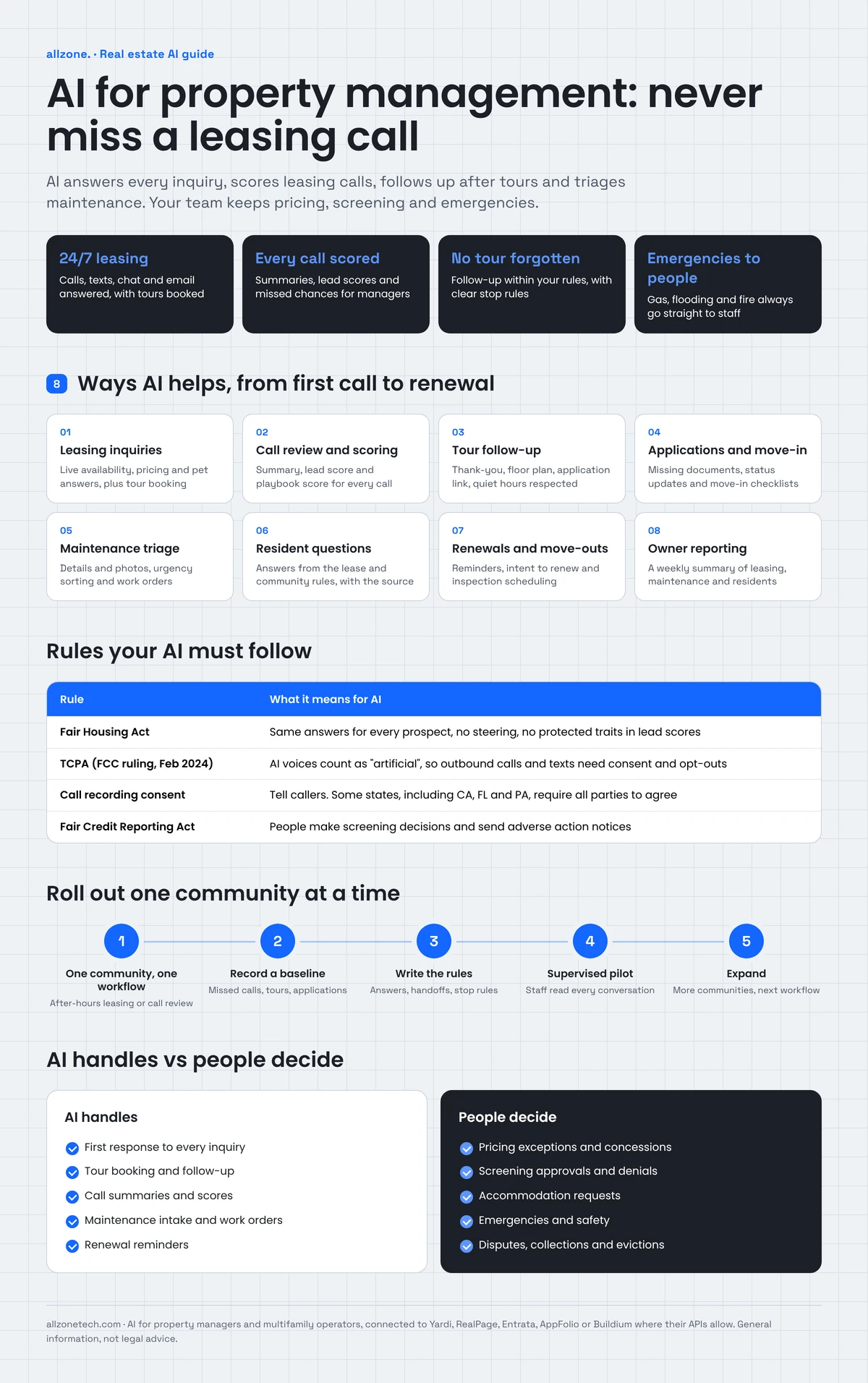
AI for property management fills those gaps. It answers leasing calls and messages at any hour and scores calls so managers see which leads are slipping. It follows up after tours, sorts maintenance requests and keeps residents informed. Your team keeps the decisions that matter.
This guide covers where AI helps from first inquiry to renewal and what should stay with people. It also covers fair housing and calling rules, how AI connects to your property management system, and how to roll it out one community at a time.
Quick answer: AI for property management answers leasing inquiries 24/7, books tours, reviews and scores leasing calls, follows up after tours, triages maintenance requests and sends renewal reminders. It connects to your property management system and CRM, follows your rules, and hands off to staff for pricing exceptions, screening decisions, emergencies and disputes.
Key takeaways
- The biggest early win is speed: answering every call, text and email, including evenings and weekends.
- AI call review shows managers which leads were handled well, which were lost and why, without listening to every call.
- Follow-up after tours is where many leases are won or lost, and it's easy to automate within clear rules.
- Maintenance triage works when emergencies always go straight to a person.
- Fair housing, calling and screening rules apply to AI exactly as they apply to your staff.
- Start with one community and one workflow, measure, then expand.
What does AI for property management mean?
Most property management systems already automate rent collection, accounting and work orders. AI adds something different. It understands and replies to people in plain language, reads call recordings, photos and emails, and takes the next step in a workflow without someone pressing a button.
In practice, AI for property management usually means a few connected assistants:
| Assistant | What it does |
|---|---|
| Leasing assistant | Answers calls, texts, chats and emails about availability, pricing, pets and amenities, and books tours |
| Call review and scoring | Transcribes and summarizes leasing calls, scores the lead and the call, and flags missed opportunities |
| Follow-up assistant | Sends post-tour and application reminders, and reactivates quiet leads within your rules |
| Maintenance triage | Collects details and photos, sorts requests by urgency and creates work orders |
| Resident assistant | Answers questions from the lease and community rules, with the source shown |
| Renewal assistant | Sends reminders, collects intent to renew and alerts staff to likely move-outs |
| Reporting assistant | Summarizes leasing, maintenance and resident activity for managers and owners |
You don't need all of them. Most teams start with the leasing assistant or call review, because that's where lost revenue is easiest to see.
Where property teams lose time and leases
- Missed and after-hours calls. Prospects call when they're free, which is often evenings and weekends. A missed call often becomes a lease somewhere else.
- Slow replies to internet listing leads. Inquiries from listing sites and your website wait in an inbox until someone gets to them.
- No consistent follow-up after tours. Busy leasing agents follow up with some prospects and forget others.
- No visibility into calls. Managers can't listen to hundreds of calls, so they don't know which agents convert well or which questions keep coming up.
- Maintenance requests by phone. Residents call the office, staff write notes, and details like the unit number, photos and access permission get lost.
- Late renewal conversations. Renewal offers go out late or without follow-up, and move-outs come as a surprise.
- Scattered data. Guest cards, call logs, work orders and resident messages sit in different systems, so nobody sees the whole picture.
8 ways AI helps property management teams
1. Answer every leasing inquiry, at any hour
A leasing assistant answers calls, texts, chats and emails the moment they arrive. It checks live availability and pricing from your property management system, answers questions about pets, parking, amenities and fees, and books a tour on your team's calendar.
It also creates or updates the guest card, so your leasing team sees the full conversation the next morning instead of a missed call with no name. When a prospect asks something the assistant shouldn't answer, such as a pricing exception or a question about a specific accommodation, it hands off to a person.
We build these assistants with our AI voice agent development team, using the same approach we use for AI real estate lead follow-up.
2. Review and score leasing calls
This is one of the most useful and least known uses of AI in property management. Instead of a manager listening to a handful of calls each week, AI reviews every recorded leasing call and:
- writes a short summary: what the prospect wanted, their move-in date, budget, unit type and pets
- scores the lead, for example by move-in timing and fit with available units
- scores the call against your playbook: did the agent ask for the tour, mention the right floor plans, collect contact details and set a next step?
- flags missed opportunities, such as a qualified prospect who was never offered a tour
- surfaces common questions and objections across a community or portfolio
Managers get a short list of calls worth listening to, and leasing agents get specific, fair feedback. For multifamily teams, AI phone lead scoring helps decide which prospects to call back first.
Recording and analyzing calls has its own legal rules, covered below.
Free leasing call audit
Send us a few recorded leasing calls from one community. We'll show you how AI would summarize them, score each lead and call and flag missed tour opportunities. Then we'll walk you through the results on a 30-minute call. See our real estate software services
3. Follow up after tours
The hours after a tour are when a prospect decides. A follow-up assistant can send a thank-you message, answer questions, share the floor plan they liked, remind them of a move-in special, and send the application link, all within rules you set.
Good follow-up has clear stop rules:
- stop when the prospect applies, says they're no longer looking, or asks to stop
- respect quiet hours and the prospect's preferred channel
- hand over to a leasing agent when the prospect asks a question the assistant shouldn't answer
So, can AI help agents close more leases? It can make sure no prospect is forgotten, answer faster and follow up consistently. Whether a prospect signs still depends on the apartment, the price and the people they meet, but AI removes the gaps where leads go cold.
4. Guide applications and move-in
Once someone applies, AI can remind them about missing documents, answer questions about the process, and send updates as the application moves forward. After approval, it can share move-in checklists, utility setup steps and key pickup details.
Screening decisions stay with people and your screening provider. AI should not approve or deny applicants. If a screening report leads to a denial or other adverse action, the Fair Credit Reporting Act requires a specific adverse action notice, and your team should handle that process.
5. Triage maintenance requests
A maintenance assistant collects the details your team needs: the unit, the problem, photos or video, when someone can enter, and whether there are pets. It sorts each request by urgency and creates a work order in your maintenance system with everything attached.
Some rules are non-negotiable:
- emergencies go straight to a person. Gas smells, flooding, fire, no heat in freezing weather, electrical hazards and security issues should trigger an immediate call to on-call staff, along with instructions to call 911 when there's danger
- residents always get a way to reach a person
- the assistant never promises a repair time your team hasn't confirmed
6. Answer resident questions
Residents ask the same questions again and again: guest parking, quiet hours, package rooms, pet rules, trash days, how to pay rent. An assistant can answer from your lease documents and community rules, showing the passage it used so staff can check it. Anything about a dispute, a lease violation or money owed goes to a person.
7. Manage renewals and move-outs
A renewal assistant sends reminders on your schedule, collects each resident's intent to renew, answers questions about the process, and alerts the team when a resident seems likely to leave. Renewal offers and any pricing changes come from your team or your pricing system, not from the AI.
When a resident gives notice, the assistant can share move-out instructions and schedule inspections, so the unit turn starts on time.
8. Report to managers and owners
AI can summarize each community's week: inquiries, tours, applications, leases, maintenance volume and response times, plus the most common resident questions. Owners and asset managers get a readable summary instead of a pile of exports.
What should stay with people
- Pricing exceptions and concessions beyond what your rules allow
- Screening decisions, approvals, denials and adverse action notices
- Reasonable accommodation and modification requests under fair housing law
- Emergencies and safety issues
- Lease violations, disputes, collections and evictions
- Anything the assistant isn't sure about
Legal rules to follow when using AI in property management
AI doesn't change your legal duties. It can make them easier to meet consistently, or it can repeat a mistake thousands of times. This section is general information, not legal advice; check with your counsel.
Fair housing
The federal Fair Housing Act prohibits discrimination based on race, color, religion, sex, national origin, familial status and disability, and many states and cities add more protected classes. For AI assistants, that means:
- give every prospect the same information about availability, pricing and specials
- never steer prospects toward or away from units or communities
- don't use protected characteristics, or close stand-ins for them, in lead scoring
- route accommodation requests to a person
- review conversations and scores regularly for patterns that could signal unequal treatment
Calling and texting
Under the Telephone Consumer Protection Act (TCPA), the FCC ruled in February 2024 that AI-generated voices count as "artificial" voices, so the TCPA's consent rules for robocalls apply to them. Read the FCC's announcement. In practice:
- answering inbound calls from prospects is different from making outbound calls
- get and record proper consent before outbound AI calls or automated texts
- honor opt-outs immediately and respect calling hours
Call recording
Before recording or analyzing calls, tell callers. Several states, including California, Florida and Pennsylvania, require every party to agree to a recording, so a clear notice at the start of each call is the safest approach.
Resident data
Applications, payment details and maintenance records are personal data. Limit what the AI can see, choose providers that don't train on your data, and keep an audit log of what the assistant accessed and did.
How AI connects to your property management system
AI works best as a layer that connects the systems you already use, rather than a new place your team has to check.
| System | What the AI reads | What the AI writes |
|---|---|---|
| Property management system | Availability, pricing, unit details, resident records | Guest cards, notes, work orders, as you allow |
| CRM | Lead history, source, stage | Conversation summaries, scores, next steps |
| Phone and SMS | Calls, transcripts, messages | Replies, follow-ups, call summaries |
| Calendars | Agent and tour availability | Tour bookings |
| Maintenance system | Open work orders and status | New work orders with details and photos |
| Documents | Lease templates, community rules, policies | Nothing; read only |
Common property management platforms such as Yardi, RealPage, Entrata, AppFolio and Buildium offer different levels of API access, and some features need partner agreements. Part of planning is confirming what each system allows. Our guide on how to integrate AI into existing systems explains the options when APIs are limited.
Real example: an AI voice CRM that takes leads to a booked appointment
Zonified Connect is our own AI voice CRM, and it follows the same pattern as leasing follow-up. When a new lead arrives, voice and SMS agents start a sequence based on rules the business sets. Every call and text is logged on one timeline per lead, with a summary and a lead score. Appointments are booked only after the lead confirms a specific time. Timing follows the business's own time zone, voicemail retries stop at a set limit, and automated contact stops when the lead reaches a set stage, so staff take over at the right moment. It connects to Google and Outlook calendars, HubSpot and Twilio. Read the Zonified Connect case study.
Buy AI tools or build your own?
Many property management platforms and proptech vendors now sell AI leasing assistants and call analytics. They're a good fit when you run one main system and their rules match yours.
A custom AI system makes sense when:
- you run several systems, such as different platforms across portfolios, that one vendor tool can't connect
- you want your own leasing playbook, scoring and follow-up rules
- you want one view of calls, leads, maintenance and residents across every community
- you need control over where data is stored and how the AI behaves
- you want to add AI to your own resident or owner portal
Many operators combine both: vendor tools where they fit and a custom layer that ties everything together. Our real estate software development services cover both approaches.
How to roll out AI in property management
- Pick one community and one workflow. After-hours leasing inquiries or call review are good first choices.
- Record a baseline. Measure response time, missed calls, tour bookings, tour-to-application rate and maintenance response time before you start.
- Write the rules. Decide what the assistant can say, which questions go to people, when follow-up stops, and how emergencies are handled.
- Pilot with staff reviewing. Let the leasing team read every conversation for the first weeks and correct anything wrong.
- Expand. Add communities, then the next workflow, such as tour follow-up or maintenance triage.
What to measure
| Metric | What it shows |
|---|---|
| Response time to new inquiries | How fast prospects hear back |
| Missed and abandoned calls | Leads you never had a chance with |
| Tours booked per 100 inquiries | Whether conversations turn into visits |
| Tour-to-application rate | Whether follow-up works |
| Call scores by agent and community | Where coaching helps |
| Maintenance response and completion time | Resident experience |
| Renewal rate and notice timing | Whether early conversations help retention |
| Handoffs to staff | How often the assistant needs a person, and why |
What does AI for property management cost?
Cost depends on how many communities and workflows you cover, the systems the AI connects to, call and message volume, the languages you support, and how much you customize the playbook and reporting. Running costs grow with call minutes, messages and model usage. Starting with one community and one workflow keeps the first investment small and the results easy to measure. Our AI development cost guide explains the main price drivers.
Illustrative example: a regional multifamily operator
A regional operator runs six garden-style communities. Its leasing teams work standard office hours, and the office phones go to voicemail after 6 p.m. and on Sundays. Managers have no time to review calls, and tour follow-up depends on each agent.
The operator starts at its two busiest communities with two workflows:
- After-hours leasing: an assistant answers calls and texts in the evening and on weekends, checks availability, answers common questions and books tours. Every conversation becomes a guest card with a summary.
- Call review: every recorded leasing call is summarized and scored against the operator's playbook, and managers get a weekly list of calls to review.
After a supervised pilot, the team compares missed calls, tours booked, tour-to-application rate and call scores with the baseline. Tour follow-up and maintenance triage come next.
Turn more inquiries into leases
Tell us where your communities lose the most leads: after-hours calls, tour follow-up or slow maintenance responses. We'll map the workflow, connect AI to your property management system and plan a pilot at one community.
Explore our real estate software development services or talk to our team.